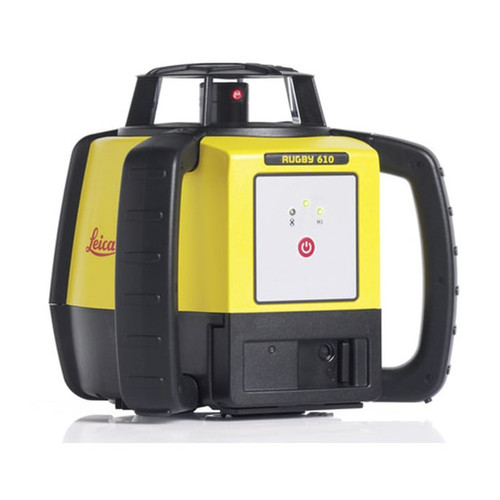
Overview
The Spectra Precision LL300S-2 Laser Complete Package delivers reliable single-slope grade control for commercial contractors, site developers, and municipal crews working on foundation pours, drainage installations, and utility trenching. This self-leveling rotary laser system features dual-axis slope capability (±8%), 1,000-foot diameter working range with the included HL450 receiver, and rugged IP67-rated housing that withstands job site dust and water exposure. The complete package includes laser transmitter, HL450 digital receiver with rod clamp, remote control, rechargeable battery system, and hard-shell carrying case—eliminating the need for separate component purchases. Contractors choose this configuration when they need accurate elevation transfer and simple slope layout without the cost premium of dual-slope or machine control systems.
Key Specifications
- Leveling Range: ±5° self-leveling with automatic shut-off beyond range
- Accuracy: ±1/16 inch at 100 feet (±1.5 mm at 30 m)
- Slope Capability: Single-axis slope, ±8% in 0.1% increments
- Working Diameter: 1,000 feet (300 m) with HL450 receiver, 400 feet (120 m) visible beam
- Rotation Speed: 0, 150, 300, 600, 1500 RPM (5 speeds)
- Beam Type: Class 2 laser, 635 nm red wavelength
- Environmental Protection: IP67 dust-tight and waterproof rating
- Power: Rechargeable NiMH battery pack, 40+ hours runtime; accepts 4 D-cell alkaline backup
- Operating Temperature: –4°F to 122°F (–20°C to 50°C)
- Remote Control Range: 300 feet (100 m) line-of-sight
- Receiver Accuracy: HL450 ±1/16 inch digital readout with audio alert
- Mounting Thread: 5/8"-11 industry standard
What's in the Kit
- LL300S-2 rotary laser transmitter with integrated single-slope capability
- HL450 digital laser receiver with LCD display and five-channel detection
- RC402N remote control with 300-foot operating range
- Rechargeable NiMH battery pack with AC wall charger
- Rod clamp for HL450 receiver (fits grade rods and poles)
- Hard-shell protective carrying case with custom foam insert
- Operator manual and quick-start laminated guide
- Factory calibration certificate
Job Applications
- Foundation and Slab Elevation: Establish consistent reference grades for formwork, screeding, and final surface verification across pours up to 500 feet diameter—the self-leveling head eliminates manual adjustment when moving the laser between setup positions.
- Drainage and Utility Slope: Set and verify constant fall grades for storm sewers, sanitary lines, and French drains—the single-axis slope function maintains precise pitch percentages that prevent standing water and ensure proper flow velocity.
- Excavation Depth Control: Guide operators during basement digs, pond excavation, and parking lot cuts by providing a stable rotating reference plane that receivers on excavator buckets or grade poles can track in real-time.
- Concrete Curb and Sidewalk: Control screed height for continuous pours along roadways and pathways—the 600 RPM speed provides fast beam detection for workers moving quickly along linear projects.
- Retaining Wall Alignment: Verify consistent top-of-wall elevation over long runs and establish batter (backward slope) using the manual slope feature combined with offset measurements from the rotating plane.
- Interior Floor Leveling: Check subfloor flatness and guide self-leveling compound application in commercial spaces—the visible red beam works effectively indoors without requiring additional detection equipment for close-range layout work.
Compatible Accessories
HR320 Machine Receiver – Dual-display receiver for excavator and dozer masts
HL700 Digital Receiver – Backlit display with increased detection range
25-Foot Telescoping Grade Rod – Aluminum extension rod with metric/imperial markings
Heavy-Duty Laser Tripod – Reinforced aluminum tripod with quick-clamp legs
Magnetic Laser Wall Mount – Attaches to steel forms and structural columns
Red Beam Laser Enhancement Glasses – Improves beam visibility in bright conditions
Replacement NiMH Battery Pack – Spare power for extended shifts
Related Guides
Rotary Laser Setup for Site Grading Projects
Single-Slope vs. Dual-Slope Laser Systems: Which Do You Need?
Calculating and Setting Drainage Slopes with Rotary Lasers
Laser Receiver Detection Problems: Diagnosis and Solutions
Frequently Asked Questions
- What's the difference between single-axis and dual-axis slope on rotary lasers?
- Single-axis slope (like the LL300S-2) creates a tilted plane in one direction only—ideal for drainage runs, pipe laying, and simple grading where fall occurs along a single bearing. Dual-axis systems tilt in two directions simultaneously, required for complex surface grades like athletic fields, parking lots with cross-slopes, or building pads on hillsides. For the majority of utility, concrete, and excavation work, single-axis slope handles all common applications while reducing system cost and setup complexity.
- How far can I use the HL450 receiver from the laser transmitter?
- The HL450 detects the rotating laser beam up to 500 feet radius (1,000-foot diameter working area) under typical job site conditions. Detection range decreases in bright sunlight, dust, or rain—expect 300–400 feet radius in harsh conditions. The laser's visible red beam is only apparent to the naked eye within approximately 200 feet radius; beyond that distance, you must rely on the receiver's digital display and audio signals for positioning. For work beyond 500 feet radius, upgrade to the HL700 receiver or consider a laser with greater output power.
- Can I mount this laser on an excavator or dozer for machine control?
- The LL300S-2 transmitter mounts on tripods, poles, or fixed structures—not on moving equipment. For machine control applications, you would mount the laser on a stable tripod at the work area perimeter, then attach a compatible machine receiver (like the HR320) to the excavator stick or dozer blade. The receiver detects the rotating plane and provides high/low/on-grade indication to guide the operator. This is a manual grade control system where the operator responds to receiver signals; it does not interface with hydraulic systems for automatic blade control.
- What maintenance does this laser system require between calibration checks?
- Perform visual inspection before each use, checking for cracked windows, loose battery contacts, and debris in the rotating head. Clean the laser window and receiver lens weekly using a soft cloth—never use solvents or abrasive materials. Verify the self-leveling function daily by deliberately tilting the laser beyond range and confirming the beam stops rotating and the alarm sounds. Store the system in its case with batteries removed if not used for more than two weeks. Spectra Precision recommends professional calibration verification every 12 months or after any drop or impact, even if the unit appears to function normally—internal compensator components can shift without visible damage.