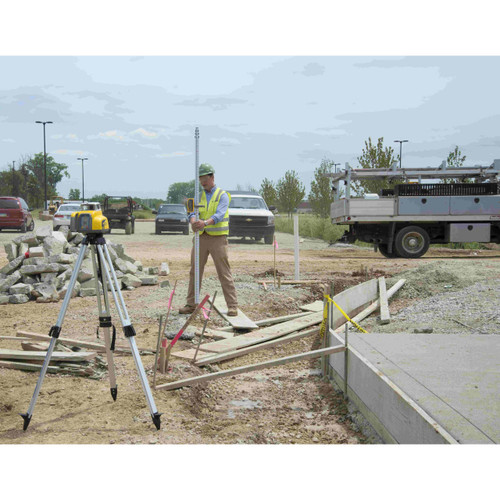
The Sokkia 1005156-01 is a 25-foot fiberglass leveling rod graduated in tenths, engineered for survey crews and grading teams that need reliable extended-reach readings without constant instrument repositioning. Built to Sokkia's construction-grade CR-type standard, this rectangular rod delivers consistent legibility and dimensional stability on demanding jobsites — from large infrastructure grading operations to open-field boundary surveys where long sight distances are the norm.
Overview & Jobsite Applications
When your project footprint stretches across broad terrain — highway corridors, subdivision pads, or drainage basin surveys — the 25-foot Sokkia rod eliminates redundant instrument setups that eat into your schedule. The fiberglass construction resists warping and moisture absorption that plague wooden alternatives, keeping graduation accuracy intact across temperature swings and wet conditions. The CR-type rectangular cross-section prevents rolling on sloped surfaces and gives rod men a consistent face orientation for faster, error-free readings.
Key Specifications
- Model: Sokkia 1005156-01
- Length: 25 feet
- Graduation: Tenths (0.1 ft)
- Rod Type: CR-type rectangular
- Material: Fiberglass
- Compatible Instruments: Automatic levels, optical levels, digital levels
- Unit System: U.S. feet
- Manufacturer: Sokkia
Key Features
- Fiberglass construction for warp resistance and long-term dimensional stability
- Rectangular CR-type profile prevents rolling and ensures consistent rod face orientation
- High-contrast graduation markings in tenths for fast, accurate readings at long sight distances
- 25-foot length reduces instrument setup count on large-format projects
- Lightweight relative to comparable aluminum rods, reducing fatigue during extended fieldwork
- Durable finish withstands UV exposure, moisture, and routine jobsite handling
- Authorized Sokkia product with full manufacturer quality assurance
Job Applications
Highway & Corridor Grading: Road construction and earthwork crews benefit from the 25-foot reach when establishing grade stakes across wide cut-and-fill sections, reducing the number of level setups needed per station.
Subdivision & Site Development: Lot grading and drainage design teams use the extended rod length to carry elevations efficiently across large pad areas, keeping layout crews moving without waiting on instrument moves.
Boundary & Topographic Survey: Licensed surveyors working open terrain use the additional rod height to maintain line-of-sight over ground cover and undulating topography that would obstruct a standard-length rod.
Utility & Infrastructure Projects: Pipeline, utility corridor, and stormwater crews use the Sokkia CR-type rod for invert and rim elevation checks where deep cuts or tall embankments demand vertical range beyond a standard rod.
Compatible Accessories
- Sokkia Fiberglass Rod Level Bubble
- Sokkia Rod Target (Sliding)
- Sokkia Optical Level — C330 Series
- Sokkia Digital Level SDL30
- Rod Carrying Case for CR-Type Rods
Related Guides
- How to Read a Leveling Rod in Tenths — Field Guide
- Choosing the Right Rod Length for Your Survey Project
- Fiberglass vs. Aluminum Leveling Rods: Contractor Comparison
- Setting Up a Level Loop: Best Practices for Grade Crews
Frequently Asked Questions
- Is the Sokkia 1005156-01 compatible with digital levels?
- The 1005156-01 is a standard optical-read CR-type rod graduated in tenths. It is intended for use with optical and automatic levels. For digital level instruments that use bar-code rods, Sokkia offers separate invar or fiberglass digital rod models. Confirm your instrument's rod requirements before ordering.
- What does "graduated in tenths" mean for field use?
- The rod face is divided into increments of 0.1 foot, which is the standard for U.S. construction and surveying work. Each major division equals one foot, with clearly marked 0.1-foot subdivisions that allow direct rod readings to the nearest tenth and estimated readings to the nearest hundredth of a foot when needed.
- Why choose fiberglass over aluminum for a leveling rod?
- Fiberglass rods resist moisture absorption and won't corrode, making them better suited for wet or humid jobsite conditions. They are also less prone to bending under incidental contact compared to thin-wall aluminum rods, and the material maintains calibration stability across a wider temperature range — important for precision elevation work.
- Does the 25-foot length come as a single section or multiple sections?
- The Sokkia 1005156-01 is a multi-section telescoping rod that collapses to a manageable transport length while extending to the full 25 feet for use. Each section locks securely to prevent slippage during readings. Always verify that all section locks are fully engaged before taking a rod shot.