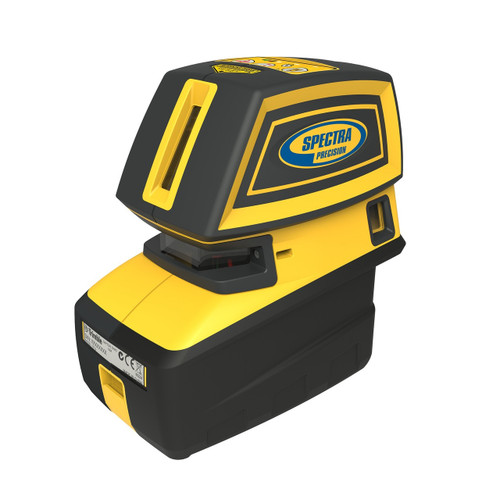
Overview
The DG711-7 addresses the core challenge gravity-flow contractors face: maintaining consistent grade over extended pipe runs while managing battery logistics across multiple crews. Unlike rechargeable systems requiring overnight charging cycles, this alkaline-powered package enables crews to swap fresh batteries in seconds, eliminating downtime that delays concrete pours, backfill operations, and inspector approvals. The laser transmitter mounts securely in pipe inverts using Spectra's tri-stand system, automatically leveling within ±10 arc seconds while projecting a visible red beam that target receivers track during pipe placement. Dual-axis leveling compensates for uneven pipe bedding, while the rotating head design allows 360-degree beam projection for large-diameter installations. Four D-cell alkaline batteries provide approximately 30-40 hours of continuous operation depending on temperature and humidity conditions—sufficient runtime for 3-5 full workdays on typical residential subdivision projects. The battery compartment features tool-free access with positive-locking cover that prevents moisture intrusion in wet trench environments. Spectra Precision includes grade-setting capabilities from -10% to +40% in 0.01% increments, accommodating standard sewer gradients (0.5% to 2%) as well as steep storm drain runs. Digital grade entry through the control panel ensures accurate setup, while the memory function retains your last-used grade setting between battery changes. The package includes P40 precision-grade pipe target, 711 remote control for adjustments from the trench, protective hard case, and complete accessory kit—everything required for immediate deployment on gravity-flow projects. ---Key Specifications
- Leveling Accuracy: ±10 arc seconds (±0.08" at 100 feet)
- Leveling Range: ±5 degrees dual-axis automatic compensation
- Grade Range: -10% to +40% in 0.01% increments
- Beam Type: Visible red laser diode, Class 2 safety rating
- Pipe Diameter Range: 8" to 72" with standard tri-stand
- Power Source: Four D-cell alkaline batteries
- Battery Runtime: 30-40 hours continuous operation (typical conditions)
- Operating Temperature: 14°F to 122°F (-10°C to 50°C)
- Ingress Protection: IP67 rating (dust-tight, temporary immersion protected)
- Remote Control Range: Up to 650 feet line-of-sight with 711 remote
- Transmitter Weight: 13.2 lbs with batteries installed
- Warranty: 3 years manufacturer coverage
What's in the Kit
- DG711 Pipe Laser Transmitter — Dual-axis self-leveling laser with alkaline battery compartment
- P40 Precision Pipe Target — High-visibility grade target with centering markings and magnetic mount
- 711 Remote Control — Wireless adjustment of grade, power, and beam rotation from up to 650 feet
- Tri-Stand Mounting System — Adjustable three-point stabilizer for 8" to 72" pipe diameters
- Four D-Cell Alkaline Batteries — Factory-installed primary power cells
- Hard Shell Transit Case — Impact-resistant protective case with custom foam insert
- Lens Cleaning Cloth — Microfiber cloth for beam window maintenance
- Operator Manual — Complete setup, calibration, and troubleshooting documentation
- Calibration Certificate — Factory verification of leveling accuracy specifications
Job Applications
- Municipal Sanitary Sewer Installation — Maintains precise 0.5% to 2% gravity-flow grades over 300-500 foot residential runs, ensuring proper hydraulic performance that passes inspector verification. Alkaline power eliminates hotel room recharging for crews working sequential subdivisions across the county.
- Storm Drain Systems — Controls steeper gradients (2% to 8%) for stormwater conveyance from catch basins to retention ponds, with battery endurance supporting full-day installations on commercial parking lot developments. Remote operation allows grade adjustments without entering active trenches near traffic.
- Agricultural Drainage Tile — Establishes consistent 0.25% to 0.5% slopes for subsurface field tile systems, where minimal grade variance prevents ponding that reduces crop yields. Battery availability at rural farm supply stores eliminates project delays in areas without contractor supply access.
- Culvert and Cross-Drain Projects — Guides accurate alignment for highway culverts and driveway crossings where elevation tolerances affect roadway integrity and drainage function. Compact tri-stand mounts in smaller diameter corrugated metal pipe common to DOT cross-drain specifications.
- Industrial Process Piping — Provides reference grade for gravity-fed waste systems at food processing plants, refineries, and manufacturing facilities where alkaline batteries meet facility requirements prohibiting lithium-ion technology in hazardous locations. IP67 protection withstands washdown environments.
- Golf Course Drainage Networks — Controls subsurface drainage line installation that prevents turf saturation on fairways and greens, with battery runtime supporting multi-day projects on sprawling course layouts. Silent operation respects active play on adjacent holes during construction windows.
Compatible Accessories
Spectra Precision RC402N Machine Receiver — Dual-display receiver with remote readout for excavator-mounted grade control on pipe bedding operations
Spectra Precision 1283 Pipe Laser Grade Rod — Telescoping grade rod with laser detector for establishing invert elevations at manholes and structures
Heavy-Duty Alkaline D-Cell Batteries (24-pack) — Bulk replacement batteries for extended projects and multi-crew operations
Spectra Precision C59 Universal Pipe Stand — Extended-range pipe stand for 24" to 96" diameter installations including large storm sewers
Red Beam Laser Enhancement Glasses — Improves target visibility in bright sunlight conditions during summer construction season
---Related Guides
Complete Setup Guide: Pipe Lasers for Gravity Sewer Installation
Alkaline vs. Rechargeable Batteries: Choosing the Right Power System for Your Laser
How to Verify and Maintain Pipe Laser Accuracy in the Field
Safe Trench Operations: Using Pipe Lasers and Remote Controls to Minimize Excavation Entry
---FAQ
- How long do alkaline batteries last in the DG711-7 compared to rechargeable models?
- The four D-cell alkaline configuration provides 30-40 hours of continuous runtime under typical conditions (50-70°F ambient temperature, moderate humidity). This translates to approximately 3-5 full workdays depending on daily usage patterns. In comparison, Spectra's rechargeable NiMH battery systems offer 20-25 hours per charge cycle. While individual alkaline runtime is longer, rechargeable systems prove more economical for single-crew operations with consistent recharging access. Alkaline models excel in multi-crew scenarios, remote locations, or as backup systems where fresh batteries can be swapped in seconds versus 8-12 hour recharge times. Cold weather below 40°F reduces alkaline performance by approximately 20-30%, while heat above 90°F can decrease runtime by 10-15%.
- Can I upgrade the DG711-7 to rechargeable batteries later, or use rechargeable D-cells?
- The DG711-7 is specifically designed and calibrated for alkaline D-cell chemistry with voltage regulation optimized for 1.5V primary cells. Spectra Precision does not offer factory conversion kits to rechargeable NiMH systems, as the battery compartment, charging circuitry, and power management differ significantly between models. While rechargeable D-cell NiMH batteries physically fit the compartment, their 1.2V nominal voltage may cause unreliable operation, inaccurate low-battery warnings, and potential damage to voltage-sensitive components. For operations requiring rechargeable capability, consider the DG711-R model which includes factory-engineered NiMH battery system with integrated charging. The alkaline model provides better value when battery replacement cost is offset by elimination of charging infrastructure and faster crew rotation capabilities.
- What's the actual cost difference in battery consumption between this and rechargeable models over a year?
- For a single-crew operation running 200 workdays annually at 8 hours per day (1,600 total hours), you'll consume approximately 40-50 sets of D-cell batteries at roughly $8-12 per four-battery set, totaling $400-600 in annual alkaline costs. A comparable rechargeable system requires one battery pack ($250-350) with approximately 500-charge lifespan (2-3 year replacement cycle), plus minimal electricity costs for recharging. Over five years, alkaline costs reach $2,000-3,000 versus $500-700 for rechargeable systems. However, this calculation changes dramatically with multiple crews. Three crews sharing alkaline-powered units simply carry spare battery sets ($50 total investment), while rechargeable systems require three battery packs ($750-1,050) plus crew truck charging infrastructure. Additionally, alkaline systems eliminate downtime costs from forgotten charges or dead batteries mid-project, which on commercial work can exceed $500-1,000 per incident in crew delays and equipment mobilization.
- Will the laser maintain accuracy throughout the battery discharge cycle, or does performance degrade as batteries weaken?
- The DG711-7 incorporates voltage regulation circuitry that maintains full leveling accuracy and beam intensity throughout 90% of the battery discharge cycle. As alkaline batteries naturally decrease from 1.5V to approximately 1.2V during use, the laser's electronics compensate to deliver consistent ±10 arc second accuracy. When batteries reach the minimum operating threshold (typically with 2-3 hours runtime remaining), the low-battery indicator activates with audible alarm and flashing LED warning. At this point, you should plan battery replacement at the next convenient break, though the laser continues operating with full accuracy. Once batteries drop below minimum voltage, the laser automatically shuts down to prevent inaccurate operation rather than continuing with degraded performance. This failsafe design ensures you never unknowingly install pipe to incorrect grade due to battery depletion. Best practice involves replacing batteries at the low-battery warning rather than running to complete shutdown, and always carrying two spare sets on the job truck.