Free Shipping on orders over $500


Machine Control ROI: Is It Worth the Investment for Grading Contractors?
Machine control is the largest technology investment most grading contractors will make. The question is not whether it saves time — it demonstrably does — but whether the savings are large enough to justify the cost on your specific operation. The answer depends on your project mix, rework history, and how efficiently you currently handle staking and grade verification.
Quick Answer
What is the ROI on machine control for grading contractors?
For contractors doing significant earthwork volume, machine control typically pays back in 1-2 years through three sources: 10-15% grading time reduction, 50-70% rework cost reduction, and 5-10% fuel savings. The ROI is strongest on projects with tight tolerances, deep cut/fill, and high staking cost — weakest on small, low-tolerance jobs where a grade checker with a laser level is sufficient.
Grading time reduction
10-15%
Rework cost reduction
50-70%
Typical payback period
1-2 years
Where the ROI Comes From
1. Reduced Staking Costs
Without machine control, a grading crew relies on grade stakes set by a surveyor or layout crew. Large earthwork jobs require thousands of stakes — placing them takes days, and operators destroy them as they work, requiring re-staking. Machine control eliminates most grade stakes. The operator can see the design model on-screen and the system guides the blade to the correct elevation without physical stakes. A job that required $15,000 in staking may need only $2,000 in control points with machine control.
2. Fewer Checking Passes
Conventional grading involves multiple checking passes — the operator cuts, a grade checker walks the area and marks high and low spots, the operator cuts again. With machine control, the operator sees real-time deviation from design and can achieve finish grade in fewer passes. Fewer passes mean less fuel, less wear on the machine, and faster job completion.
3. Rework Prevention
Rework is the most variable and most expensive cost item in earthwork. A graded area that needs to be re-done costs at minimum double the original grading cost — you pay to move the material twice. Machine control operators catch grade errors in real time and correct them before moving to the next area, dramatically reducing the probability of completing a large area that then fails grade verification.
4. Fuel Savings
Fewer machine passes directly translate to fuel savings. A dozer averaging 5 gallons per hour operating at $4.50/gallon over a 10-hour day burns $225 in fuel per day. A 10% reduction in passes saves $22.50 per day per machine — not large on a single day but meaningful over a season. For a fleet of 5 machines running 200 days per year, that is $22,500 per year in fuel alone.
ROI Example: Medium Grading Operation
| Savings Category | Annual Estimate | Assumptions |
|---|---|---|
| Staking cost reduction | $40,000-$60,000 | $2M revenue, staking reduced from 2.5% to 0.5% of revenue |
| Rework reduction | $30,000-$80,000 | Based on 3-5% historical rework rate, 60% reduction |
| Productivity gain (time) | $40,000-$70,000 | 10-15% more cubic yards per day, valued at margin |
| Fuel savings | $15,000-$25,000 | 5-10% fuel reduction, 3-5 machine fleet |
| Total annual benefit | $125,000-$235,000 | Wide range reflects project type and prior efficiency |
| System cost (3D dozer) | $75,000-$100,000 | Retrofit installed, single machine |
| Payback period | 6-18 months | Faster on high-staking, high-rework operations |
When Machine Control ROI Is Weak
Machine control ROI is weakest in these situations:
- Small jobs with simple grades. A 0.5-acre parking lot with a single uniform slope does not generate enough staking or rework cost for machine control to pay back quickly.
- Operations with low rework history. If your crews consistently hit grade on the first pass with conventional methods, the rework savings category is small.
- Very low staking costs. If you do your own staking with in-house crew and the cost is minimal, that category disappears from the ROI calculation.
- Older operators resistant to the technology. Machine control requires operator training and buy-in. An experienced operator who does not use the system correctly will not generate the savings.
Frequently Asked Questions
What is the ROI on machine control for grading contractors?
For operations doing significant earthwork, machine control typically returns 10-15% grading time reduction, 50-70% rework cost reduction, and 5-10% fuel savings. Payback period is typically 1-2 years on a $75,000-$100,000 system investment.
How much does a machine control system cost for a dozer?
A complete 3D GPS blade control system for a dozer costs $60,000-$100,000 installed. Indicate-only systems cost $15,000-$30,000. Factory-installed OEM options run $50,000-$80,000 on a new machine.
Is machine control worth it for smaller contractors?
It depends on your project mix. If you do repetitive large earthwork with high staking costs and occasional rework, yes. If your jobs are mostly small with simple grades, the ROI is slower. Calculate based on your actual staking spend and rework history.
Powered by Gradelog
Maximize Machine Control ROI with Better Documentation
Gradelog captures grade verification data from your machine control system and builds the as-built record automatically — so every pass is documented and every rework is tracked.
Try Gradelog FreeRelated Guides
Free 14 days with every Express Tools purchase
Your equipment. Your data. All in one place.
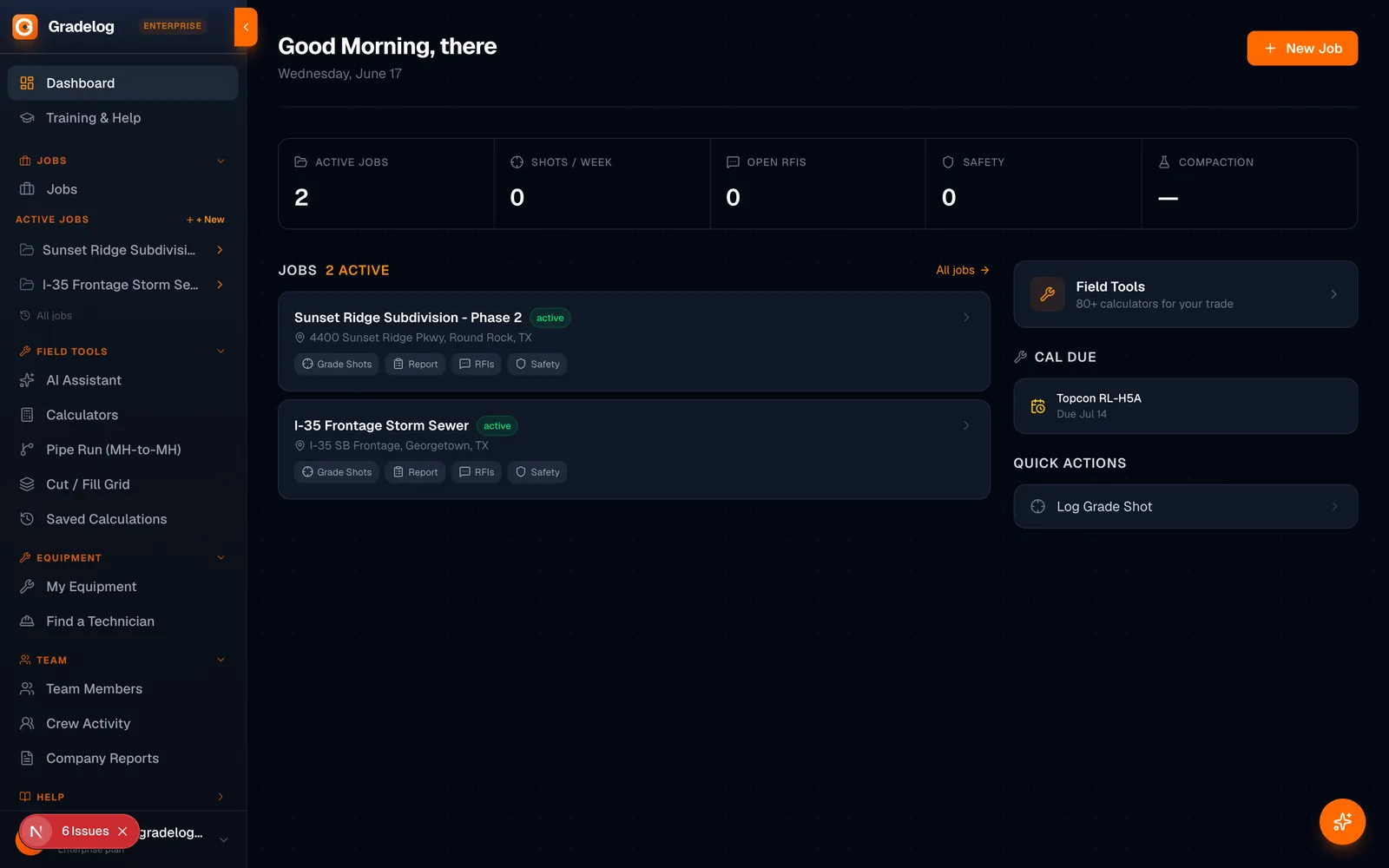
Gradelog is the field-execution platform built for grading and earthwork crews. Log grade shots, track cut/fill, document phases with photos, and generate as-built reports — from the cab to the office.
- Grade shots & cut/fill tracking per job
- Photo documentation by phase, task, and equipment
- As-built reports ready for inspector sign-off
- AI field assistant — troubleshoot on the jobsite
Built by the same team as Express Tools
Try Free →14 days
Free trial
8 languages
Supported
iPhone + Android
Works on