Free Shipping on orders over $500


Learn
Laser & Survey Terminology
The spec sheet, in plain English. Know exactly what you're reading before you buy — and what actually matters for your work.
Every term below maps to gear we carry and ship free across the United States — rotary, grade & pipe lasers, receivers, and accessories.
A–C
- Accuracy
- How close the laser holds a true level or grade plane, usually stated as ± inches over a distance (e.g. ±1/16" at 100 ft). Lower numbers are tighter. The single most important spec for grade work.
- Automatic / Self-Leveling
- The laser levels itself within a set range (typically ±5°) using internal pendulums or servo motors, then locks. If knocked out of range it warns you instead of giving a false reading.
- Beam (Red vs. Green)
- Green beams are ~4× more visible to the human eye than red, useful for interior and bright conditions. Red beams cost less and draw less battery. Outdoors, most crews use a receiver and beam color barely matters.
- Calibration
- Verifying and adjusting the laser so its plane reads true. Should be checked periodically and after any hard drop. A drifted laser silently puts your whole grade off. Calibration & maintenance →
- Cone Grade
- A laser mode that creates a sloping plane radiating from a center point — used for parking lots, pads, and drainage that pitch toward or away from a point.
D–G
- Dial-In Grade
- Entering a precise slope (e.g. 1.250%) on the laser so the beam plane tilts to that exact grade. Dual-grade units dial in two axes independently.
- Dual Grade (Dual Slope)
- A laser that holds two independent slopes at once (X and Y axis) — required for crowned roads, complex parking lots, and compound pad grades. Shop grade lasers →
- Grade
- The slope of a surface, expressed as a percent (%) or ratio. "Setting grade" means establishing that slope reference across the site.
- Grade Rod
- A graduated measuring rod the receiver mounts to. You read elevation off the rod where the receiver catches the beam. Rods & accessories →
H–N
- Handheld Receiver
- A detector the operator holds (clamped to a rod) that beeps and shows arrows when it catches the laser beam — used for grade-checking by hand. Laser receivers →
- IP Rating
- Ingress Protection — two digits for dust and water resistance (e.g. IP66 = dust-tight + strong water jets). Jobsite lasers should be IP66 or better.
- Machine Receiver / Display
- A receiver mounted on a mast on a dozer, grader, or excavator that shows the operator on/off grade in the cab. Larger reception window than handheld units. Machine display receivers →
- Manual / Fixed Grade
- A laser that lets you tilt the plane by hand without auto-leveling that axis — older or simpler grade workflow.
P–S
- Pipe Laser
- A laser built to sit in or over a pipe and project a beam down the invert at a set grade for sewer, storm, and utility work — sealed against trench water and dust. Shop pipe lasers →
- Plumb / Plumb Beam
- A vertical down/up beam for transferring points and setting vertical reference (columns, walls, layout).
- Rotary Laser
- A laser that spins a beam 360° to create a level (or sloped) reference plane across an entire site — the workhorse for site prep, foundations, and grading. Shop rotary lasers →
- RPM / Rotation Speed
- How fast the head spins. Higher RPM gives a brighter apparent line for interior visual use; with a receiver, RPM barely matters.
- Self-Leveling Range
- The maximum out-of-level the laser can correct for automatically (e.g. ±5°). Set the tripod roughly level and the laser does the rest.
- Slope
- See Grade. Often used interchangeably; "single slope" = one axis, "dual slope" = two.
T–Z
- Tripod
- The leg stand the laser mounts to. Flat-head and dome-head (5/8"-11) variants exist; match the mount to your laser and rod system. Tripods & accessories →
- Working Diameter / Range
- The usable radius/diameter the laser + receiver can operate over (e.g. 2,600 ft diameter). Stated with a receiver, not naked-eye.
- Vial
- A bubble level used to roughly level a manual instrument or check setup before relying on the laser.
Common Questions
- What is the most important spec on a laser level?
- Accuracy — how tightly the laser holds a true plane, stated as ± inches over a distance (e.g. ±1/16" at 100 ft). Lower is tighter. For grade and foundation work it matters more than range, RPM, or beam color.
- What is the difference between single grade and dual grade?
- A single-grade laser holds one slope on one axis. A dual-grade (dual-slope) laser holds two independent slopes at once (X and Y), which is required for crowned roads, complex parking lots, and compound pad grades.
- Do I need a laser receiver outdoors?
- Yes. Outdoors you generally cannot see the beam in daylight, so a receiver (detector) catches it and tells you on-grade, high, or low. Beam color barely matters outdoors because you read the receiver, not the beam.
- What IP rating should a jobsite laser have?
- Look for IP66 or better. The two digits cover dust and water resistance — IP66 means dust-tight and able to take strong water jets, which is what a laser needs to survive a real jobsite.
Still deciding what you need?
Answer six quick questions and we'll match you to a complete laser setup — or ask our AI expert anything about the gear.
Gradelog is the AI that knows your gear better than the spec sheet
Once you own the equipment, Gradelog walks your crew through setup and calibration, answers any field question instantly, logs your grade shots, and generates the as-built documentation inspectors accept.
- In-depth AI answers for your exact instrument
- Guided setup, calibration & grade checks
- Auto as-built reports inspectors accept
- Works with every laser, level & rover
Card required · cancel anytime before day 15 · then your selected plan
Free 14 days with every Express Tools purchase
Your equipment. Your data. All in one place.
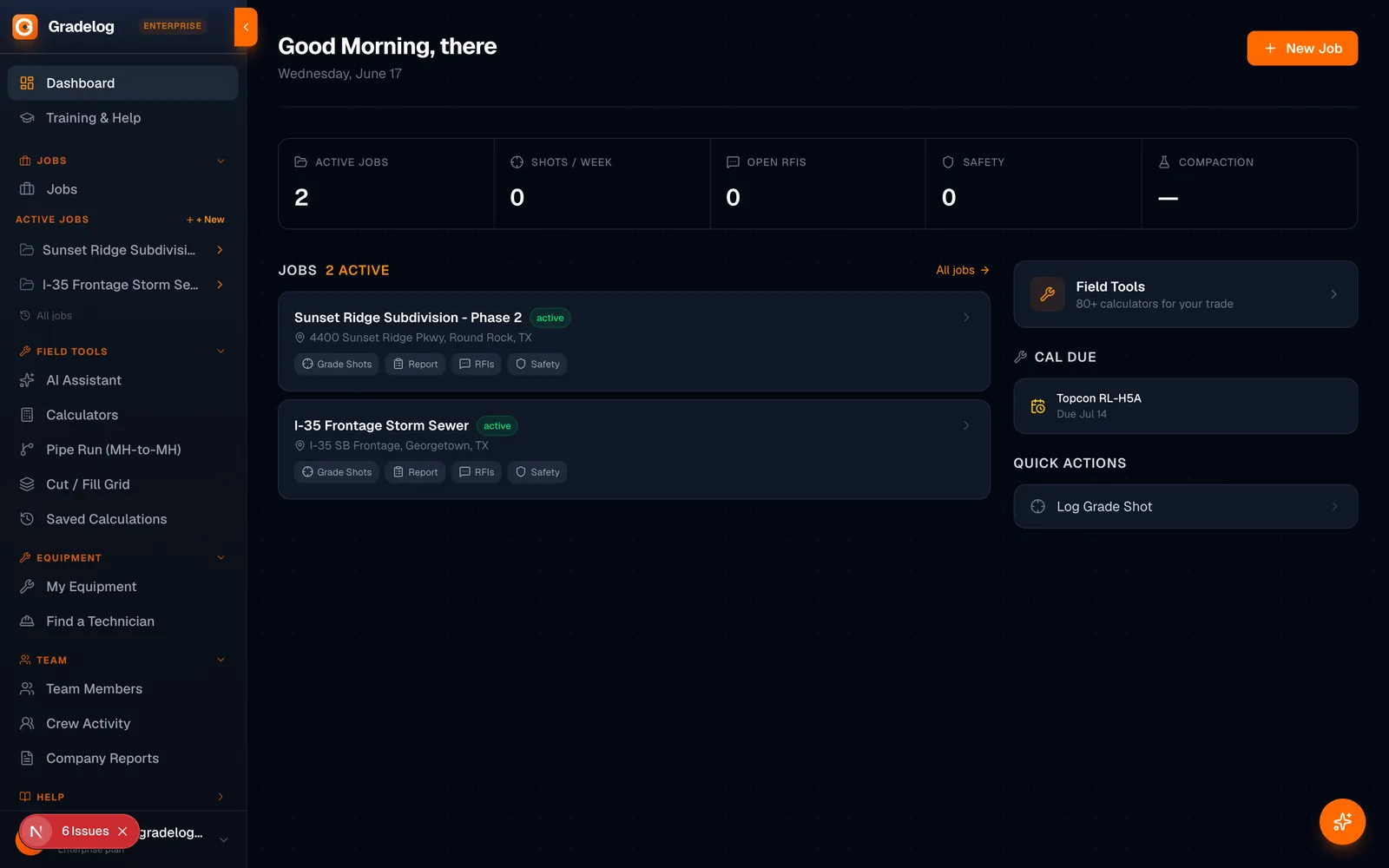
Gradelog is the field-execution platform built for grading and earthwork crews. Log grade shots, track cut/fill, document phases with photos, and generate as-built reports — from the cab to the office.
- Grade shots & cut/fill tracking per job
- Photo documentation by phase, task, and equipment
- As-built reports ready for inspector sign-off
- AI field assistant — troubleshoot on the jobsite
Built by the same team as Express Tools
Try Free →14 days
Free trial
8 languages
Supported
iPhone + Android
Works on