
Machine Control ROI for Contractors: Real Numbers, Real Savings
Quick Answer
Machine control systems represent a significant capital investment, but the return can be substantial. This guide is designed for contractors, fleet managers, and project engineers evaluating whether GPS-guided machine control technology makes financial sense for their operations
Machine control systems represent a significant capital investment, but the return can be substantial. This guide is designed for contractors, fleet managers, and project engineers evaluating whether GPS-guided machine control technology makes financial sense for their operations. We'll break down the real costs, quantifiable savings, and realistic payback timelines based on actual job site performance metrics.
Quick ROI Verdict
Machine Control ROI: The Financial Case
Machine control (also called GPS-guided grading or automated machine guidance) uses satellite positioning and 3D design data to guide excavators, dozers, and graders with precision. Instead of relying on spotters and manual stake placement, the operator follows automated guidance on an in-cab display. The result: straighter cuts, fewer passes, and less material movement.
Cost Breakdown: What You'll Invest
Initial Hardware Investment
| Component | Cost Range | Notes |
|---|---|---|
| Single Machine System (display + receiver) | See expresstools.com for current pricing | Topcon or Trimble in-cab display system |
| Base Station / Rover Network | See expresstools.com for current pricing | For on-site RTK corrections; one per 2-3 machines |
| Multiple Machine Installation (3-4 machines) | See expresstools.com for current pricing | Display + receiver per machine + shared base station |
| GNSS Network Subscription | See expresstools.com for current pricing | Alternative to base station; provider like Topcon Positioning or Trimble RTX |
Ongoing Operating Costs
Real Savings: Where the Money Comes Back
1. Material Waste Reduction (Biggest ROI Driver)
Typical Savings: 30-40% reduction in fill material and excavation rework
Without machine control, operators grade to grade stakes and visual reference. This creates:
- Over-excavation requiring additional fill
- Under-excavation requiring rework and delays
- Inconsistent slope angles needing correction
- Wasted time moving material multiple times
With machine control, the bucket stays on design elevation automatically. One operator passes instead of three. On a 50,000 cubic yard earthwork project:
- Typical waste without machine control: 8,000 - 12,000 cubic yards (16-24%)
- Waste with machine control: 2,000 - 4,000 cubic yards (4-8%)
- Material cost savings: $40,000 - $80,000 (at $10-15/cubic yard)
2. Fuel & Equipment Operating Costs
Typical Savings: 15-20% reduction in diesel consumption
Fewer passes = less fuel burned. Example for a 40-hour grading job on a 4-lane highway section:
- Manual grading: 120+ hours of machine time (multiple passes, repositioning)
- Machine control grading: 95-100 hours of machine time (straighter cuts, fewer repositions)
- Fuel saved: 80-160 gallons × $3.50/gallon = $280 - $560 per job
- Per-month savings on active projects: $1,500 - $3,000
3. Labor Efficiency & Spotters Eliminated
Typical Savings: Reduce crew by 1-2 spotters per machine
Machine control eliminates the need for surveyors and spotters on the grade line. For a typical earthwork crew:
- Manual crew: 1 operator + 2 spotters + 1 surveyor = $2,800 - $4,200/week
- Machine control crew: 1 operator + occasional design engineer = $1,600 - $2,200/week
- Labor savings: $1,200 - $2,000 per week per machine
- Annual savings per machine: $60,000 - $100,000
4. Schedule Acceleration & Project Completion Bonuses
Typical Savings: 15-30% reduction in grading phase duration
Completing earthwork faster means:
- Earlier mobilization of paving, utilities, and building crews
- Reduced general contractor overhead (supervision, site management)
- Opportunity to win schedule-bonus incentives
- Ability to take on additional projects with same crew size
On a 6-month grading project, accelerating by 4 weeks could save $150,000 - $300,000 in indirect costs.
ROI Payback Timeline Scenarios
Scenario 1: Single Dozer (Low Volume Contractor)
Payback Timeline: 27-30 months — suitable for contractors running steady earthwork, grading, or site prep projects.
Scenario 2: Fleet of 3 Machines (Mid-Tier Contractor)
Payback Timeline: 18-21 months — faster payback due to economies of scale and shared base station. Best scenario for contractors with consistent workload.
Scenario 3: Large Fleet (5+ Machines, Heavy Contractor)
Payback Timeline: 12-18 months — fastest payback. Fleet-wide implementation recommended for contractors with multiple concurrent projects and high machine utilization.
Key Factors That Impact ROI
Positive Factors (Accelerate Payback)
- Project Volume: More active projects = more opportunity to realize savings
- Project Complexity: Complex grades and slopes = more waste prevented
- Material Costs: Higher fill material costs = faster payback on waste reduction
- Design Repeatability: Similar grades across projects reduces design import setup time
- Operator Skill: Experienced operators leverage machine control faster
- Fleet Utilization: 70%+ utilization dramatically improves ROI
Negative Factors (Slow Payback)
- Sporadic Projects: Infrequent grading work reduces annual savings
- Simple Site Work: Flat sites with minimal rework see less benefit
- Operator Resistance: Retraining time and adoption curves delay payback
- Low Equipment Utilization: Machines sitting idle reduce annual savings
- GPS-Challenged Sites: Heavily wooded or urban canyons reduce accuracy benefits
Product Recommendations from Express Tools
Best Overall: Topcon SiT80 + GCS900
The Topcon SiT80 machine control system combines real-time kinematic GNSS with laser/sonic sensor backup. The GCS900 field controller provides intuitive machine guidance with a large touchscreen display. Ideal for contractors seeking comprehensive machine control with minimal learning curve. Topcon's network of RTK providers ensures coverage across the U.S.
Estimated ROI: 20-24 months (mid-fleet scenario)
Shop Topcon SiT80 at Express ToolsBest Value: Trimble GCS900 / Blade
Trimble's Grade Control System integrates with Caterpillar, Komatsu, and other OEM machines. The Blade display offers a cost-effective entry point with proven ROI across North America. Strong network integration with Trimble Positioning Services.
Estimated ROI: 22-26 months (mid-fleet scenario)
Shop Trimble GCS900 at Express ToolsBest for Retrofits: Spectra Precision DG813
Spectra Precision's 3D-MC (3D Machine Control) is one of the most affordable retrofit solutions for existing machines. Works with most excavator and dozer models. Excellent for contractors looking to upgrade one or two existing machines without full fleet overhaul.
Estimated ROI: 26-30 months (single machine scenario)
Shop Spectra Precision Machine Control at Express ToolsWhich Should You Buy? Buyer Scenarios
Scenario 1: Established Contractor with 3-4 Active Dozers
Recommendation: Topcon SiT80 + GCS900 system (3-machine package)
You have predictable earthwork projects and want to maximize operator adoption. Topcon's system excels at intuitive operation and integrates seamlessly with major OEMs. Payback in 18-21 months with shared base station infrastructure. Start with 2-3 machines to prove ROI internally, then expand.
Scenario 2: Smaller Contractor or Equipment Owner with 1-2 Machines
Recommendation: Trimble GCS900 + GNSS network subscription
Use a monthly GNSS network (Trimble Positioning Services) instead of owning a base station. Lower upfront cost (~$30,000 vs. $50,000 for base station). Payback extends to 26-30 months, but you avoid capital infrastructure. Good fit if you want to test machine control on a single machine first.
Scenario 3: Fleet Operator with Heavy Utilization (5+ Machines)
Recommendation: Topcon or Trimble fleet package with owned base station
Invest in a company-owned base station. Payback accelerates to 12-18 months due to higher machine utilization and economies of scale. Negotiate fleet pricing with dealers (typically 15-20% discount for multi-machine purchases). Plan for one base station per 3-4 machines and dedicated GNSS support role.
Scenario 4: Skeptical or Risk-Averse Contractor
Recommendation: Spectra Precision 3D-MC retrofit + GNSS network
Start small with a single retrofit to an existing machine. Spectra's system is proven, affordable, and doesn't require fleet-wide commitment. Use Spectra's network for RTK. If ROI materializes in Year 1, expand to remaining fleet. Lowest risk entry point.
Questions to Ask Before Investing
Calculate hours per year each machine runs on paying projects. Below 1,500 hours/year = slower payback. Above 2,500 hours/year = fast payback (12-18 months). High utilization is critical; low-utilization fleets may see 3-4 year payback.
Machine control requires 3D CAD models or survey data in standard formats (LandXML, etc.). If design data isn't readily available, add 2-4 weeks of preparation per project. Work with your engineering team to establish design-to-field workflows.
If your crew includes full-time spotters and surveyors, ROI accelerates dramatically (labor savings alone justify 24-month payback). If you use spotters occasionally, material waste savings become the primary ROI driver.
Machine control requires clear sky view (not dense trees or buildings). Verify GNSS availability on your typical project sites. Some areas benefit from local RTK networks; others require owning a base station. Request a site coverage study from your system provider.
Budget 3-5 days per operator for training. Some experienced operators resist change; plan for 10-15% longer learning curve. Allocate $1,500-$3,000 per operator for training and certification. Positive: younger operators typically adopt machine control eagerly.
Do I need field management software with this equipment?
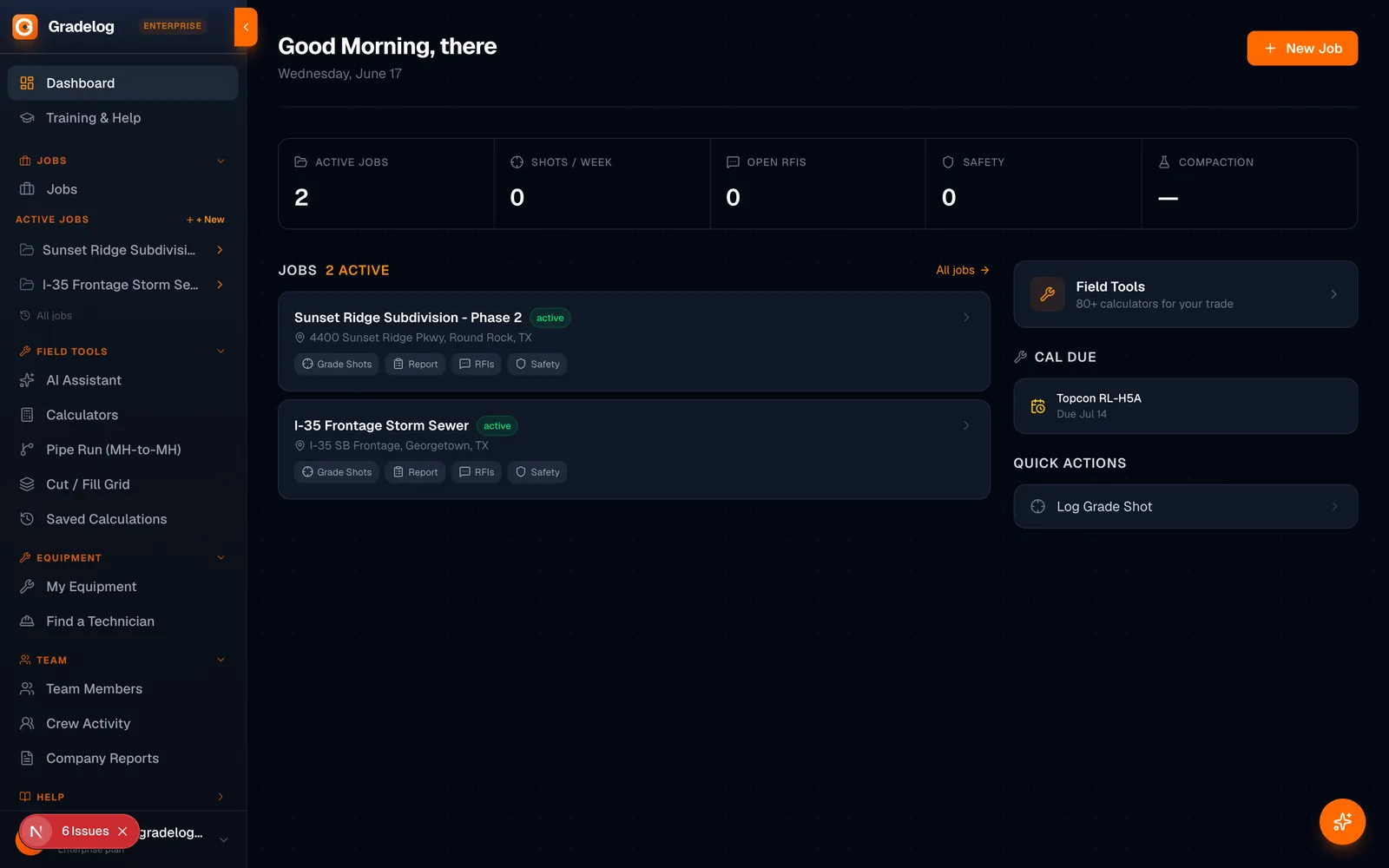
Gradelog complements machine control with free cut/fill and excavation calculators, plus paid features for job logs, equipment tracking, and as-built report generation. Built for Topcon, Trimble, and Spectra Precision users.
How do I document grade work on a job site?
GradeLog logs cut/fill passes, daily production, and generates as-built reports automatically. Replaces paper grade books. $19–$149/mo.
Machine control systems hold 40-60% residual value after 3-5 years. Display units can be upgraded or transferred to new machines. Factor resale value into long-term ROI; it improves payback by 10-15%.
Final ROI Verdict
Machine control systems deliver measurable, quantifiable ROI for contractors with:
- 3+ active grading projects per year
- Fleet utilization above 60%
- Earthwork scopes involving material cost >$500,000
- Experienced, tech-forward operators
Expected Payback: 18-30 months for most contractors. Year 2 and beyond become pure profit.
Implement in phases: start with 1-2 machines, document savings, then expand fleet-wide. Most contractors who adopt machine control expand to full fleets within 18-24 months once ROI is proven.
Related Resources
Topcon vs. Trimble Machine Control: Head-to-Head
Browse All Machine Control Systems
GNSS Base Stations & Networks
RTK Network Providers Compared
Ready to Calculate Your ROI?
Contact Express Tools for a free ROI analysis specific to your operation. We'll review your project types, machine utilization, and current costs to provide a custom payback timeline.
Shop Topcon SiT80 at Express Tools Shop Trimble GCS900 at Express Tools Shop Spectra Precision 3D-MC at Express ToolsCalculate Cut & Fill Before You Buy
Before choosing your machine control system, use Gradelog's free calculators to model cut/fill volumes, excavation requirements, and elevation changes — so you size the right system before you invest. No account required.
Use Free Cut & Fill Calculators at Gradelog →Document Your Earthwork Digitally
Once your machine control system is running, GradeLog gives you a digital field record for every cut and fill pass — daily reports, as-built generation, equipment logs. Pairs with every system on this page. $19–$149/mo.
Try GradeLog →