Free Shipping on orders over $500

Machine Control Installation: What Contractors Need to Know Before Buying
The machine control system price tag on the spec sheet is not the full cost. Installation, calibration, and machine-specific hardware add thousands to the total — and choosing the wrong system or installer can cost you weeks of downtime. Here is what experienced grading contractors know before they sign a purchase order.
Quick Answer
What do contractors need to know about machine control installation?
Machine control installation involves hardware mounting, sensor calibration, and software configuration — all of which affect system accuracy and longevity. Aftermarket systems require a factory-trained installer and add $3,000-$8,000 to total cost. Factory-integrated systems (Komatsu iMC, Cat Grade) avoid installation complexity but limit brand choice. Before buying, confirm installer availability, calibration timeline, and which machine-specific components are transferable.
Aftermarket install cost
$3K–$8K labor+parts
Calibration time
4–8 hrs per machine
Factory option
Komatsu iMC, Cat Grade
Aftermarket vs Factory-Integrated Systems
The first decision is whether you are adding an aftermarket system to an existing machine or buying a new machine with factory-integrated grade control. Both approaches work; they involve different tradeoffs.
Factory-integrated systems — Komatsu iMC, Caterpillar Cat Grade, Volvo Co-Pilot — are installed and calibrated at the factory. They typically carry the OEM warranty, have no aftermarket installation risk, and reduce setup time dramatically. The tradeoff is that you are locked into the OEM's software and GNSS hardware — usually Topcon for Komatsu and Trimble for Caterpillar.
Aftermarket systems from Trimble, Topcon, and Leica can be installed on most major excavators, dozers, and motor graders. They offer more flexibility in brand and software choice and can be moved between machines (partially). But they require a certified installer, add cost, and introduce installation quality as a variable.
What Installation Actually Involves
A full aftermarket 3D GPS machine control installation on a dozer or excavator includes these steps:
- GNSS antenna mounting on the machine cab or blade — must be rigid, vibration-resistant, and positioned for clear sky view.
- Slope sensors (IMUs) mounted on the blade, boom, stick, and bucket — each sensor must be installed precisely parallel or perpendicular to the relevant axis.
- In-cab display mounting with ergonomic placement for operator visibility without blocking sight lines.
- Wiring harness routing — protects cables from heat, pinch points, and hydraulic fluid exposure.
- System configuration including machine geometry entry, sensor offset measurements, and software calibration.
- Calibration verification using a check shot to a known elevation.
Each step requires precision. An incorrectly mounted slope sensor throws off grade by the sine of the angular error — small installation mistakes produce consistent grade errors that cost more to diagnose than to prevent.
Cost Breakdown
| Component | Typical Range |
|---|---|
| System hardware (GPS, display, sensors) | $15,000–$55,000 |
| Aftermarket installation labor | $1,500–$4,000 |
| Machine-specific mounting kits | $500–$2,000 |
| Initial calibration and training | $500–$1,500 |
| Annual correction network subscription | $1,200–$3,600 |
| Annual service and calibration check | $500–$1,200 |
See our machine control ROI guide for a full payback period analysis against staking savings and rework reduction.
Choosing an Installer
Installation quality is the single most controllable risk in machine control adoption. Before selecting an installer, verify:
- Factory-certified technicians for the brand you are purchasing — Trimble and Topcon both require dealer certification for warranty-valid installation.
- Reference installs on your machine model — mounting kits and cable routing differ significantly between Caterpillar, Komatsu, John Deere, and Volvo platforms.
- Post-installation training included — operators who understand basic calibration checks catch sensor issues before they create grade problems on the job.
- Service turnaround time — if a sensor fails mid-project, how quickly can your installer respond?
Common Installation Mistakes to Avoid
- Installing GNSS antennas too close to metal obstructions or other antennas — causes multipath and heading errors in dual-antenna systems.
- Routing cables near hydraulic hoses that flex under pressure — eventual chafing and wiring failure.
- Skipping recalibration after machine repairs — any structural work that shifts sensor mounting angles invalidates previous calibration data.
- Not documenting baseline measurements — without recorded geometry offsets, future recalibration requires full re-measurement instead of quick verification.
Frequently Asked Questions
How much does machine control installation cost?
Aftermarket installation adds $3,000-$8,000 to system cost, covering labor, machine-specific mounting kits, and initial calibration. Factory-integrated systems (Komatsu iMC, Cat Grade) eliminate installation cost but limit brand flexibility.
Can machine control be moved between machines?
GNSS receivers and displays can be moved. Machine-specific sensors and mounting hardware require recalibration for each machine. Plan for recalibration time and cost when relocating components.
How long does machine control calibration take?
Initial calibration for a full 3D GPS system takes 4-8 hours per machine by a certified technician. Annual recalibration checks take 2-4 hours. Calibration must be repeated after sensor relocation or major machine repairs.
Powered by Gradelog
Verify Your Machine Control Results
Gradelog connects to your machine control data to automatically generate as-built grade reports and catch deviations before final inspection.
Try Gradelog FreeRelated Guides
Free 14 days with every Express Tools purchase
Your equipment. Your data. All in one place.
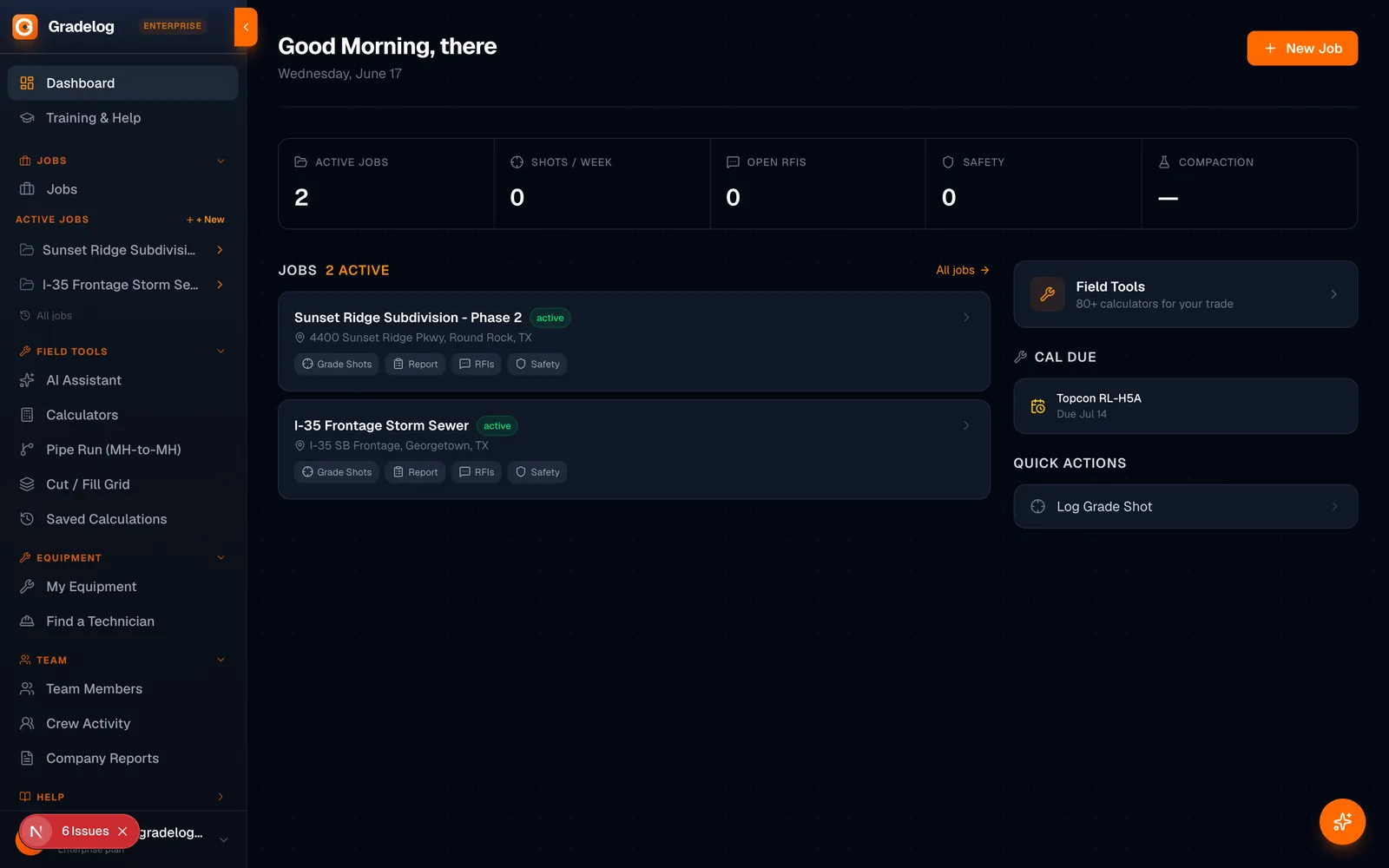
Gradelog is the field-execution platform built for grading and earthwork crews. Log grade shots, track cut/fill, document phases with photos, and generate as-built reports — from the cab to the office.
- Grade shots & cut/fill tracking per job
- Photo documentation by phase, task, and equipment
- As-built reports ready for inspector sign-off
- AI field assistant — troubleshoot on the jobsite
Built by the same team as Express Tools
Try Free →14 days
Free trial
8 languages
Supported
iPhone + Android
Works on