Free Shipping on orders over $500


Rotary Laser Receiver Guide: How to Choose the Right Detector
Most contractors buy a rotary laser and accept whatever receiver comes in the box. That is fine until you need to push the detection range, read the display in direct sun, or mount a receiver on a machine. Understanding what separates a good receiver from a mediocre one prevents a $150 piece of equipment from becoming the bottleneck on your site.
Quick Answer
How do contractors choose the right rotary laser receiver?
Choose a receiver based on how it will be used: hand-held for layout and checking grades on foot, machine-mount for dozer and grader control, or dual-purpose for mixed use. Key specs are detection range (must exceed your working distance), display visibility in sunlight, audio indicator for eyes-up use, and whether you need brand-matched features like remote grade adjustment. Most quality receivers are cross-brand compatible for basic grade indication.
Hand-held range
Up to 600–1,000 ft
Machine-mount range
Up to 2,000+ ft
Cross-brand compatible
For basic use, yes
Types of Laser Receivers
There are three main receiver types used in construction, each suited to different applications:
- Hand-held receivers — the most common type. Clip to a grade rod or story pole. Used for grade checking on foot, formwork setting, and layout verification. Typically 3-5 inches of detection window.
- Machine-mount receivers — larger sensor face for extended range. Mounted to a mast on a dozer blade or grader moldboard. Connects to a grade indicator display in the cab for the operator.
- Dual-purpose receivers — work both hand-held and on a machine mount. Offer flexibility for mixed-use operations where one receiver needs to serve multiple functions.
Key Specifications Explained
| Spec | What It Means | What to Look For |
|---|---|---|
| Detection range | Max working distance from laser | 600 ft+ hand-held, 2,000 ft+ machine |
| Detection window | Vertical sensor face height | 3-5 in hand-held; wider is easier to find beam |
| Display type | How grade position is shown | LED bar (fast) vs LCD numeric (precise) |
| Audio indicator | Beep when beam hits sensor | Adjustable volume for noisy site use |
| Accuracy mode | Fine vs coarse grade indication | Both modes; fine mode for precise work |
| IP rating | Water and dust resistance | IP54 minimum; IP65+ for heavy outdoor use |
Cross-Brand Compatibility
For basic grade indication — finding on-grade, above, or below — most quality receivers work with any brand rotary laser. The receiver detects the infrared beam; it does not care which brand emits it.
Brand matching matters when you need advanced features. Topcon receivers connected to Topcon RL-H5A lasers enable wireless remote slope adjustment — you dial in the grade from the receiver without walking back to the laser. Trimble and Spectra Precision offer similar features within their respective ecosystems. These features require matched brand components and are worth the premium for frequent grade-adjustment workflows.
For our full analysis of rotary laser brands, see our rotary laser buyer guide and Spectra vs Topcon comparison.
Display Visibility in Sunlight
A receiver display that is unreadable in direct sunlight is a serious productivity problem. Budget receivers use basic LED displays that wash out in bright conditions. Better receivers use high-brightness LEDs with shade shields, or large-format displays with higher contrast ratios specifically designed for outdoor use.
When reviewing options, prioritize display visibility over detection range specifications — most job sites operate well within the range of any quality receiver, but every outdoor job site involves direct sun at some point in the day.
Frequently Asked Questions
Are rotary laser receivers brand-specific?
For basic grade indication, no — most receivers work cross-brand. For advanced features like wireless grade adjustment or machine control integration, brand-matched receivers and lasers are required.
What is the detection window on a laser receiver?
The vertical height of the sensor face that can detect the beam — typically 3-5 inches on hand-held receivers. A wider window finds the beam faster; a narrower window enables more precise grade indication.
What range does a rotary laser receiver work at?
Hand-held receivers typically work to 600-1,000 feet; machine-mount receivers to 2,000+ feet. Outdoor range is limited by sunlight and atmospheric conditions more than receiver sensitivity.
Powered by Gradelog
From Laser Grade to Digital As-Built
Gradelog connects your grade control data to digital as-built records, cutting the manual documentation that typically follows every laser grade operation.
Try Gradelog FreeRelated Guides
Free 14 days with every Express Tools purchase
Your equipment. Your data. All in one place.
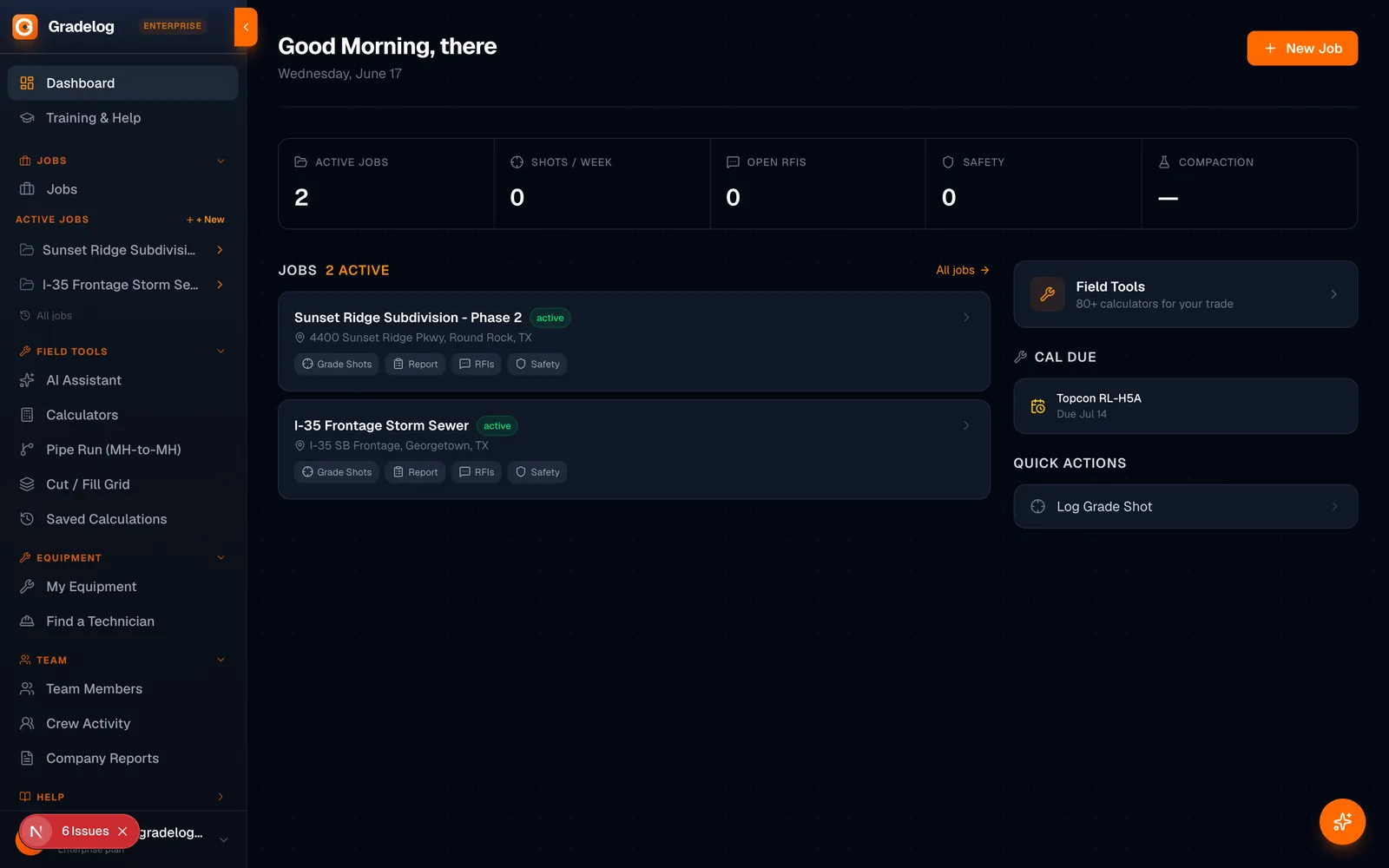
Gradelog is the field-execution platform built for grading and earthwork crews. Log grade shots, track cut/fill, document phases with photos, and generate as-built reports — from the cab to the office.
- Grade shots & cut/fill tracking per job
- Photo documentation by phase, task, and equipment
- As-built reports ready for inspector sign-off
- AI field assistant — troubleshoot on the jobsite
Built by the same team as Express Tools
Try Free →14 days
Free trial
8 languages
Supported
iPhone + Android
Works on