
Best Direct Elevation and Lenker Rod for Grade Work
Quick Answer
When you're running grade on a site, you need a direct elevation rod that reads accurately and holds up to real jobsite conditions. Whether you're setting footings, checking elevations for concrete pours, or establishing benchmarks, a quality Lenker-style rod pays for itself in t
When you're running grade on a site, you need a direct elevation rod that reads accurately and holds up to real jobsite conditions. Whether you're setting footings, checking elevations for concrete pours, or establishing benchmarks, a quality Lenker-style rod pays for itself in time saved and mistakes avoided. We've tested these rods across residential and commercial sites to find which ones deliver the best combination of durability, readability, and value for professional contractors.
Top Direct Elevation Rod Picks
1. Seco 10ths Direct Elevation Fiberglass Rod - Best Overall
The Seco 4160-10 Direct Elevation Rod is our top choice for most contractors. This 16-foot fiberglass rod features bold black numerals on a white background that read in tenths from 0 at the top to 16.00 at the bottom. The graduated markings are heat-bonded, not painted, so they won't wear off after months of dragging through mud and tossing in the truck bed.
Price: $289
What sets this rod apart is the rigidity. The fiberglass construction doesn't flex like cheaper aluminum rods, which means more accurate readings when you're shooting long distances. The oval profile provides excellent stability when extended, and the compression locks hold sections tight without slipping. We've had the same rod on sites for three years with zero calibration drift.
2. CST/Berger LD-400 Direct Reading Rod - Best Budget Option
For smaller contractors who don't shoot grade daily, the CST/Berger LD-400 delivers solid performance at a working-man's price. This 13-foot aluminum rod reads in hundredths and features high-contrast graphics that are easy to read through a builder's level or transit.
Price: $164
The LD-400 uses a twist-lock mechanism that's faster than traditional compression locks, though you need to make sure it's fully seated before taking readings. At 2.8 pounds, it's lighter than fiberglass alternatives, which matters when you're walking grade all day. The aluminum construction won't last as long as fiberglass in heavy use, but for residential work and occasional commercial jobs, it's hard to beat the value.
3. Sokkia 16-Foot Direct Elevation Fiberglass Rod - Best for Precision Work
When you're working to tight tolerances on commercial slabs or setting structural steel, the Sokkia 715745 Direct Elevation Rod is worth the premium. This rod features dual graduations with direct elevation on one face and conventional Philadelphia rod markings on the reverse.
Price: $342
The bi-directional readability means you can use it for both grade work and standard differential leveling without carrying two rods. Sokkia applies a UV-resistant coating that prevents fading even in harsh sunlight, and the fiberglass laminate construction maintains dimensional stability across temperature extremes. The round target and built-in level vials help your rod person keep it plumb for accurate readings.
4. Leica Sprinter Direct Elevation Rod - Best for Digital Levels
If you're running a Leica Sprinter or similar digital level, the Leica GPCL2 Barcode Rod with Direct Elevation combines traditional visual reading with encoded barcode for electronic measurement.
Price: $448
This hybrid rod features direct elevation numbers alongside the barcode pattern, so you can verify digital readings visually. The invar tape provides extreme accuracy across temperature changes, making it ideal for precise control work and machine control applications. It's overkill for basic grade work, but if you're running GPS equipment or robotic total stations alongside traditional levels, this rod integrates into both workflows.
Comparison Table
How to Choose a Direct Elevation Rod
Material Matters
Fiberglass rods cost more upfront but outlast aluminum 3-to-1 in heavy use. The dimensional stability of fiberglass means your rod maintains accuracy over years, while aluminum can bend slightly from repeated impacts. If you're on sites daily, fiberglass is the clear choice. For weekend warriors and light-duty use, aluminum saves weight and money.
Graduation Style
Direct elevation rods read from 0 at the top, increasing downward—opposite of traditional Philadelphia rods. This matches how you actually think about elevations: if your benchmark is at elevation 100.00 and the rod reads 4.50, your point is at 95.50. Make sure your crew understands this difference to avoid costly errors. Some rods offer dual graduations, letting you switch between direct and conventional readings.
Length Requirements
Most site work needs a 13-16 foot rod. Residential foundations and flatwork rarely require more than 13 feet, while commercial grading and site work benefits from the extra reach of a 16-footer. Longer rods are heavier and more cumbersome in tight spaces, so don't overbuy. If you're regularly shooting elevations beyond 16 feet, you might need better benchmark placement rather than a longer rod.
Readability Features
High-contrast markings are non-negotiable. You'll be reading these rods in early morning shadows, bright midday sun, and everything between. Look for bold numerals at least 1 inch tall with clear graduation marks every 0.01 feet. Some rods include movable targets for long-distance shots—useful but not essential if you're working within 200 feet with a quality automatic level.
Lock Mechanisms
Compression locks are bombproof but slower to adjust. Twist locks are faster but require full engagement to prevent slipping. Button locks are the fastest but tend to wear out first. For production grading where you're constantly adjusting height, twist locks offer the best speed-reliability balance. For occasional use, compression locks eliminate worry.
Frequently Asked Questions
- What's the difference between direct elevation and Philadelphia rod graduations?
- Direct elevation rods read from 0 at the top increasing downward, showing actual elevation drop from your benchmark. Philadelphia rods read from 0 at the bottom increasing upward, requiring you to subtract the reading from your benchmark elevation. Direct elevation rods eliminate math errors and are faster for most grade work. If you learned on Philadelphia rods, there's a brief adjustment period, but most crews prefer direct reading once they make the switch.
- Can I use a direct elevation rod with a laser level or rotary laser?
- Yes, direct elevation rods work with any type of level including laser levels, rotating lasers, automatic levels, and digital levels. The rod graduation style is independent of the instrument you're using. Just make sure your detector (if using a laser) can mount securely to your rod. Some contractors prefer a dedicated laser detector rod with metric graduations when running GPS-controlled equipment, but standard direct elevation rods handle laser work fine.
- How do I maintain accuracy on a fiberglass leveling rod?
- Check your rod against a known measurement quarterly—a steel tape stretched vertically works well. Store the rod fully collapsed in a protective case to prevent warping. Clean graduations with mild soap and water, never solvents that can damage the bonding. Inspect locking mechanisms for wear and replace sections if they don't lock tight. A quality fiberglass rod should maintain accuracy within 0.01 feet over several years with basic care. If your rod has been bent or damaged in a vehicle accident, verify it against a tape before trusting it on critical work.
- What rod length do I need for residential foundation work?
- A 13-foot rod handles 95% of residential foundation and flatwork. You'll typically shoot from batter boards or hubs that are within 8-10 feet of your benchmark elevation. The 13-footer gives you plenty of range while being easier to handle in tight crawlspaces and around formwork. Step up to 16 feet if you're regularly working on sloped lots with significant elevation changes or doing site development work where cuts and fills exceed 10 feet. The extra length matters more in commercial and civil work than residential construction.
Calculate Your Grade Before You Buy
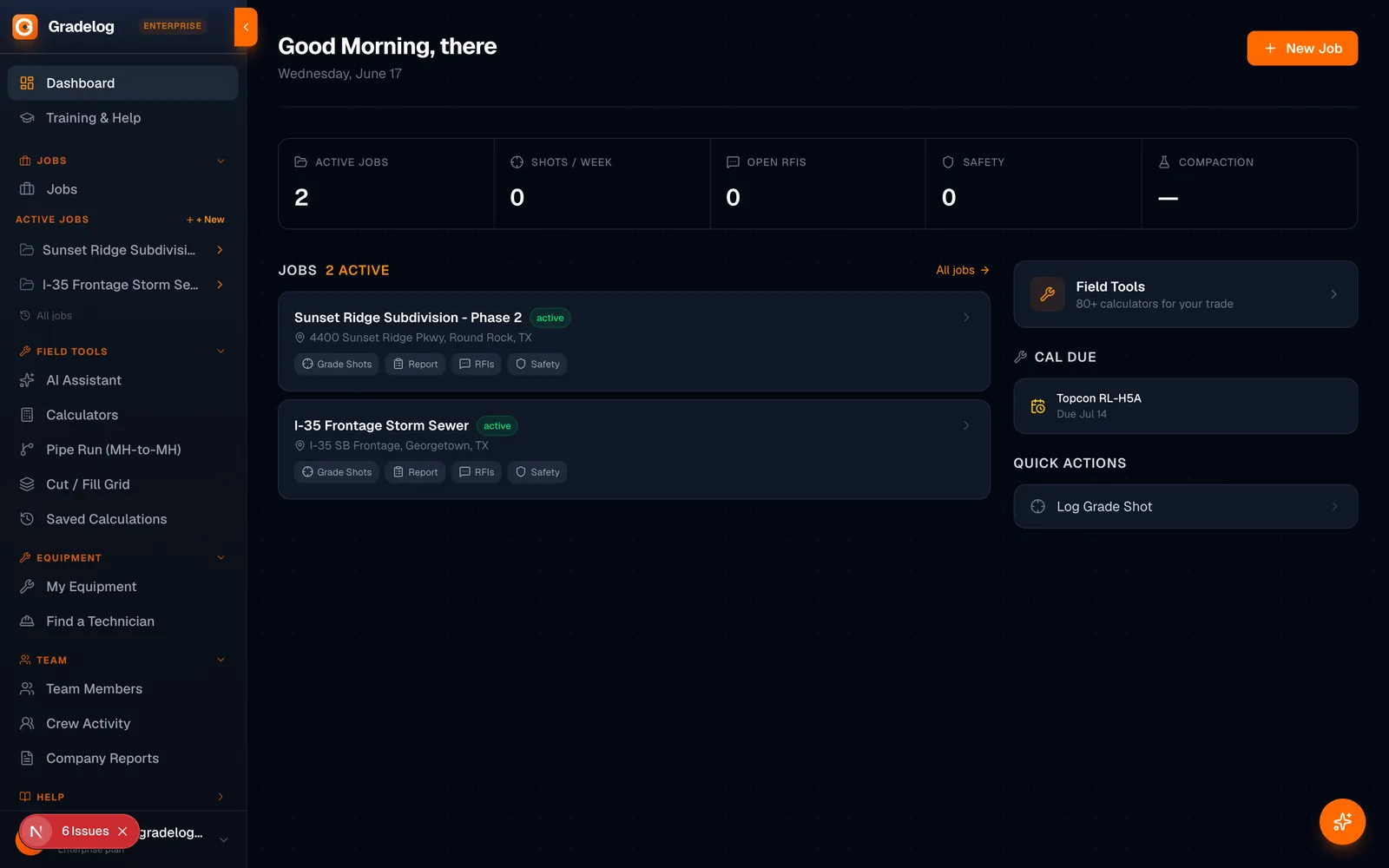
Before selecting between these instruments, use Gradelog's free field calculators to verify your project requirements — grade percentage, cut and fill, elevation, slope, and more. No account required.
Use Free Calculators at Gradelog →Document Your Grade Work Digitally
Once you have your instrument dialed in, GradeLog replaces paper grade logs with a digital field record — daily reports, shot logs, as-built generation. Pairs with every instrument on this page. $19–$149/mo.
Try GradeLog →Our Verdict
Quick Answer When you're running grade on a site, you need a direct elevation rod that reads accurately and holds up to real jobsite conditions. Whether you're setting footings, checking elevations for concrete pours, or establishing benchmarks, a quality Lenker-style rod pays for itself in t
For the full breakdown, see the sections above covering specifications, pros and cons, and use case recommendations for each option.