

Best Grade Laser for Excavation Contractors: Top Picks for Earthwork Crews
Quick Answer
Selecting the right grade laser directly impacts your crew's productivity, accuracy, and profit margins on earthwork projects. This guide compares single-grade and dual-grade rotary lasers from Topcon, Trimble, and Leica based on real-world performance data from excavation contra
Selecting the right grade laser directly impacts your crew's productivity, accuracy, and profit margins on earthwork projects. This guide compares single-grade and dual-grade rotary lasers from Topcon, Trimble, and Leica based on real-world performance data from excavation contractors running scrapers, dozers, and motor graders.
Grade Laser Comparison: Key Specifications
Receiver and Machine Mount Systems
Laser performance depends equally on receiver quality and mounting systems. Most manufacturers offer three receiver tiers: basic rod-mounted units ($350-$500), machine-mounted grade receivers ($800-$1,200), and integrated machine control receivers ($1,500-$2,500).
Rod receivers work for excavator bucket grade checking and hand labor verification. Machine-mounted receivers with digital readouts mount to dozer masts, grader moldboards, or scraper arms, providing continuous grade reference during cutting operations. Advanced receivers integrate with automatic blade control systems, eliminating manual grade adjustments entirely.
Cross-brand compatibility exists for basic detection—Topcon receivers detect Trimble lasers and vice versa—but advanced features like digital grade readout and remote laser control require matched systems. Contractors should budget $1,200-$1,800 for a complete laser package including appropriate receivers and mounts.
Browse laser receivers and detector systems →Selecting the Right Grade Laser: Key Decision Factors
Project Scale and Typical Site Diameter
Projects under 2,000 feet diameter operate efficiently with entry-level single-grade units. Sites exceeding 2,500 feet require extended-range models or multiple laser setups. Highway and commercial developers working 3,000+ foot sites need premium models with maximum diameter specifications to minimize instrument relocations.
Grade Complexity: Single-Slope vs. Dual-Slope Requirements
Parking lots, building pads, and roadways requiring crown or cross-slope justify dual-grade investment through reduced setup time. Linear work—trenches, pipelines, roadway subgrade—achieves equivalent productivity with single-grade units at half the capital cost.
Accuracy Requirements and Project Specifications
Standard commercial grading specs (±0.10' elevation tolerance) work within all modern grade laser capabilities. Precision applications—sports fields, hardscape, architectural concrete—require ±1/16" @ 100' accuracy levels found in premium models. Review project specifications before equipment selection to avoid over-purchasing unnecessary precision.
Integration with Existing Machine Control Systems
Contractors already operating Trimble, Topcon, or Leica machine control systems benefit from purchasing matching-brand grade lasers. System integration eliminates compatibility issues, simplifies operator training, and often provides package pricing advantages through dealers.
Expert Recommendations by Contractor Type
Large Commercial/Highway Contractors
Recommended: Trimble LL500 or Leica Rugby 640
Extended range, dual-grade capability, and maximum accuracy justify premium pricing on large-scale projects where downtime costs exceed equipment investment.
Mid-Size Site Development Companies
Recommended: Topcon RL-SV2S or Spectra Precision GL722
Dual-grade functionality at mid-tier pricing balances capability with cost. These models handle 80% of commercial grading applications without premium unit expense.
Utility and Pipeline Contractors
Recommended: Topcon RL-H5A
Linear work rarely requires dual-grade capability. Premium single-grade accuracy and extended battery life optimize trench and corridor productivity at the lowest per-foot cost.
Residential and Small Commercial Builders
Recommended: Topcon RL-H4C
Entry-level pricing, simple operation, and adequate range for typical lot sizes provide fastest ROI for contractors performing occasional grading work.
Maximizing Grade Laser Lifespan and Accuracy
Annual calibration verification maintains accuracy specifications and satisfies quality control requirements on surveyed projects. Most manufacturers recommend professional calibration every 12-24 months depending on usage intensity and environmental exposure.
Transport lasers in padded cases even for short moves between site positions—impact damage to compensator assemblies causes accuracy degradation that field checks don't detect. Clean exterior optics weekly in dusty conditions using microfiber cloths and optical cleaning solution, never abrasive materials that scratch laser windows.
Store units with batteries removed during extended non-use periods to prevent corrosion damage from battery leakage. Lithium-ion batteries maintain charge better during storage but require charging every 3-4 months to prevent deep discharge damage.
View all rotary laser models →Frequently Asked Questions: Grade Lasers for Excavation
What accuracy level do I need for commercial site grading?
Most commercial grading specifications require ±0.10 feet (approximately 1.2 inches) elevation tolerance, which all professional-grade lasers exceed. Standard models providing ±3/32" accuracy at 300 feet satisfy typical commercial requirements. Precision applications like parking structures, sports fields, or architectural sitework benefit from ±1/16" @ 100' accuracy found in premium models like the Topcon RL-H5A or Leica Rugby 640. Review project specifications and consult with your surveyor before selecting equipment—over-purchasing precision adds cost without improving productivity on standard work.
Can single-grade lasers handle cross-slope parking lots?
Calculate Cut & Fill Before You Buy
Before choosing your machine control system, use Gradelog's free calculators to model cut/fill volumes, excavation requirements, and elevation changes — so you size the right system before you invest. No account required.
Use Free Cut & Fill Calculators at Gradelog →Document Your Earthwork Digitally
Once your machine control system is running, GradeLog gives you a digital field record for every cut and fill pass — daily reports, as-built generation, equipment logs. Pairs with every system on this page. $19–$149/mo.
Try GradeLog →Our Verdict
Quick Answer Selecting the right grade laser directly impacts your crew's productivity, accuracy, and profit margins on earthwork projects. This guide compares single-grade and dual-grade rotary lasers from Topcon, Trimble, and Leica based on real-world performance data from excavation contra
For the full breakdown, see the sections above covering specifications, pros and cons, and use case recommendations for each option.

Built for equipment owners
Run the jobsite around your equipment
Gradelog is the AI field platform for contractors — grade shots, photo documentation, calibration tracking, and as-built reports, all tied to your gear.
- Equipment & calibration tracking
- Photo + grade documentation
- AI field assistant, 8 languages
Free 14 days with every Express Tools purchase
Your equipment. Your data. All in one place.
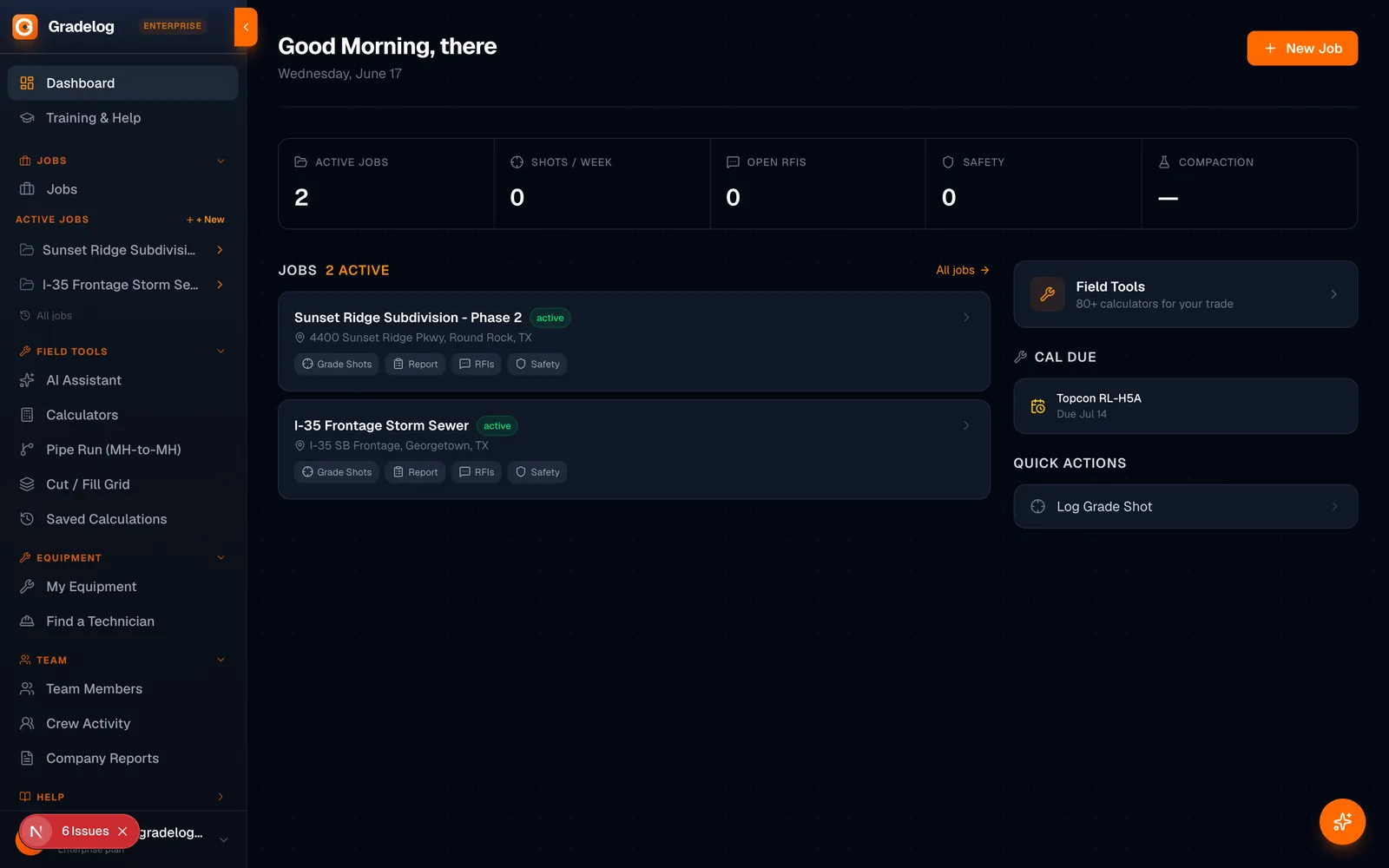
Gradelog is the field-execution platform built for grading and earthwork crews. Log grade shots, track cut/fill, document phases with photos, and generate as-built reports — from the cab to the office.
- Grade shots & cut/fill tracking per job
- Photo documentation by phase, task, and equipment
- As-built reports ready for inspector sign-off
- AI field assistant — troubleshoot on the jobsite
Built by the same team as Express Tools
Try Free →14 days
Free trial
8 languages
Supported
iPhone + Android
Works on