
Best Grade Laser for Road Construction Work
Quick Answer
Road construction demands precision grading equipment that can withstand harsh jobsite conditions while delivering millimeter-level accuracy across expansive work areas. Grade lasers for road work must handle rough terrain, extreme weather, and the constant vibration from heavy m
Road construction demands precision grading equipment that can withstand harsh jobsite conditions while delivering millimeter-level accuracy across expansive work areas. Grade lasers for road work must handle rough terrain, extreme weather, and the constant vibration from heavy machinery while maintaining reliable performance throughout long workdays. Whether you're grading highways, residential streets, or parking lots, the right laser level system ensures proper drainage, smooth surfaces, and compliance with engineering specifications.
Professional road contractors need grade lasers with exceptional range (often 2,000+ feet radius), robust construction rated for heavy equipment mounting, and dual-axis capabilities for both slope and cross-slope work. The best systems integrate seamlessly with GPS and machine control technology while offering manual grade matching for versatility across different project types.
Our Top Picks for Road Construction Grade Lasers
1. Topcon RL-H5A Rotating Laser – Best Overall
Price Range: $3,800 - $4,200
Why We Recommend It: The Topcon RL-H5A stands as the industry standard for road construction, offering exceptional durability with an IP66 rating and the ability to handle drops up to 1 meter onto concrete. Its horizontal self-leveling system works across slopes up to ±5°, with manual slope matching capability for variable grade work. The 2,600-foot diameter working range covers most road projects without repositioning, while the rechargeable Li-ion battery provides up to 100 hours of operation.
Pros:
- Exceptional range and accuracy (±1/16" at 100 feet)
- Weatherproof construction (IP66 rating)
- Long battery life with dual power options
- Electronic self-leveling saves setup time
- Compatible with all major machine control systems
Cons:
- Higher initial investment
- Receiver sold separately
- Heavier than some compact models (13.2 lbs)
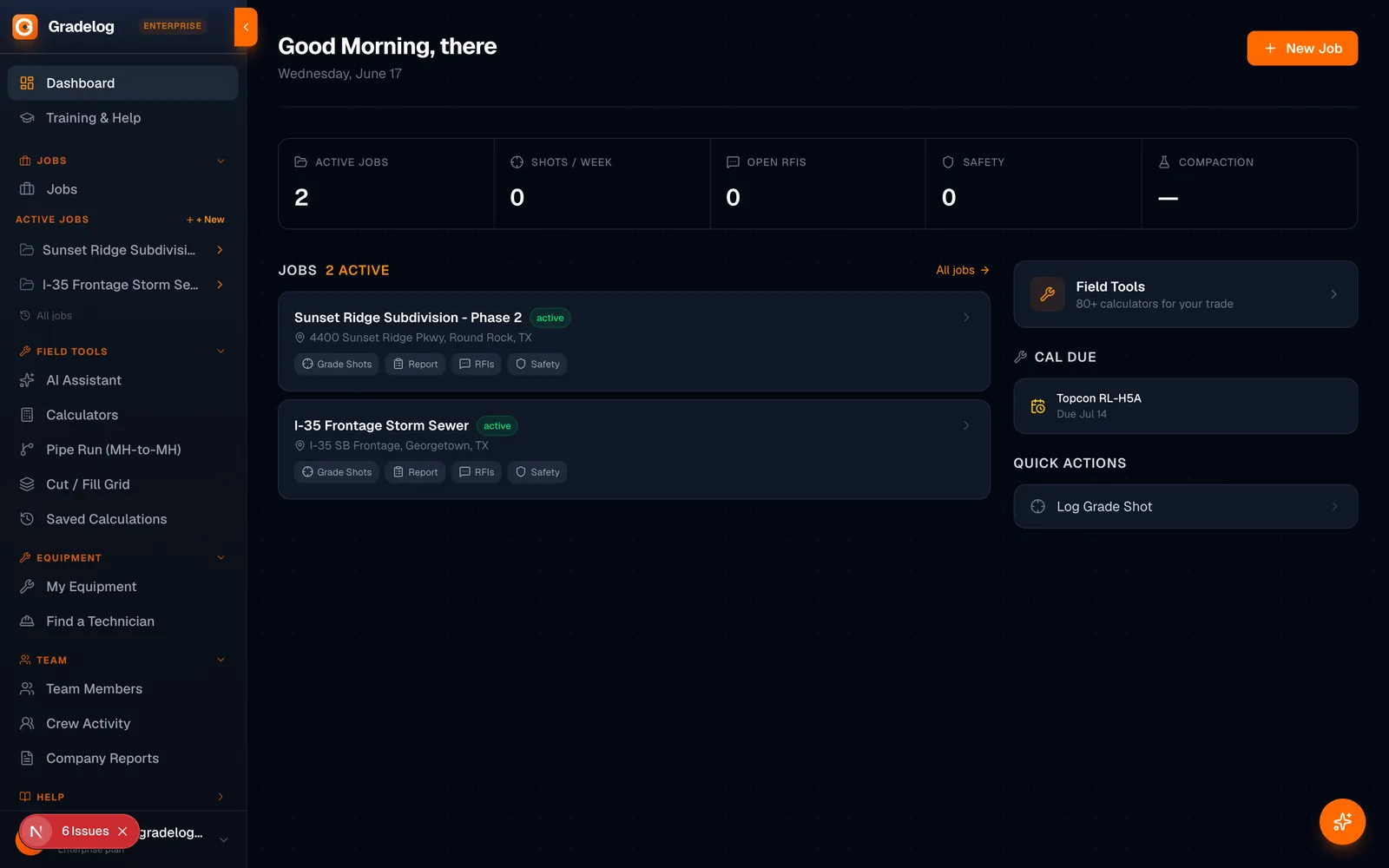
Express Tools specializes in laser grade-control and layout equipment. For field documentation, Gradelog organizes your job logs, calibration records, and as-built reports — free to start.
2. Spectra Precision GL722 Dual Grade Laser – Best for Complex Grades
Price Range: $8,500 - $9,800
Why We Recommend It: For road projects requiring precise cross-slopes and complex drainage patterns, the Spectra GL722 delivers dual-grade capability with independent X and Y axis control. This dual-slope functionality is invaluable for crowned roads, super-elevated curves, and multi-directional drainage work. The system includes advanced grade matching technology and works seamlessly with Spectra's RC803 remote control for on-the-fly adjustments without leaving your equipment.
Pros:
- True dual-grade capability for complex road profiles
- Remote operation up to 1,000 feet from laser
- Automatic grade matching saves layout time
- Exceptional accuracy (±1/32" at 100 feet)
- Field-swappable battery system minimizes downtime
Cons:
- Premium pricing
- Requires training for advanced features
- More complex setup than single-grade units
Express Tools specializes in laser grade-control and layout equipment. For field documentation, Gradelog organizes your job logs, calibration records, and as-built reports — free to start.
3. Leica Rugby 640 – Best Value for Smaller Projects
Price Range: $2,900 - $3,400
Why We Recommend It: The Leica Rugby 640 offers professional-grade performance at a more accessible price point, making it ideal for smaller road contractors or municipal crews handling residential street work. While it lacks dual-grade capability, its horizontal and vertical operation modes, combined with a 2,000-foot working diameter, handle most road grading applications effectively. TheRuggedROOT technology protects against shocks and vibrations common in road construction environments.
Pros:
- Competitive pricing without sacrificing quality
- Simple, intuitive operation
- IP68 dust and water protection
- Variable rotation speeds (300-600 RPM) for different conditions
- Three-year manufacturer warranty
Cons:
- Single-grade operation only
- Shorter range than premium models
- Manual slope adjustment (no motorized grade matching)
Express Tools specializes in laser grade-control and layout equipment. For field documentation, Gradelog organizes your job logs, calibration records, and as-built reports — free to start.
4. Topcon RL-SV2S Dual Slope Laser – Best for GPS Integration
Price Range: $7,200 - $8,100
Why We Recommend It: When your road construction workflow incorporates GPS machine control, the Topcon RL-SV2S offers seamless integration with Topcon's 3D-MC2 and LN-150 systems. This dual-slope laser features GGLS (Geomax Global Laser System) technology for automatic height alignment and works as part of a comprehensive site positioning solution. Its rechargeable battery system and extreme temperature tolerance (-20°C to +50°C) ensure reliable performance in any climate.
Pros:
- Full integration with GPS machine control systems
- Dual-slope capability with motorized adjustment
- Advanced calibration and diagnostics
- Extremely wide operating temperature range
- MAGNET software compatibility for office-to-field workflow
Cons:
- Requires investment in Topcon ecosystem for full benefits
- More features than needed for traditional grade work
- Higher complexity requires trained operators
Express Tools specializes in laser grade-control and layout equipment. For field documentation, Gradelog organizes your job logs, calibration records, and as-built reports — free to start.
Grade Laser Comparison Table
How to Choose a Grade Laser for Road Construction
Working Range Requirements
Road construction projects typically span hundreds of feet, requiring lasers with extended range capabilities. For highway work, prioritize models offering 2,600+ foot diameters to minimize repositioning. Smaller residential street projects may work effectively with 2,000-foot range systems. Remember that effective range decreases in bright sunlight, so consider models with high-visibility beams or upgrade to laser receivers for extended distance work.
Single-Grade vs. Dual-Grade Capability
Single-grade lasers rotate in a horizontal plane and can be tilted to match a single slope, making them suitable for straightforward road grading with consistent cross-slopes. Dual-grade lasers control both X and Y axes independently, essential for crowned roads, super-elevated curves, and complex drainage patterns. While dual-grade systems cost significantly more ($7,000-$10,000 vs. $3,000-$4,500), they eliminate manual grade changes and reduce total station setup on complex projects.
Durability and Environmental Protection
Road construction environments expose equipment to dust, water, vibration, and impact. Look for IP66 minimum rating (dust-tight and protected against powerful water jets). IP67 or IP68 ratings provide additional protection for wet conditions or submersion scenarios. Consider models specifically rated for equipment mounting, with shock protection for vibrations from dozers, motor graders, and pavers. Temperature range matters in extreme climates—professional models typically operate from -20°C to +50°C.
Power and Battery Considerations
Long road construction workdays demand extended battery life. Premium models offer 80-100 hours of continuous operation on rechargeable lithium-ion batteries. Dual-power systems that accept both rechargeable batteries and alkaline cells provide backup options when charging isn't available. Field-swappable battery systems minimize downtime by allowing quick changes without recalibration.
Machine Control Integration
Modern road projects increasingly use GPS and laser-based machine control systems. If you're running or planning to add 3D machine control, choose grade lasers compatible with your existing systems (Topcon, Trimble, Leica). Some lasers function as standalone units or integrate into larger positioning networks, offering flexibility as technology needs evolve.
Receiver and Detection Systems
Most grade lasers require separate receivers mounted on grading equipment. Verify receiver compatibility, especially with multi-manufacturer fleets. Digital receivers with large capture ranges (8-10 inches) work better in rough grading, while precision receivers (narrower capture height) suit finish work. Wireless systems eliminate cable damage risks common with blade-mounted equipment.
Read Our Complete Grade Laser Buying Guide
Frequently Asked Questions
What's the difference between a rotary laser and a grade laser for road construction?
The terms are often used interchangeably in road construction contexts. Both refer to rotating lasers that create a level or sloped reference plane. "Grade laser" specifically emphasizes the tool's ability to set and maintain specific slopes or grades—critical for road drainage and surface profiles. All grade lasers are rotary lasers, but not all rotary lasers have the slope-setting and durability features needed for professional road work. For road construction, ensure your rotary laser has manual or motorized slope adjustment, adequate range (2,000+ feet), and environmental protection suitable for outdoor/equipment-mounted use.
How accurate do grade lasers need to be for road construction work?
Most road construction specifications require accuracy within ±1/16 inch at 100 feet for general grading work, which all professional-grade lasers achieve. Finish paving and critical drainage areas may demand ±1/32 inch accuracy, available in premium models like the Spectra GL722 or Topcon RL-SV2S. Remember that total system accuracy includes the laser, receiver, and mounting setup—a perfectly accurate laser with a poorly calibrated receiver or unstable mount won't deliver specification-grade results. Regular calibration (every 6-12 months) maintains accuracy in the demanding road construction environment.
Can I use a single-slope laser for crowned roads?
Single-slope lasers can handle crowned roads, but require more manual work. You'll need to set different slopes for each side of the crown, typically by repositioning the laser or using offset calculations on your receiver. For occasional crowned sections, this approach works adequately. However, contractors regularly building crowned roads, super-elevated curves, or complex multi-directional drainage should invest in dual-grade systems that control both axes simultaneously. The productivity gains from eliminating repositioning and recalculation typically justify the higher cost on projects with significant crowned sections.
How do weather conditions affect grade laser performance in road work?
Rain, fog, and snow can reduce effective laser range by scattering the beam, though professional receivers compensate somewhat. Extreme heat creating ground-level shimmer affects long-distance accuracy—work during cooler morning hours when possible for maximum precision. Bright sunlight is the biggest challenge, often reducing visible range to 100-200 feet without a receiver; this is why professional road systems always use laser receivers rather than visual detection. Wind doesn't affect laser accuracy itself but can destabilize tripod or equipment mounting, making solid setup critical. Temperature extremes can affect battery life and electronic components—choose models rated for your climate's temperature range.
Explore Professional Surveying Equipment
Our Verdict
Quick Answer Road construction demands precision grading equipment that can withstand harsh jobsite conditions while delivering millimeter-level accuracy across expansive work areas. Grade lasers for road work must handle rough terrain, extreme weather, and the constant vibration from heavy m
For the full breakdown, see the sections above covering specifications, pros and cons, and use case recommendations for each option.
Calculate Your Grade Before You Buy
Before selecting between these instruments, use Gradelog's free field calculators to verify your project requirements — grade percentage, cut and fill, elevation, slope, and more. No account required.
Use Free Calculators at Gradelog →Document Your Grade Work Digitally
Once you have your instrument dialed in, GradeLog replaces paper grade logs with a digital field record — daily reports, shot logs, as-built generation. Pairs with every instrument on this page. $19–$149/mo.
Try GradeLog →