
Best Laser Level for Commercial Construction in 2024
Quick Answer
Commercial construction demands precision, durability, and efficiency on a scale that residential projects simply don't require. When you're grading a 50-acre site, establishing elevation across multiple floors, or aligning formwork for a concrete pour that can't afford rework, y
Commercial construction demands precision, durability, and efficiency on a scale that residential projects simply don't require. When you're grading a 50-acre site, establishing elevation across multiple floors, or aligning formwork for a concrete pour that can't afford rework, your laser level becomes mission-critical equipment. Professional contractors need rotating laser levels that deliver accuracy within 1/16 inch at 100 feet, withstand jobsite abuse, and maintain calibration through temperature fluctuations and vibration. Unlike consumer-grade tools, commercial construction laser levels must operate reliably in dusty conditions, provide sufficient range for large-scale projects (often 1,000+ feet with a detector), and offer the battery life to run full shifts without interruption.
The best laser levels for commercial construction combine rugged IP66 or IP67-rated housings, self-leveling mechanisms that work on uneven surfaces, and bright beams visible in ambient light. They need to handle drops from equipment, resist water infiltration during weather exposure, and provide the dual-slope capability essential for drainage and underground utility work. This guide examines the top-performing models trusted by site superintendents, grading contractors, and concrete specialists on commercial projects nationwide.
Top Laser Level Picks for Commercial Construction
Topcon RL-H5A Rotating Laser Level – Best Overall
Price Range: $2,400 - $2,800
The Topcon RL-H5A has earned its reputation as the workhorse of commercial construction laser levels. This horizontal self-leveling rotating laser delivers exceptional accuracy of ±1.5mm per 30 meters (approximately 1/16" at 100 feet) with a working diameter of 800 meters (2,600 feet) when paired with a detector. What sets the RL-H5A apart is its intelligent leveling system that automatically alerts you if the unit is bumped out of level—critical when multiple trades are working simultaneously on active sites.
Why it's ideal for commercial construction: The RL-H5A features horizontal and vertical alignment modes, plus dual-axis slope capability with adjustments to ±10% in both axes. The IP66 rating means it shrugs off dust storms and rain, while the rechargeable battery system provides 100+ hours of operation. Commercial contractors particularly value the quick-change battery system that eliminates downtime. The unit includes fall protection up to 1 meter onto concrete, though most contractors add protective caging for sites with heavy equipment traffic. Construction managers appreciate the optional remote control (RC-200) that allows single-operator setup from up to 300 feet away, dramatically reducing setup time on large slabs and site work.
Express Tools specializes in laser grade-control and layout equipment. For field documentation, Gradelog organizes your job logs, calibration records, and as-built reports — free to start.
Spectra Precision GL412N Dual Grade Laser – Best for Site Grading
Price Range: $2,100 - $2,500
When your commercial project involves extensive earthwork, parking lot grading, or underground utility installation, the Spectra GL412N delivers specialized capabilities that general-purpose lasers can't match. This dual-grade laser allows simultaneous slope settings on two axes—essential for complex drainage requirements and cross-slope applications on large pads.
Why it's ideal for commercial construction: The GL412N provides ±10% grade range in single-slope mode and ±8% in dual-slope, with adjustments in 0.1% increments for precision drainage work. Its 1,200-meter (4,000-foot) diameter with detector covers even the largest commercial sites without repositioning. The unit's advanced self-leveling compensator works on slopes up to 5%, allowing setup on rough grade without perfectly level tripod positioning—a significant time-saver during mass grading operations. The IP67 rating (submersion-resistant) provides peace of mind during wet season work. Battery life exceeds 60 hours, and the integrated plumb-down feature assists with formwork alignment from slab to deck. Site contractors running GPS-guided equipment appreciate that the GL412N interfaces with machine control systems for automated grading operations.
Express Tools specializes in laser grade-control and layout equipment. For field documentation, Gradelog organizes your job logs, calibration records, and as-built reports — free to start.
Leica Rugby 640 – Best for All-Around Versatility
Price Range: $3,200 - $3,700
The Leica Rugby 640 represents the premium tier of commercial construction lasers, offering features that justify the investment for contractors running multiple concurrent projects or specializing in high-precision work. This dual-grade rotating laser combines exceptional accuracy (±1.5mm at 30m) with intelligent automation features that reduce operator error.
Why it's ideal for commercial construction: The Rugby 640's standout feature is its fully automatic dual-slope capability with digital readout and memory storage for grade settings—eliminating setup errors when moving between benchmarks. The unit stores up to four grade settings, invaluable when working on projects with multiple elevation zones. Its advanced vibration and shock management system maintains calibration even when operating near pile-driving or heavy compaction equipment. The 1,000-meter working diameter suits most commercial applications, while the optional RodEye receiver provides digital readout for faster grade-checking. The IP68 rating offers the highest environmental protection available, and the lithium-ion battery system provides 80+ hours runtime. Commercial concrete contractors value the precision alignment mode that narrows the beam for ultra-precise formwork and wall placement.
Express Tools specializes in laser grade-control and layout equipment. For field documentation, Gradelog organizes your job logs, calibration records, and as-built reports — free to start.
Trimble LL400 – Best Value for Growing Operations
Price Range: $1,400 - $1,700
Not every commercial project requires $3,000+ laser technology. The Trimble LL400 delivers commercial-grade performance at a price point that allows growing contractors to equip multiple crews without excessive capital outlay. While it lacks some advanced features of premium models, it handles the core requirements of most commercial construction applications.
Why it's ideal for commercial construction: The LL400 provides ±10 arc-second accuracy (roughly 1/8" at 100 feet) across a 400-meter diameter—sufficient for mid-sized commercial buildings, parking structures, and tenant improvement work. The single-slope capability (±10%) handles standard drainage applications, though dual-slope projects require a more advanced unit. Its IP67 rating and 2-meter drop survival ensure it withstands typical jobsite conditions. The 40-hour battery life covers most work weeks on a single charge. Commercial contractors often deploy the LL400 as a secondary unit for interior work while reserving premium lasers for critical site grading and foundation work. The simple control interface reduces training time for new crew members, and the included carrying case protects the investment during transport between sites.
Express Tools specializes in laser grade-control and layout equipment. For field documentation, Gradelog organizes your job logs, calibration records, and as-built reports — free to start.
Comparison Table: Commercial Construction Laser Levels
How to Choose a Laser Level for Commercial Construction
Accuracy Requirements
Commercial construction tolerances are unforgiving. Foundation work, structural concrete, and site grading all demand accuracy within 1/16 inch at 100 feet minimum. While ±1/8 inch may suffice for rough grading or non-critical applications, structural elements and finish grading require tighter tolerances. Consider that a 1/16-inch error at 100 feet compounds to nearly 5/8 inch over 1,000 feet—potentially causing drainage failures, structural misalignment, or costly rework. Invest in lasers with ±10 arc-second accuracy or better (equivalent to ±1/16" at 100 feet) for primary commercial applications.
Range and Visibility
Commercial sites often exceed residential dimensions by an order of magnitude. A laser with only 300-foot capability becomes a productivity bottleneck when working 500-foot building footprints or multi-acre grading projects. Plan for 800-1,200 meter (2,600-4,000 foot) range with detector for versatility across project types. Beam brightness matters significantly—commercial work often occurs in full daylight where weak beams become invisible. Look for lasers rated at 600nm+ wavelength with rotation speeds up to 600 RPM for maximum visibility, or plan to use detector and grade rod for all exterior work.
Slope and Grade Capabilities
Single-slope capability handles basic drainage and utility work, but commercial projects frequently require dual-slope functionality for parking lots, complex drainage systems, and cross-pitched surfaces. Dual-grade lasers allow simultaneous X and Y axis slopes, essential for efficient layout of surfaces that drain in multiple directions. If your work includes significant site development, parking structures, or underground utility installation, dual-slope capability becomes essential rather than optional. The ability to adjust slope in 0.1% increments provides precision for engineered drainage specifications.
Durability and Environmental Protection
Commercial construction environments subject equipment to dust, moisture, vibration, impacts, and temperature extremes. IP ratings indicate environmental protection—IP66 provides excellent dust and water spray resistance, IP67 adds temporary submersion protection, and IP68 offers extended submersion resistance. Most commercial applications require IP66 minimum, with IP67 preferred for wet climates or projects with groundwater exposure. Drop protection should meet or exceed 1 meter onto concrete, though protective caging adds insurance for sites with heavy equipment traffic. Temperature operating ranges should cover your climate extremes—many lasers perform poorly below 14°F or above 122°F.
Battery System and Runtime
Commercial projects can't afford mid-shift downtime for battery changes. Seek lasers offering 40+ hour battery life minimum, with 80-100 hours preferred for extended operation without charging cycles. Rechargeable lithium-ion systems reduce long-term operating costs compared to alkaline batteries, though disposable battery compatibility provides emergency backup options. Quick-change battery systems allow charged spare batteries to swap in seconds, eliminating downtime. Consider total cost of ownership—a laser requiring $200 annually in disposable batteries costs $2,000 over a ten-year service life versus minimal electricity costs for rechargeable systems.
Additional Features for Commercial Applications
Remote controls allow single-operator setup and adjustment, particularly valuable on large slabs or when the laser sits 300+ feet from active work areas. Electronic self-leveling with out-of-level alerts prevents continued work after equipment bumps—manual leveling systems risk undetected errors and extensive rework. Plumb-up/plumb-down capability assists with multi-story alignment and formwork transfer. Memory storage for grade settings eliminates setup errors when moving between benchmarks. Machine control compatibility matters if you operate GPS-guided equipment. Vertical and horizontal operation modes in a single unit eliminate the need for separate tools.
Frequently Asked Questions
What's the difference between rotary and line laser levels for commercial construction?
Rotary laser levels project a 360-degree horizontal or vertical plane by spinning a single laser beam, making them ideal for commercial construction's long-range requirements (up to 4,000 feet with detector). Line lasers project fixed lines using prisms or multiple diodes, typically limited to 100-200 foot ranges—suitable for interior finish work but inadequate for site work, foundation layout, or large-scale grading. Commercial construction overwhelmingly requires rotary lasers for their range, accuracy over distance, and ability to establish grade across entire project sites. Line lasers serve as supplementary tools for interior alignment, tile work, and finish applications where their compact size and multi-line projection offer advantages.
How often do commercial construction laser levels need calibration?
Manufacturer recommendations typically specify annual calibration for commercial laser levels, but actual frequency depends on usage intensity and exposure conditions. Lasers subjected to frequent transport, heavy vibration environments (pile driving, compaction near operating area), or impacts should receive calibration verification every 3-6 months. Many contractors perform field accuracy checks monthly using the two-point reversal method—setting up the laser at measured distances and comparing readings. Professional calibration costs $150-400 depending on model complexity and typically includes accuracy certification, compensator adjustment, and environmental seal verification. Budget downtime for calibration or maintain backup equipment, as calibration typically requires 5-10 business days including shipping.
Do I need field management software with this equipment?
Gradelog is an AI field assistant designed for contractors using precision grade equipment. Free calculators for grade percentage, cut/fill, elevation, and slope are available with no account required. Paid plans add job logs, equipment tracking, and as-built exports.
How do I document grade work on a job site?
GradeLog replaces paper grade logs with digital field records — shot logs, daily reports, as-built generation. $19–$149/mo.
Do I need field management software with this equipment?
Gradelog is an AI field assistant designed for contractors using precision grade equipment. Free calculators for grade percentage, cut/fill, elevation, and slope with no account required. Paid plans add job logs, equipment tracking, and as-built exports.
How do I document grade work on a job site?
GradeLog replaces paper grade logs with digital field records — shot logs, daily reports, as-built generation. $19–$149/mo.
Can I use a commercial laser level in bright sunlight without a detector?
Practical visibility of laser beams in bright sunlight is limited to approximately 30-50 feet even with high-output commercial lasers—insufficient for most commercial construction applications. Red laser beams (630-650nm wavelength) become nearly invisible in direct sunlight beyond close range regardless of output power. This is why commercial laser levels are designed for detector use in
Before selecting between these instruments, use Gradelog's free field calculators to verify your project requirements — grade percentage, cut and fill, elevation, slope, and more. No account required. Once you have your instrument dialed in, GradeLog replaces paper grade logs with a digital field record — daily reports, shot logs, as-built generation. Pairs with every instrument on this page. $19–$149/mo.Calculate Your Grade Before You Buy
Document Your Grade Work Digitally
Our Verdict
Quick Answer Commercial construction demands precision, durability, and efficiency on a scale that residential projects simply don't require. When you're grading a 50-acre site, establishing elevation across multiple floors, or aligning formwork for a concrete pour that can't afford rework, y
For the full breakdown, see the sections above covering specifications, pros and cons, and use case recommendations for each option.

Built for equipment owners
Run the jobsite around your equipment
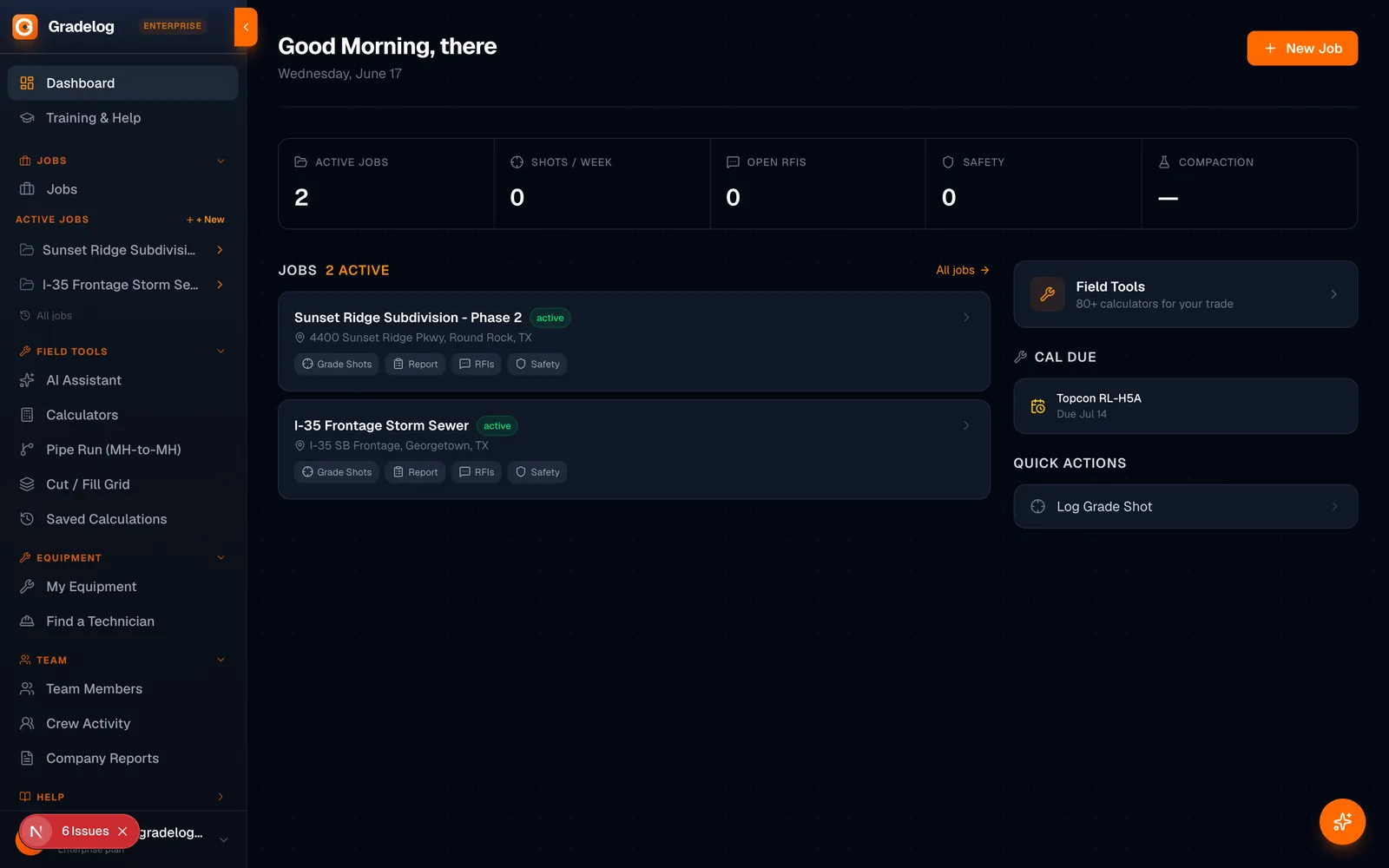
Gradelog is the AI field platform for contractors — grade shots, photo documentation, calibration tracking, and as-built reports, all tied to your gear.
- Equipment & calibration tracking
- Photo + grade documentation
- AI field assistant, 8 languages
Free 14 days with every Express Tools purchase
Your equipment. Your data. All in one place.
Gradelog is the field-execution platform built for grading and earthwork crews. Log grade shots, track cut/fill, document phases with photos, and generate as-built reports — from the cab to the office.
- Grade shots & cut/fill tracking per job
- Photo documentation by phase, task, and equipment
- As-built reports ready for inspector sign-off
- AI field assistant — troubleshoot on the jobsite
Built by the same team as Express Tools
Try Free →14 days
Free trial
8 languages
Supported
iPhone + Android
Works on