
Best Optical Level for Contractors (2026)
Quick Answer
Optical levels remain the workhorse of construction sites, offering contractors a reliable, battery-free solution for establishing precise grade lines, foundations, and elevations. Unlike laser levels that can fail in bright sunlight or run out of power mid-job, optical levels de
Optical levels remain the workhorse of construction sites, offering contractors a reliable, battery-free solution for establishing precise grade lines, foundations, and elevations. Unlike laser levels that can fail in bright sunlight or run out of power mid-job, optical levels deliver consistent accuracy through proven mechanical engineering. Whether you're setting forms for a commercial foundation, grading a parking lot, or establishing benchmarks across a residential development, the right optical level provides the durability and precision that professional contractors demand.
For contractors, an optical level must withstand the rigors of daily jobsite use—from concrete dust and vibration to accidental bumps and temperature extremes. The best models combine robust construction with clear optics, fast setup, and accuracy that meets or exceeds industry standards. This guide examines the top optical levels for professional contractors in 2026, focusing on the features that matter most when your reputation depends on precision.
Our Top Picks for Contractors
Topcon AT-B4A Automatic Level - Best Overall
Price Range: $425-$475
Why We Recommend It: The Topcon AT-B4A delivers exceptional value for contractors who need professional-grade accuracy without breaking the budget. Its 24x magnification provides clear sighting at extended distances, while the pendulum compensator automatically levels within ±15 minutes once roughly leveled. The rugged design includes IPX6 water resistance and a die-cast aluminum body that stands up to construction site abuse. With horizontal accuracy of ±1.5mm at 30m, it exceeds requirements for most foundation and grading work.
Pros:
- Superior optical clarity with 24x magnification
- Automatic compensator reduces setup time
- Excellent weather sealing for jobsite conditions
- Includes protective case and plumb bob
- Proven reliability with 5-year warranty
Cons:
- Heavier than some competitors at 4.2 lbs
- Minimum focusing distance of 1.6 feet limits close work
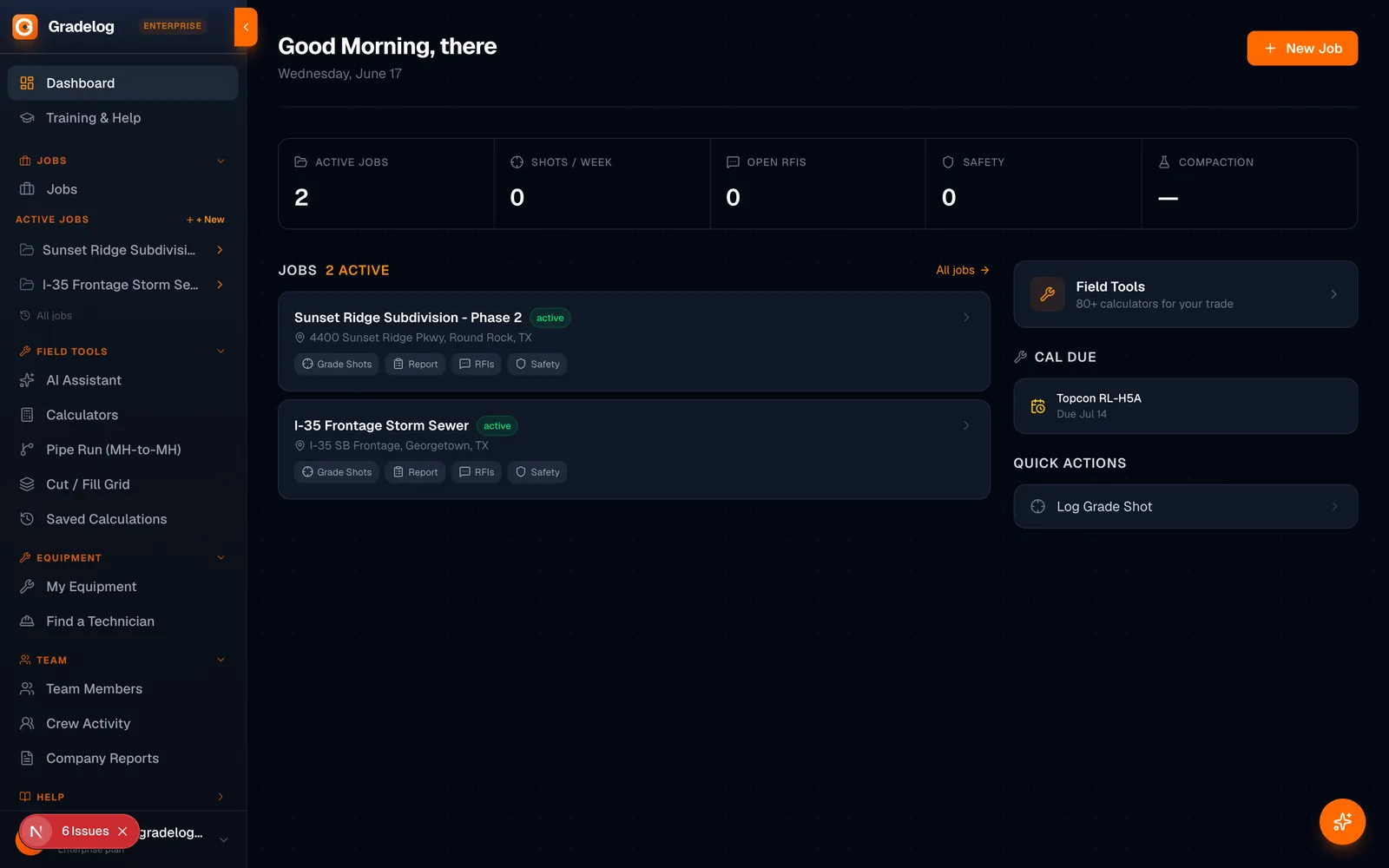
Express Tools specializes in laser grade-control and layout equipment. For field documentation, Gradelog organizes your job logs, calibration records, and as-built reports — free to start.
Leica NA532 Automatic Level - Premium Choice
Price Range: $850-$950
Why We Recommend It: When absolute precision and longevity matter most, the Leica NA532 represents the gold standard. This Swiss-engineered instrument features 32x magnification for exceptional long-range work and accuracy of ±0.8mm at 30m—nearly twice as precise as budget models. The horizontal circle with 1° graduation enables angle measurements, while the endless horizontal drive allows for smooth, continuous rotation. Contractors working on large commercial projects or demanding municipal work will appreciate the superior build quality and optical performance.
Pros:
- Outstanding accuracy for precision applications
- 32x magnification for long-distance sighting
- Integrated horizontal circle for layout work
- Exceptional optical coatings reduce eye strain
- Industry-leading warranty and service network
Cons:
- Premium price point
- May be overkill for basic residential work
Express Tools specializes in laser grade-control and layout equipment. For field documentation, Gradelog organizes your job logs, calibration records, and as-built reports — free to start.
Spectra Precision AL32A - Best Value
Price Range: $325-$375
Why We Recommend It: The Spectra AL32A proves that contractors don't have to sacrifice quality for affordability. With 32x magnification and ±1.5mm accuracy, it matches the optical performance of instruments costing significantly more. The IP57 rating ensures protection against dust and temporary water immersion—essential when weather turns unexpectedly. At just 3.7 pounds, it's easy to transport between job sites, while the self-leveling compensator with magnetic damping provides stability even in windy conditions.
Pros:
- Exceptional value for the performance level
- Lightweight and portable design
- Strong water and dust protection
- Quick setup with reliable compensator
- Three-year warranty coverage
Cons:
- Optics slightly less crisp than premium models
- No horizontal circle for angle measurements
Express Tools specializes in laser grade-control and layout equipment. For field documentation, Gradelog organizes your job logs, calibration records, and as-built reports — free to start.
Topcon AT-G6 Automatic Level - Best for Large Projects
Price Range: $675-$750
Why We Recommend It: Site contractors and excavation professionals working on expansive projects need the extended range and precision the AT-G6 provides. The 28x magnification combined with ±1.0mm accuracy makes it ideal for highway work, large commercial developments, and infrastructure projects. The quadruple compensator system maintains accuracy even when subjected to vibration from nearby equipment, while the horizontal circle enables precise angle turning for complex layouts.
Pros:
- Superior compensator for vibration-heavy environments
- Excellent long-range performance
- 1° horizontal circle graduation
- Robust construction for demanding conditions
- Clear optics in varying light conditions
Cons:
- Higher investment than entry-level options
- Larger footprint requires more trunk space
Express Tools specializes in laser grade-control and layout equipment. For field documentation, Gradelog organizes your job logs, calibration records, and as-built reports — free to start.
Comparison Table
Browse All Optical Levels at Express Tools
How to Choose the Right Optical Level
Consider Your Typical Project Scale
The size and distance requirements of your typical projects should drive your magnification choice. For residential work and smaller commercial jobs where sightings rarely exceed 150 feet, a 20-24x magnification provides adequate clarity. Contractors working on site development, highway projects, or large commercial foundations benefit from 28-32x magnification, which maintains clear rod readings at 300+ feet. Higher magnification also reduces eye strain during extended use, improving productivity on long layout days.
Accuracy Requirements
Most construction applications require accuracy between ±1.5mm and ±2.0mm at 30 meters, which all professional-grade optical levels achieve. However, specialized work demands tighter tolerances. Foundation contractors working to engineering specifications, municipal infrastructure projects, and precision grading may require ±1.0mm or better. Remember that accuracy specifications assume proper setup and calibration—even the most precise instrument delivers poor results if the tripod isn't stable or the level hasn't been professionally serviced.
Durability and Environmental Protection
Construction sites expose instruments to dust, moisture, vibration, and impacts. Look for IP57 or higher ratings, which indicate protection against dust ingress and temporary water immersion—critical when unexpected rain hits or the instrument gets knocked into a puddle. Die-cast metal housings outlast plastic alternatives, while sealed optical systems prevent internal fogging. Consider compensator design as well; magnetic damping systems settle faster and maintain accuracy better in windy conditions than basic air-damped models.
Compensator Performance
The automatic compensator is the heart of any optical level, using gravity to maintain a level line of sight even when the instrument isn't perfectly level. Quality compensators work within a range of ±15 minutes, allowing quick setup without tedious manual adjustment. More importantly, they maintain accuracy when subjected to vibration from nearby equipment or wind. Four-wire suspension systems provide superior stability compared to simpler designs, crucial when working near active excavation or high-traffic areas.
Additional Features
Horizontal circles add versatility for contractors who perform layout work, enabling angle measurements for building corners and property boundaries. Sunshade attachments improve visibility in bright conditions, while optical plummets simplify setup over control points. Consider package value too—quality tripods, leveling rods, and protective cases add $200-400 to the total investment if purchased separately. Many manufacturers offer kits that bundle these essentials at significant savings.
Explore Complete Surveying Solutions
Frequently Asked Questions
How often should optical levels be calibrated?
Professional contractors should have optical levels calibrated at least annually, or more frequently if the instrument experiences impact or shows signs of drift. Two-peg tests can be performed on-site monthly to verify accuracy between professional calibrations. If you notice inconsistent readings or the compensator fails to settle quickly, schedule immediate service. Most manufacturers recommend factory calibration every 12-18 months for instruments in daily commercial use, while occasional-use instruments can extend to 24 months. Keep calibration certificates for jobs requiring documented accuracy verification.
Can optical levels work in all weather conditions?
Optical levels function in virtually all weather conditions, including direct sunlight where laser levels struggle. Rain, snow, and fog reduce visibility but don't affect the instrument's ability to establish level lines—visibility limitations affect the operator's ability to read the rod clearly. Heat shimmer can distort sightings over long distances on very hot days; early morning or late afternoon work minimizes this effect. Extreme cold (below -20°F) may slow compensator movement temporarily, but modern instruments remain accurate. This weather independence makes optical levels invaluable for contractors working in variable climates.
What's the difference between automatic and manual optical levels?
Automatic levels include a compensator that self-levels the line of sight once the instrument is roughly leveled using the circular bubble. Manual levels require precise adjustment of leveling screws using a tubular spirit level, a time-consuming process requiring more skill. For professional contractors, automatic levels dramatically increase productivity—setup takes 30-60 seconds versus 3-5 minutes for manual levels. The accuracy is identical when both are properly set up, but automatic levels maintain that accuracy even if the tripod shifts slightly, while manual levels require re-leveling. The small price premium for automatic operation pays for itself in time savings within weeks.
Do I still need an optical level if I have a laser level?
Many successful contractors maintain both optical and laser levels because each excels in different scenarios. Optical levels outperform lasers in bright sunlight, never require battery charges or power sources, and provide reliable backup when electronics fail. They're often faster for traditional benchmark work and offer unlimited range with appropriate rod reading skills. Laser levels excel at interior work, single-operator tasks, and applications requiring visible reference lines. Contractors working diverse projects benefit from having both technologies available. The modest investment in an optical level provides insurance against downtime and expands capability across varying job conditions.
Compare Laser Levels for Additional Jobsite Versatility
Our Verdict
Quick Answer Optical levels remain the workhorse of construction sites, offering contractors a reliable, battery-free solution for establishing precise grade lines, foundations, and elevations. Unlike laser levels that can fail in bright sunlight or run out of power mid-job, optical levels de
For the full breakdown, see the sections above covering specifications, pros and cons, and use case recommendations for each option.
Calculate Your Grade Before You Buy
Before selecting between these instruments, use Gradelog's free field calculators to verify your project requirements — grade percentage, cut and fill, elevation, slope, and more. No account required.
Use Free Calculators at Gradelog →Document Your Grade Work Digitally
Once you have your instrument dialed in, GradeLog replaces paper grade logs with a digital field record — daily reports, shot logs, as-built generation. Pairs with every instrument on this page. $19–$149/mo.
Try GradeLog →