
Best Pipe Laser for Municipal Utility Work
Quick Answer
Municipal utility work demands precision and reliability. Whether you're installing storm drains, sanitary sewers, or water mains, a quality pipe laser keeps your crew on grade and eliminates costly rework. We've tested the leading models on actual job sites to identify which pip
Municipal utility work demands precision and reliability. Whether you're installing storm drains, sanitary sewers, or water mains, a quality pipe laser keeps your crew on grade and eliminates costly rework. We've tested the leading models on actual job sites to identify which pipe lasers deliver the accuracy, durability, and ease of use that municipal contractors need.
Top Pipe Laser Picks for Municipal Projects
1. Topcon TP-L5BV – Best Overall Performance
Price: $8,995
The Topcon TP-L5BV sets the standard for municipal sewer and water line installation. This dual-grade pipe laser delivers ±10 arc second accuracy and features a five-beam design with a dedicated vertical reference beam. The TP-L5BV handles pipes from 8" to 60" diameter and grades from -15% to +40%. Its sealed laser housing (IP68 rating) survives complete submersion, which matters when you're working in wet utility trenches. The automatic grade matching function saves 10-15 minutes per setup compared to manual adjustment. Battery life hits 60 hours on a single charge, enough for a full work week without swapping batteries.
2. Leica Piper 200 – Best for Versatility
Price: $7,450
The Leica Piper 200 works in pipes from 6" to 48" and handles grades up to 30%. Accuracy sits at ±15 arc seconds, suitable for most municipal specs. What makes the Piper 200 stand out is its versatility – it functions as both a single-grade and dual-grade laser depending on your project needs. The integrated laser target and large backlit display make alignment fast, even in dim manholes. Battery runtime reaches 40 hours. The Piper 200's lower price point makes it ideal for municipalities running multiple crews or contractors who need a second laser for smaller diameter pipe work.
3. Spectra Precision DG813 – Best Value
Price: $6,295
The Spectra DG813 delivers solid performance at a municipal budget-friendly price. This dual-grade system works in 8" to 36" pipes with ±20 arc second accuracy. While not quite as precise as the Topcon, it meets ASTM specifications for most municipal storm and sanitary work. The DG813's simple three-button interface gets new operators up to speed quickly. IP68 waterproof rating and drop-tested housing handle typical job site abuse. Battery life is 30 hours – adequate but requires mid-week charging on longer runs. If you're primarily running 10" to 24" storm pipe, this laser handles it without the premium price tag.
4. Trimble LP430 – Best for Large Diameter Pipe
Price: $9,750
For large diameter concrete pipe (36" to 72"), the Trimble LP430 excels where other lasers struggle. Its high-power laser beam remains visible at 800+ feet, critical for long runs between manholes. Accuracy of ±8 arc seconds ensures you stay within spec on tight tolerance projects. The LP430's automatic leveling works up to 10% grade, then switches to manual fine-tuning for steeper grades. The trade-off? This laser is heavier (18 lbs vs. 12 lbs for the Topcon) and costs more. But if you're installing large trunk sewers or major water transmission lines, the LP430's extended range and precision justify the investment.
Pipe Laser Comparison Table
How to Choose the Right Pipe Laser
Accuracy Requirements
Municipal specs typically require accuracy within 0.04 feet per 100 feet of run. In laser terms, ±20 arc seconds or better meets this standard. Storm sewers often have looser tolerances than sanitary sewers. Check your project specifications before buying – some treatment plant force mains require ±10 arc seconds or tighter. Don't overpay for precision you don't need, but don't go cheap and fail inspections either.
Pipe Diameter Range
Match the laser's diameter range to your typical work. Most residential and small commercial municipal work uses 8" to 18" pipe. Trunk sewers and collector systems run 24" to 48". Large regional systems may use 54" to 72" concrete pipe. A laser that doesn't fit your pipe diameter properly won't maintain accurate alignment. If you work across a wide range, choose a model with the broadest diameter capability.
Grade Range and Terrain
Flat terrain municipalities can use lasers limited to 10-15% grades. Hilly areas need models handling 30-40% grades. Also consider negative grades – some lasers don't handle downhill grades as steep as uphill. The Topcon TP-L5BV handles -15%, useful for pump station force mains or unusual topography.
Battery Life and Runtime
Long sewer runs between manholes (300-500 feet) require lasers that run all day without battery swaps. A 40-60 hour battery life means you charge weekly, not daily. Shorter battery life means your crew stops working to swap batteries or loses the afternoon waiting for a charge. Factor in cold weather – battery performance drops 20-30% below freezing.
Durability and Weather Sealing
All the lasers listed here carry IP68 ratings – submersion proof to 6 feet. This matters in utility work where groundwater, rain, and mud are constant factors. Also check drop ratings. A laser that survives a 3-foot drop onto concrete lasts longer than one that doesn't. Cheaper lasers often fail at weather sealing and impact resistance.
Ease of Use
Complex interfaces slow down setup and increase operator error. Look for lasers with intuitive controls, clear displays, and fast setup features like automatic grade matching. Your best operator won't always run the laser – sometimes the new guy does. Simple operation reduces mistakes and keeps productivity high.
Frequently Asked Questions
What's the difference between single-grade and dual-grade pipe lasers?
Single-grade lasers project one laser plane for basic pipe alignment. Dual-grade lasers project two planes (horizontal and vertical reference), allowing simultaneous grade and alignment verification. For municipal work with strict inspection requirements, dual-grade lasers reduce errors and speed up the approval process. They cost $1,000-$2,000 more but eliminate the need for separate alignment checks. Storm sewer work often uses single-grade lasers successfully, while sanitary sewers benefit from dual-grade precision.
How often do pipe lasers need calibration?
Manufacturers recommend annual calibration for pipe lasers used in municipal work. Heavy use or rough handling may require semi-annual calibration. You'll know calibration is overdue when your grade checks consistently show errors or inspectors reject your work. Professional calibration costs $300-$500 and takes 1-2 weeks. Some contractors keep a backup laser to avoid downtime. Never skip calibration – out-of-spec work costs far more than calibration fees.
Can I use a pipe laser for both storm and sanitary sewer installation?
Yes, provided the laser meets the tighter specifications. Sanitary sewers typically require ±10 to ±15 arc second accuracy for proper flow and to prevent infiltration/exfiltration. Storm sewers often allow ±20 arc seconds. If your laser meets sanitary sewer specs, it exceeds storm sewer requirements. One quality laser handles both applications, eliminating the need for separate equipment. Make sure the diameter range covers both your typical storm pipe (often larger diameter) and sanitary pipe sizes.
What range do I need for typical municipal sewer projects?
Most municipal sewer work involves runs of 300-500 feet between manholes. Your pipe laser needs effective range of 600+ feet to handle these distances with adequate beam visibility. Urban work with closely spaced manholes (150-250 feet) works fine with 400-foot range lasers. Suburban and rural municipalities often install longer runs (500-800 feet), requiring lasers with 800+ foot range like the Trimble LP430. Also consider that range decreases in bright sunlight or dusty conditions – add 30% to your typical run length when specifying range requirements.
Our Verdict
Quick Answer Municipal utility work demands precision and reliability. Whether you're installing storm drains, sanitary sewers, or water mains, a quality pipe laser keeps your crew on grade and eliminates costly rework. We've tested the leading models on actual job sites to identify which pip
For the full breakdown, see the sections above covering specifications, pros and cons, and use case recommendations for each option.
Verify Your Pipe Grade Before You Buy
Before committing to a pipe laser, use Gradelog's free pipe grade calculator to verify your project requirements — invert elevation, pipe fall, percent grade, and required accuracy. No account needed.
Use Free Pipe Grade Calculators at Gradelog →Document Your Pipe Grade Work Digitally
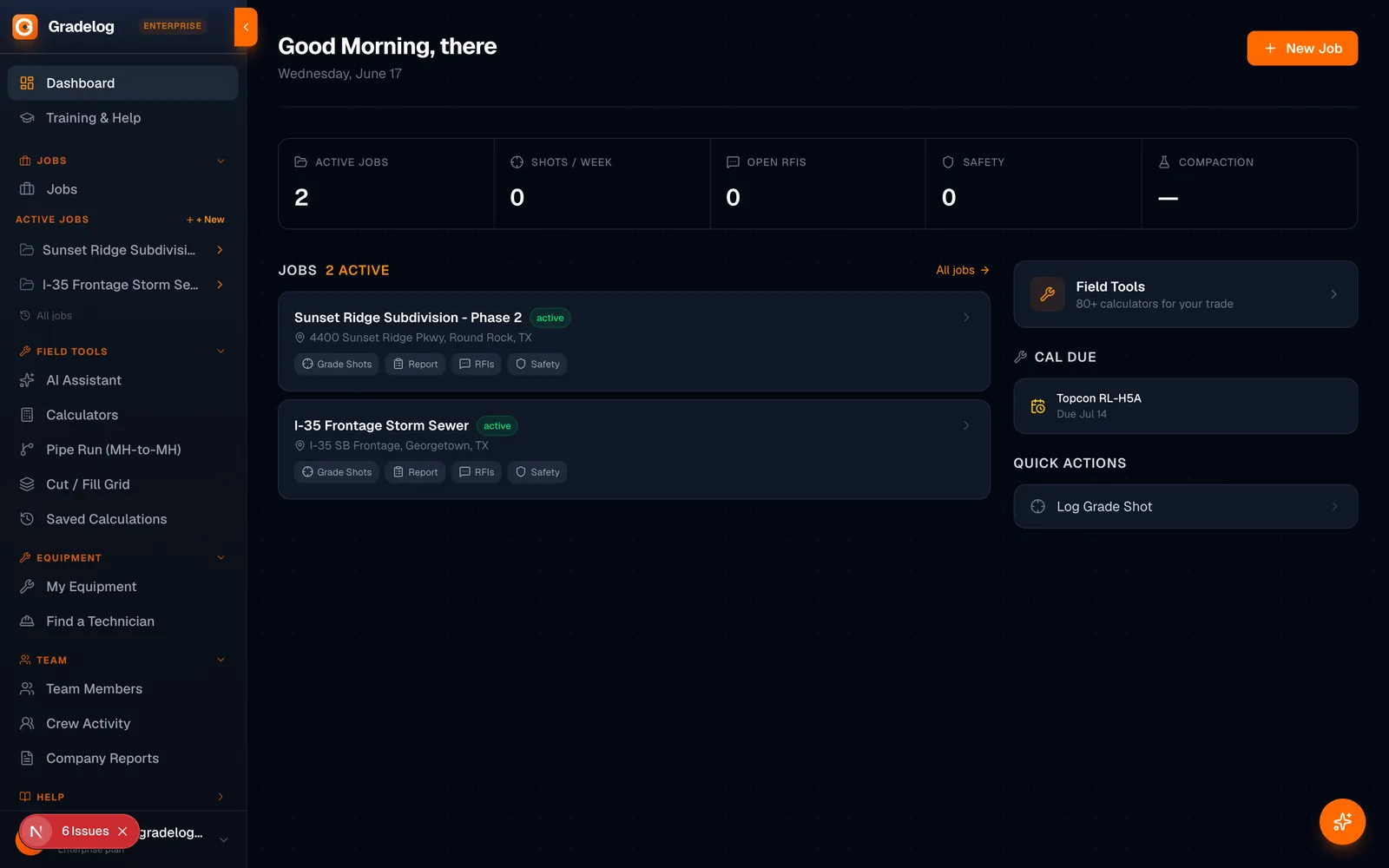
Once your pipe laser is dialed in, GradeLog replaces paper shot logs with digital field records — invert elevations, pipe grades, as-built reports. Replace the clipboard with a system that generates reports automatically. $19–$149/mo.
Try GradeLog →