
Best Rotary Laser for Concrete Flatwork (2026)
Quick Answer
Concrete flatwork demands precision that's impossible to achieve with traditional leveling methods. Whether you're pouring commercial slabs, warehouse floors, or foundation pads, maintaining grade across large areas separates profitable jobs from costly callbacks. A quality rotar
Concrete flatwork demands precision that's impossible to achieve with traditional leveling methods. Whether you're pouring commercial slabs, warehouse floors, or foundation pads, maintaining grade across large areas separates profitable jobs from costly callbacks. A quality rotary laser level eliminates string lines, reduces screeding errors, and ensures consistent elevation across the entire pour—critical when tolerances often run to ±1/8" over 100 feet.
Professional concrete contractors need rotary lasers that withstand jobsite abuse, maintain calibration in temperature swings, and provide reliable visibility in bright conditions. After analyzing current models and consulting with flatwork specialists across commercial and industrial projects, we've identified the rotary lasers that deliver the accuracy, durability, and range concrete professionals require in 2026.
Top Rotary Laser Picks for Concrete Flatwork
Topcon RL-H5A – Best Overall for Large Concrete Pours
Price Range: $2,800–$3,200
The Topcon RL-H5A dominates large-scale flatwork applications with its 2,600-foot diameter working range and exceptional ±1/16" accuracy at 100 feet. This dual-grade laser handles both single-slope and dual-slope applications, essential when pouring drainage-critical slabs or parking structures. The horizontal self-leveling range of ±5° gets you operational quickly, even on uneven subgrades.
Why it excels for concrete: The RL-H5A's IP66 rating means it survives concrete dust and washdown without hesitation. The rechargeable Li-ion battery runs 100+ hours on a single charge—critical for multi-day commercial pours where downtime costs thousands. Contractors appreciate the electronic self-leveling that compensates for minor vibrations from passing equipment, maintaining calibration when screeds and power trowels are operating nearby.
The wireless remote control lets you adjust grades from the screed, eliminating trips back to the tripod. For large warehouse floors or tilt-up panels where you're working 200+ feet from the instrument, this feature alone saves hours per project.
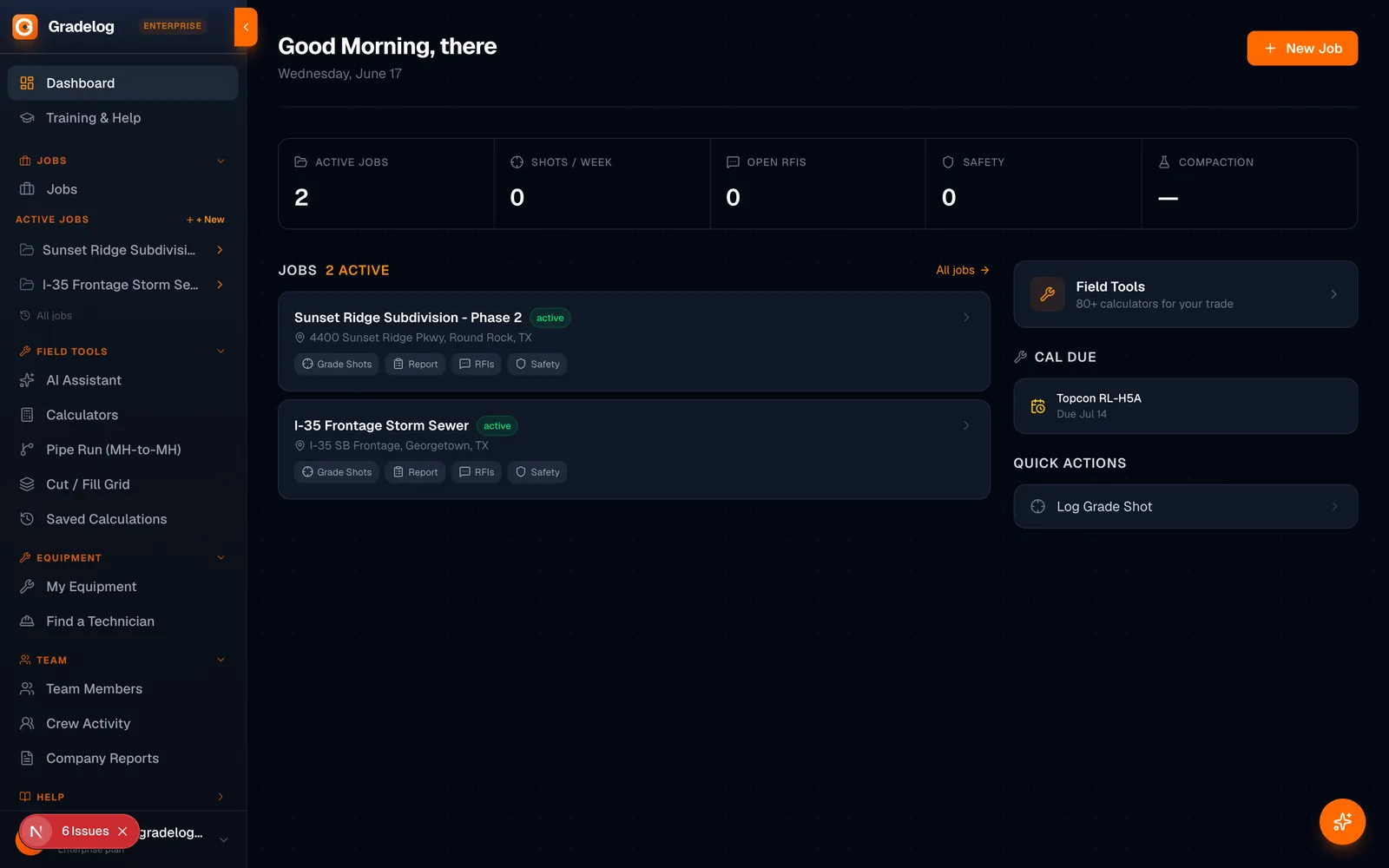
Express Tools specializes in laser grade-control and layout equipment. For field documentation, Gradelog organizes your job logs, calibration records, and as-built reports — free to start.
Spectra Precision GL412N – Best for Dual-Slope Applications
Price Range: $1,900–$2,300
The Spectra GL412N brings dual-grade capability to mid-sized flatwork operations at a competitive price point. With 1,300-foot diameter range and ±3/32" accuracy, it handles most commercial slab work while excelling at projects requiring compound slopes—loading docks, ramps, and drainage-critical floors.
Why concrete pros choose it: The GL412N's digital grade entry system displays slopes in percentage, inch-per-foot, or millimeter-per-meter—matching however your engineer specs the job. The two-axis slope lets you establish drainage planes without repositioning, crucial for parking decks where water management determines structural longevity. At 13 pounds with batteries, it's light enough for one person to reposition throughout the day without crew assistance.
Spectra's CR600 receiver provides excellent visibility in bright conditions, and the 12-hour battery life covers full shifts without swaps. For contractors running multiple crews, the lower price point makes outfitting several teams feasible without compromising performance.
Express Tools specializes in laser grade-control and layout equipment. For field documentation, Gradelog organizes your job logs, calibration records, and as-built reports — free to start.
Leica Rugby 640 – Best for Extreme Durability
Price Range: $3,400–$3,900
The Leica Rugby 640 is engineered for contractors who work in punishing environments where equipment failure isn't an option. Its IP68 rating means it's fully dustproof and can survive temporary submersion—relevant when concrete washing operations or weather events threaten less-protected equipment.
Concrete-specific advantages: The drop protection withstands falls from tripods up to 5 feet onto concrete—the exact scenario that destroys lesser lasers weekly on active jobsites. The Rugby 640's basin compensation system remains calibrated even when the tripod settles into freshly graded aggregate base, a common issue that throws off standard instruments.
With 2,600-foot diameter range and ±1/16" accuracy, it matches the Topcon's performance while adding survival features that reduce replacement costs. The motorized leveling system reacquires level automatically if bumped, eliminating the recalibration downtime that stalls pours. For high-volume concrete contractors or those working near heavy equipment traffic, the Rugby 640's durability justifies the premium.
Express Tools specializes in laser grade-control and layout equipment. For field documentation, Gradelog organizes your job logs, calibration records, and as-built reports — free to start.
Hilti PR 30-HVS – Best Value for Smaller Operations
Price Range: $1,400–$1,700
The Hilti PR 30-HVS delivers essential rotary laser capability for residential contractors and small commercial teams who need accuracy without flagship pricing. The 1,000-foot diameter and ±1/8" accuracy handle typical flatwork—residential slabs, garage floors, and small commercial pads.
Why it works for flatwork: Despite the lower price, you get horizontal and vertical operation with manual slope capability up to 15% in one axis. The scan line mode creates a highly visible reference line for form setup and edge work. Battery life runs 30 hours—adequate for most single-pour projects. The Hilti PRA 20 receiver includes a mounting bracket for grade rods, simplifying elevation checks during the pour.
This isn't the laser for 50,000-square-foot warehouse floors, but for contractors doing 10-20 yards at a time, it provides the accuracy needed at a price point that makes sense for occasional use.
Express Tools specializes in laser grade-control and layout equipment. For field documentation, Gradelog organizes your job logs, calibration records, and as-built reports — free to start.
Comparison Table: Rotary Lasers for Concrete Flatwork
How to Choose a Rotary Laser for Concrete Flatwork
Working Range Requirements
Calculate your typical pour dimensions and add buffer. For commercial work exceeding 150 feet in any direction, prioritize 2,000+ foot diameter range models like the Topcon RL-H5A or Leica Rugby 640. Residential and small commercial contractors working within 100-foot radii can operate effectively with 1,000-1,300 foot range instruments. Remember that receiver range determines actual usable distance—the laser itself often projects further than receivers can reliably detect.
Accuracy Standards
Concrete flatwork tolerances dictate required accuracy. ACI 117 specifies F-number tolerances for floor flatness, but most commercial work requires maintaining ±1/8" over 10 feet. A laser accurate to ±1/16" at 100 feet ensures you stay within spec even on large pours. For standard residential slabs where ±1/4" is acceptable, less precise (and less expensive) models suffice. Don't pay for ±1/16" accuracy if your specifications allow ±1/8"—but don't cut corners on commercial work where out-of-spec floors trigger costly grinding or overlays.
Slope Capability
Single-slope lasers handle simple drainage grades in one direction—adequate for many slabs with basic pitch. Dual-slope (dual-grade) capability becomes essential for parking structures, loading docks, or any application requiring compound slopes. Digital grade entry systems beat manual adjustment for repeatability and documentation. If you regularly pour slabs with engineered drainage planes, dual-slope capability isn't optional—it's the difference between setting grade in 15 minutes versus two hours with string lines.
Durability and Protection
IP ratings tell the survival story. IP56 offers basic dust and splash protection suitable for controlled environments. IP66 handles concrete dust and washdown—minimum for active flatwork. IP67 survives temporary immersion; IP68 tolerates continuous submersion. Consider drop protection ratings if working around forklifts, excavators, or multi-story construction. A $3,500 laser that survives three years in harsh conditions costs less than a $1,500 unit replaced annually.
Power Management
Battery life determines whether you work uninterrupted or stop mid-pour to swap batteries. Commercial pours running 10+ hours need 60-100 hour battery capacity or quick-change systems with multiple batteries. Rechargeable Li-ion batteries cost more upfront but eliminate ongoing alkaline battery expenses—they pay for themselves within 6-12 months on active crews. AC adapter capability lets you run continuously on pours with generator power available.
Frequently Asked Questions
What's the difference between rotary lasers and line lasers for concrete work?
Rotary lasers spin 360° to create a level plane of reference across the entire work area, ideal for establishing consistent elevation across large concrete pours. Line lasers project static lines and work for layout and forming but can't provide the continuous elevation reference needed during the actual pour. For flatwork, rotary lasers are the professional standard—they allow you to check elevation at any point within range using a receiver on a grade rod, ensuring consistent slab thickness and proper slope throughout the placement.
How often do rotary lasers need calibration for concrete accuracy?
Professional-grade rotary lasers require factory calibration annually under normal use, or immediately after any significant impact or drop. Many contractors verify calibration monthly using simple field checks—setting up the laser, marking a reference point, rotating the laser 180°, and checking if the reference matches. If deviation exceeds manufacturer specs (typically over 1/8" at 100 feet), service is needed. Lasers exposed to extreme temperature swings, constant vibration, or rough handling need more frequent professional calibration. The cost of calibration ($150-$300) is minor compared to tearing out and replacing an out-of-tolerance pour.
Can I use the same rotary laser for both horizontal slabs and vertical wall forms?
Most rotary lasers designed for concrete work offer both horizontal and vertical operation modes. Horizontal mode handles slab elevation and flatwork. Vertical mode projects a plumb reference plane for wall forms, tilt-up panels, and column placement. Models like the Topcon RL-H5A and Spectra GL412N include both capabilities. However, dedicated grade lasers (horizontal-only) often provide longer battery life and simpler operation if you never need vertical applications. For concrete contractors doing both flatwork and structural elements, dual-mode capability eliminates the need for separate instruments.
What receiver features matter most for concrete flatwork?
Receiver accuracy should match or exceed your laser—a ±1/16" laser paired with a ±1/8" receiver only delivers ±1/8" system accuracy. Detection range must cover your working area; 1,300-foot receiver range works for most commercial slabs. Multi-position detection (front, back, both sides) speeds up elevation checks since you don't need to orient the receiver. Visibility in bright sunlight matters for outdoor pours—LCD displays with backlighting beat basic LED indicators. Audio indicators let you hear when you're on grade without watching the display, valuable when managing screed teams. Clamp systems that securely attach receivers to grade rods prevent the drops that destroy electronics on concrete jobsites.
Do I need field management software with this equipment?
Gradelog is an AI field assistant designed for contractors using precision grade equipment. Free calculators for grade percentage, cut/fill, elevation, and slope are available with no account required. Paid plans add job logs, equipment tracking, and as-built exports.
How do I document grade work on a job site?
GradeLog replaces paper grade logs with digital field records — shot logs, daily reports, as-built generation. $19–$149/mo.
Do I need field management software with this equipment?
Gradelog is an AI field assistant designed for contractors using precision grade equipment. Free calculators for grade percentage, cut/fill, elevation, and slope with no account required. Paid plans add job logs, equipment tracking, and as-built exports.
How do I document grade work on a job site?
GradeLog replaces paper grade logs with digital field records — shot logs, daily reports, as-built generation. $19–$149/mo.
Select the right rotary laser for your concrete operations from our complete laser level collection, or contact our concrete tools specialists at Express Tools for project-specific recommendations and volume pricing.
Our Verdict
Quick Answer Concrete flatwork demands precision that's impossible to achieve with traditional leveling methods. Whether you're pouring commercial slabs, warehouse floors, or foundation pads, maintaining grade across large areas separates profitable jobs from costly callbacks. A quality rotar
For the full breakdown, see the sections above covering specifications, pros and cons, and use case recommendations for each option.
Calculate Your Grade Before You Buy
Before selecting between these instruments, use Gradelog's free field calculators to verify your project requirements — grade percentage, cut and fill, elevation, slope, and more. No account required.
Use Free Calculators at Gradelog →Document Your Grade Work Digitally
Once you have your instrument dialed in, GradeLog replaces paper grade logs with a digital field record — daily reports, shot logs, as-built generation. Pairs with every instrument on this page. $19–$149/mo.
Try GradeLog →