
Grade Rod vs Lenker Rod: Which Type for Your Work?
Quick Answer
Whether you're managing a construction site, performing land surveys, or handling grading operations, choosing the right direct elevation rod is crucial for accuracy and efficiency. Grade rods and lenker rods are two fundamental tools used in leveling and elevation work, each wit
Whether you're managing a construction site, performing land surveys, or handling grading operations, choosing the right direct elevation rod is crucial for accuracy and efficiency. Grade rods and lenker rods are two fundamental tools used in leveling and elevation work, each with distinct advantages depending on your specific application. This guide breaks down the differences, helps you understand when to use each type, and guides you toward the best solution for your workflow. Learn from industry standards and discover which rod system will improve your team's productivity and measurement accuracy.
⚡ Quick Verdict
Standard Grade Rods Explained
Grade rods, also called leveling rods or measuring rods, are vertical measurement tools marked with numerical graduations and typically feature a target or clear sighting mark. They come in various materials (wood, fiberglass, aluminum) and are held vertically at points where elevation measurements are taken.
Standard Grade Rod Specifications
Advantages
- Wide range of lengths for various applications
- Clear, easy-to-read graduations and targets
- Lightweight and portable
- Cost-effective for general construction work
- Works well with most standard levels and theodolites
- Durable in typical job-site conditions
Limitations
- Accuracy limited to ±0.01 ft or ±3 mm per 100 ft
- Target marks can be difficult to see at distance
- Thermal expansion/contraction affects longer rods
- Not ideal for high-precision surveying
- May require frequent calibration
- Reading errors increase with distance
Lenker Direct Elevation Rods Explained
Lenker rods are precision direct elevation rods designed for high-accuracy leveling applications. They feature precisely compensated scales, often made from invar steel for thermal stability, and are engineered to deliver sub-millimeter repeatability. Lenker rods are the industry standard for precise engineering surveys, tunneling, and critical infrastructure work.
Lenker Rod Specifications
Advantages
- Sub-millimeter repeatability and accuracy
- Invar material virtually eliminates thermal drift
- Precision-etched graduations for exact readings
- Suitable for demanding engineering surveys
- Works with high-precision digital levels
- Consistent performance across temperature ranges
Limitations
- Significantly higher cost ($500–$1,500+)
- Heavier than aluminum grade rods
- Less common on general construction sites
- Invar material requires careful handling
- Overkill for basic grading or general site work
- Harder to find replacement parts locally
Head-to-Head Specifications Comparison
Which Should You Buy?
Scenario 1: General Construction Contractor
Your Situation: You manage multiple building sites and need to establish elevations for foundations, drainage, and grading operations. Accuracy within 0.1 ft is acceptable, and you need affordable, durable equipment.
Recommendation: Standard Grade Rods – Purchase a set of two 10-ft aluminum grade rods with sliding targets. They're lightweight, easy to read, durable for job-site conditions, and cost-effective. Pair them with a standard builder's level or transit level for typical site work.
Expected Investment: $150–$300 total for two rods plus target upgrades
Scenario 2: Professional Land Surveyor
Your Situation: You perform precise boundary surveys, deed research, and engineering work where accuracy is legally important and clients expect high-quality results. You need consistent, repeatable measurements even across varying temperatures.
Recommendation: Lenker Direct Elevation Rods – Invest in a pair of 4-meter invar lenker rods with precision etching and thermal compensation. These deliver the sub-millimeter repeatability surveyors expect and work seamlessly with digital levels like the Trimble Spectra Precision DiNi or Leica DNA levels.
Expected Investment: $1,200–$2,500 for a complete precision rod pair
Scenario 3: Small Contractor with Budget Constraints
Your Situation: You're starting out or operating on tight margins. You need basic leveling capability for foundation checks, drainage grades, and rough site measurements, but can't justify high-end equipment.
Recommendation: Entry-Level Grade Rods – Purchase single or dual 8-ft aluminum grade rods from our budget-friendly inventory (Sokkia or SitePro options). They're adequate for general grading work and won't break the bank. Upgrade later as your business grows.
Expected Investment: $80–$150 per rod
Scenario 4: Civil Engineering Firm
Your Situation: You handle infrastructure projects—bridge approaches, tunneling, or precise datum work—where sub-millimeter accuracy is contractually specified. Your team uses advanced digital levels and laser scanning integration.
Recommendation: Premium Lenker Rods with Digital Compatibility – Select high-precision invar lenker rods compatible with Trimble or Leica digital levels. Consider models with reflective scales for automated data capture. A backup set ensures continuity on large projects.
Expected Investment: $2,000–$4,000+ for a professional-grade pair with digital integration
Frequently Asked Questions
Calculate Your Grade Before You Buy
Before selecting between these instruments, use Gradelog's free field calculators to verify your project requirements — grade percentage, cut and fill, elevation, slope, and more. No account required.
Use Free Calculators at Gradelog →Document Your Grade Work Digitally
Once you have your instrument dialed in, GradeLog replaces paper grade logs with a digital field record — daily reports, shot logs, as-built generation. Pairs with every instrument on this page. $19–$149/mo.
Try GradeLog →Our Verdict
Grade Rod vs Lenker Rod: Which Type for Your Work? | Express Tools * { margin: 0; padding: 0; box-sizing: border-box; } body { font-family: -apple-system, BlinkMacSystemFont, 'Segoe UI', Roboto, 'Helvetica Neue',
For the full breakdown, see the sections above covering specifications, pros and cons, and use case recommendations for each option.

Built for equipment owners
Run the jobsite around your equipment
Gradelog is the AI field platform for contractors — grade shots, photo documentation, calibration tracking, and as-built reports, all tied to your gear.
- Equipment & calibration tracking
- Photo + grade documentation
- AI field assistant, 8 languages
Free 14 days with every Express Tools purchase
Your equipment. Your data. All in one place.
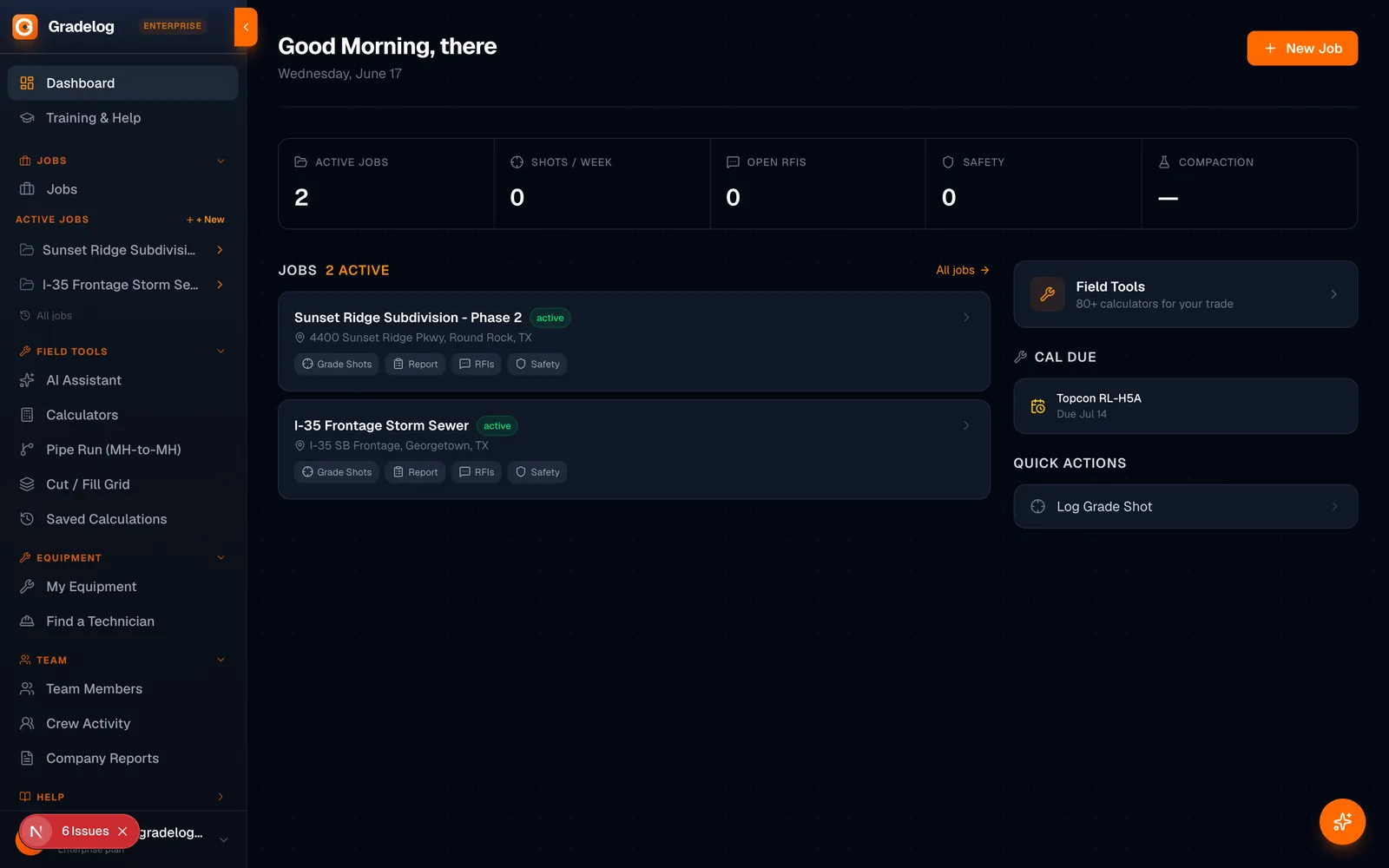
Gradelog is the field-execution platform built for grading and earthwork crews. Log grade shots, track cut/fill, document phases with photos, and generate as-built reports — from the cab to the office.
- Grade shots & cut/fill tracking per job
- Photo documentation by phase, task, and equipment
- As-built reports ready for inspector sign-off
- AI field assistant — troubleshoot on the jobsite
Built by the same team as Express Tools
Try Free →14 days
Free trial
8 languages
Supported
iPhone + Android
Works on