

Leica Rugby 620 vs Rugby 680: Specs, Features, and Which to Choose
Quick Answer
Expert comparison of two field-proven rotary lasers for concrete forming, site prep, and grading operations
Expert comparison of two field-proven rotary lasers for concrete forming, site prep, and grading operations
The Leica Rugby 620 and Rugby 680 represent two distinct tiers in Leica Geosystems' rotary laser lineup, both built for demanding job sites but engineered for different operational requirements. The Rugby 620 delivers essential leveling and slope functionality at approximately $2,800-$3,200, while the Rugby 680 commands $4,500-$5,200 with dual-grade capability and advanced remote control features.
Both lasers share Leica's proven durability standards—IP67 waterproof rating, 1-meter drop survival, and operational range exceeding 600 meters with a detector. The critical differences emerge in grade capabilities, control systems, and operational efficiency on complex grading jobs. This comparison examines real-world performance factors that affect crew productivity and job accuracy.
Specifications Comparison: Rugby 620 vs Rugby 680
Grade Capability: Single-Axis vs Dual-Grade Systems
The Rugby 620 operates as a single-axis grade laser, meaning it creates one directional slope across the job site. For typical excavation, foundation work, and drainage applications where grade runs in one direction, this configuration handles the majority of commercial and residential grading requirements. Setup involves orienting the laser along your grade direction and setting the desired percentage using the control panel.
The Rugby 680's dual-grade capability allows simultaneous slopes on both X and Y axes, creating compound grades essential for parking lot drainage, complex site work, and agricultural land leveling. This functionality eliminates multiple setups when working areas requiring cross-slopes or multi-directional drainage. The time savings become substantial on large paving jobs where proper drainage requires precise compound slopes—jobs that would require repositioning a single-grade laser multiple times.
Dual-grade operation demands more sophisticated calibration and typically requires the RC680 remote for practical field adjustments. Crews working primarily on linear grades—trenching, pipe laying, concrete screeding—rarely justify the additional investment for dual-grade capability they won't utilize.
Remote Control Systems and Field Efficiency
The optional RC620 remote provides basic control functions: power on/off, rotation speed selection, and grade adjustment. Effective range extends to approximately 60 meters, adequate for most residential and light commercial work. The interface uses physical buttons for grade entry, requiring line-of-sight operation for reliable communication.
Leica's RC680 remote represents a significant upgrade in both functionality and build quality. The backlit display remains readable in direct sunlight, critical for summer paving operations. Remote range extends to 100+ meters with improved signal penetration around obstacles. Most importantly, the RC680 provides independent control of both grade axes simultaneously, with digital readout showing current slope percentages in real-time.
For crews running multiple lasers across large sites, the RC680's channel selection prevents interference between units. The remote stores up to 20 grade presets, eliminating manual entry for repetitive jobs—a measurable time-saver on projects with standardized drainage specs or multiple phases using identical slopes.
Rotation Speed and Detection Performance
The Rugby 620's two-speed operation (300/600 RPM) covers standard applications effectively. Lower 300 RPM speed provides easier visual beam detection and works well with machine control systems on dozers and excavators. The 600 RPM setting improves visibility in bright conditions and extends effective range with laser detectors.
Adding 900 and 1500 RPM options, the Rugby 680 addresses specific high-precision scenarios. The 900 RPM setting optimizes performance with Leica's RodEye receiver series when working at extended ranges beyond 400 meters. The 1500 RPM scan mode creates an extremely visible reference line for layout work, essentially converting the rotary laser into a temporary line laser for forming alignment or interior work.
Variable rotation speed matters most in mixed-use scenarios: excavation requiring machine control at 300 RPM, then switching to 1500 RPM for layout checking without changing equipment. Single-purpose crews dedicated to excavation or rough grading show minimal productivity gain from additional speed settings.
Durability and Environmental Performance
Both models meet identical IP67 ingress protection standards, meaning full dust sealing and submersion survival to 1 meter for 30 minutes. Field experience confirms both units handle muddy excavation sites, concrete pours with standing water, and dusty earthwork without reliability issues. The 1-meter drop specification represents controlled testing; real-world survival depends on impact angle and surface, but both units routinely withstand typical jobsite handling.
The -20°C to +50°C operating range covers most construction climates. Cold weather performance relies heavily on battery technology—lithium-ion packs maintain capacity in freezing conditions where alkaline D-cells lose 40-50% capacity below 0°C. Both lasers accept either power source, providing backup options when primary batteries fail mid-shift.
Compensation system drift—the gradual accuracy loss from vibration and shock—affects all rotary lasers over time. Leica recommends annual calibration for both models. Practical accuracy testing using an optical level at 30-meter distance helps verify performance between formal calibrations, particularly for crews doing precision concrete work where 2-3mm errors become visible in finished surfaces.
Receiver Compatibility and Detection Systems
Both lasers work with Leica's RodEye receiver family—RodEye 120, 140, and 160 models—plus most third-party laser detectors using standard rotary laser frequencies. The RodEye 140 represents the sweet spot for general construction: large backlit LCD, multiple sensitivity modes, and clamp mounting for grade rods or machine masts.
Detection range reaching 600+ meters requires the RodEye 160 with digital filtering and high-sensitivity mode. Real-world effective range depends heavily on ambient light conditions, detector positioning, and atmospheric clarity. Expect 400-500 meters in typical overcast conditions, dropping to 300 meters in direct sunlight when working east-west orientations during midday.
Machine control integration uses the same detector technology, with millimeter-accurate positioning for excavator buckets or dozer blades. Both the 620 and 680 provide identical machine control performance—the dual-grade capability doesn't translate to machine control advantages since grade systems typically follow single-axis operations.
Cost Analysis and ROI Considerations
The $1,700-$2,000 price difference between models represents approximately 60-70% premium for dual-grade capability and advanced remote functionality. For excavation contractors working primarily on linear projects—utilities, pipelines, foundations—this premium rarely generates corresponding productivity returns. A Rugby 620 with alkaline battery pack and basic remote totals around $3,000 complete.
Site development contractors handling parking lots, athletic fields, and commercial pads with complex drainage requirements recoup the Rugby 680 investment through reduced setup time. A parking lot requiring 1.5% longitudinal slope and 2% cross-slope needs multiple laser positions with single-grade equipment but one central setup with dual-grade capability. On projects exceeding 5,000 square meters, time savings approach 2-3 hours per job.
Consider rental cost avoidance: purchasing a Rugby 680 at $4,800 versus renting dual-grade lasers at $180-220 per week breaks even after 22-27 rental weeks. Contractors working 30+ weeks annually on projects requiring dual-grade capability justify purchase within one season.
Which Laser Fits Your Operation?
Choose the Leica Rugby 620 When:
- Linear grading dominates your work: Trenching, underground utilities, foundation leveling, and single-direction drainage projects
- Budget constraints limit equipment investment: The 620 delivers professional accuracy without premium features rarely used in basic applications
- Crew experience levels vary: Simpler single-axis operation reduces training time and setup errors with less experienced operators
- Machine control is primary use: Excavators and dozers follow single-axis grades regardless of laser capability
- Rental supplementation is practical: Occasional complex grading jobs warrant weekly rentals rather than purchasing advanced equipment used quarterly
Choose the Leica Rugby 680 When:
- Site development and paving work are core services: Parking lots, roadways, and athletic surfaces requiring compound drainage slopes
- Large-area grading justifies efficiency investment: Projects exceeding 5,000 square meters where setup time significantly impacts labor costs
- Multiple concurrent slopes appear regularly: Agricultural leveling, solar panel fields, and complex commercial sites with varied drainage patterns
- Remote operation distance matters: Large sites where 100+ meter remote range reduces walking and repositioning time
- Equipment utilization exceeds 25 weeks annually: Frequency of use justifies the premium cost through cumulative time savings
Ready to Compare Pricing?
Express Tools stocks both Rugby models with complete packages including tripods, receivers, and extended warranties. Our equipment specialists provide job-specific recommendations based on your actual project mix.
Frequently Asked Questions
Can I upgrade a Rugby 620 to dual-grade capability later?
No, the dual-grade functionality requires different internal compensator hardware and control electronics that cannot be retrofitted. The grade capability is determined by the laser's internal leveling mechanism and processing system, making post-purchase upgrades impossible. If you anticipate needing dual-grade capability within 2-3 years, purchasing the Rugby 680 initially avoids the cost of selling and replacing equipment later. However, if you've operated 3+ years without dual-grade requirements, your work likely doesn't justify the upgrade.
Do both lasers maintain accuracy when mounted on dozers or excavators?
Both the Rugby 620 and 680 maintain leveling accuracy when properly mounted to vibrating machinery, using Leica's servo-motor compensation system that continuously adjusts for movement and vibration. The critical factor is mounting stability—the laser must be rigidly attached to the machine's cab or mast without flex. Accuracy degradation occurs from loose mounting rather than laser limitations. For machine control applications, both models perform identically since the excavator or dozer follows a single grade plane regardless of the laser's dual-axis capability. Verify your machine control receiver is compatible with Leica frequencies before purchasing either model.
Do I need field management software with this equipment?
Gradelog is an AI field assistant designed for contractors using precision grade equipment. Free calculators for grade percentage, cut/fill, elevation, and slope are available with no account required. Paid plans add job logs, equipment tracking, and as-built exports.
How do I document grade work on a job site?
GradeLog replaces paper grade logs with digital field records — shot logs, daily reports, as-built generation. $19–$149/mo.
Do I need field management software with this equipment?
Gradelog is an AI field assistant designed for contractors using precision grade equipment. Free calculators for grade percentage, cut/fill, elevation, and slope with no account required. Paid plans add job logs, equipment tracking, and as-built exports.
How do I document grade work on a job site?
GradeLog replaces paper grade logs with digital field records — shot logs, daily reports, as-built generation. $19–$149/mo.
What's the practical detection range difference between 600 RPM and 1500 RPM rotation speeds?
Higher rotation speeds (1500 RPM) actually reduce effective detection range by approximately 15-20% compared to 600 RPM operation. The faster rotation spreads beam
Before selecting between these instruments, use Gradelog's free field calculators to verify your project requirements — grade percentage, cut and fill, elevation, slope, and more. No account required. Once you have your instrument dialed in, GradeLog replaces paper grade logs with a digital field record — daily reports, shot logs, as-built generation. Pairs with every instrument on this page. $19–$149/mo.Calculate Your Grade Before You Buy
Document Your Grade Work Digitally
Our Verdict
Choose the Leica Rugby 620 if: Single-grade applications make up the majority of your work — horizontal grading, foundation layout, concrete formwork, and elevation transfer where you are setting one consistent grade across a working area. The Rugby 620 offers ±1mm accuracy in a durable, IP67-rated package at a lower price than the dual-grade 680. For contractors who occasionally need slope but can set it up on the laser rather than using the full dual-grade function, the 620 covers most construction needs at a better value.
Choose the Leica Rugby 680 if: Your work regularly includes compound slope applications — parking lots, athletic fields, retention ponds, complex drainage systems, or any grade work requiring independent grade control on perpendicular axes simultaneously. The Rugby 680's dual-grade capability eliminates the slope board setup that single-grade lasers require for cross-slope work, saving meaningful time on jobs with frequent grade changes. For grading contractors whose project mix includes 20% or more dual-grade work, the upgrade to the 680 pays back through reduced setup time on each dual-slope application.
See the feature comparison and application guide above for the full breakdown.

Built for equipment owners
Run the jobsite around your equipment
Gradelog is the AI field platform for contractors — grade shots, photo documentation, calibration tracking, and as-built reports, all tied to your gear.
- Equipment & calibration tracking
- Photo + grade documentation
- AI field assistant, 8 languages
Free 14 days with every Express Tools purchase
Your equipment. Your data. All in one place.
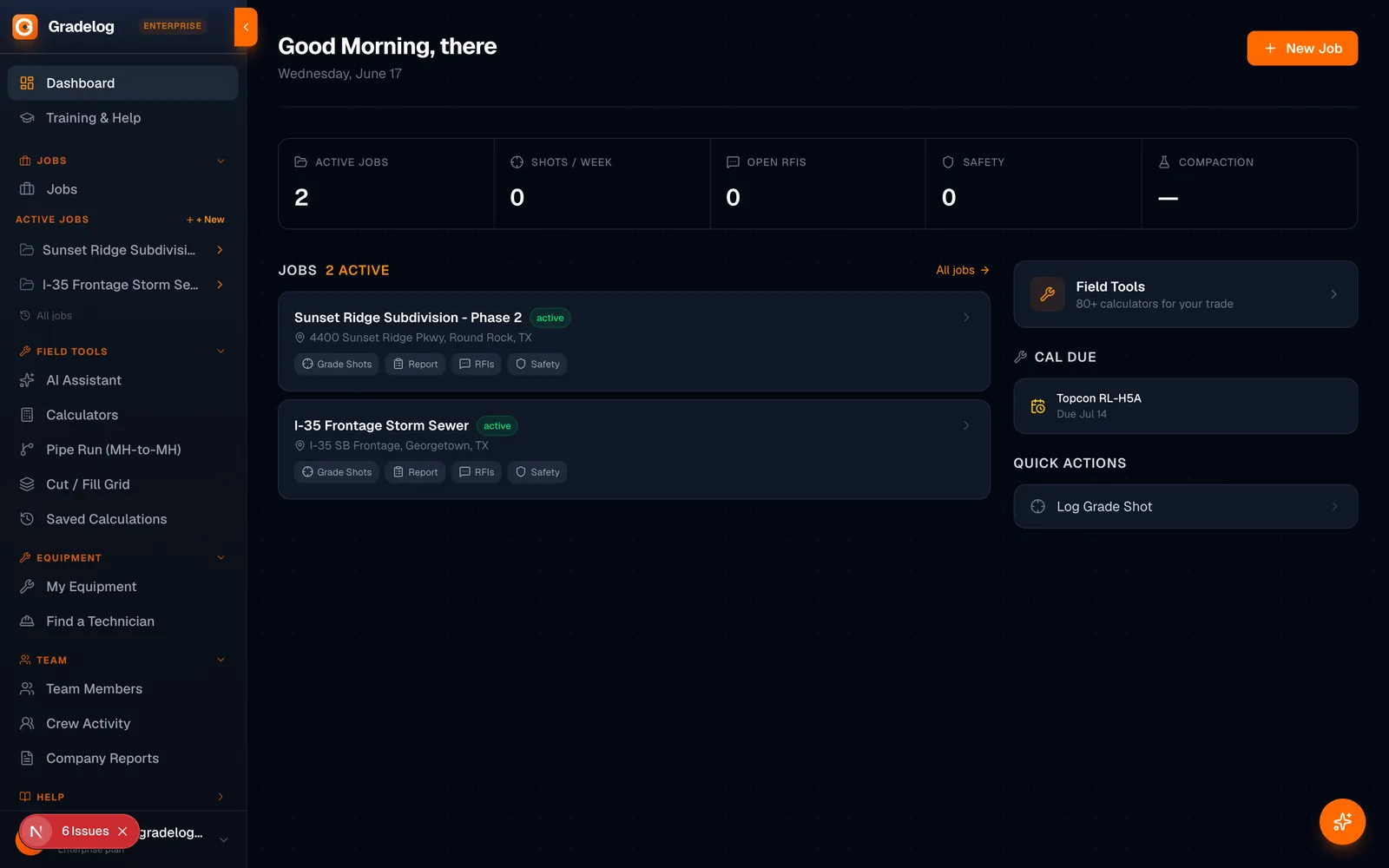
Gradelog is the field-execution platform built for grading and earthwork crews. Log grade shots, track cut/fill, document phases with photos, and generate as-built reports — from the cab to the office.
- Grade shots & cut/fill tracking per job
- Photo documentation by phase, task, and equipment
- As-built reports ready for inspector sign-off
- AI field assistant — troubleshoot on the jobsite
Built by the same team as Express Tools
Try Free →14 days
Free trial
8 languages
Supported
iPhone + Android
Works on