
Leica TS16 vs Trimble S7: Premium Robotic Total Station Showdown
Quick Answer
Choosing between the Leica TS16 and Trimble S7 robotic total stations is one of surveying's biggest decisions. Both instruments represent the pinnacle of modern surveying technology, offering exceptional accuracy, automation, and reliability for high-end construction and surveyin
Choosing between the Leica TS16 and Trimble S7 robotic total stations is one of surveying's biggest decisions. Both instruments represent the pinnacle of modern surveying technology, offering exceptional accuracy, automation, and reliability for high-end construction and surveying projects. This comprehensive comparison will guide you through the key specifications, strengths, and weaknesses of each model to help you make an informed investment. Whether you're managing large-scale infrastructure projects, performing precision cadastral surveys, or executing complex construction staking operations, understanding the differences between these two industry leaders is essential to selecting the right tool for your specific needs and budget.
Quick Verdict
Detailed Product Comparison
Leica TS16 Robotic Total Station
Specifications
Pros
- Exceptional optical performance with 30x magnification for precise sighting
- Superior ATR (Automated Target Recognition) technology with greater range and reliability
- Extremely stable and robust design with excellent durability
- Industry-leading warranty and service support
- Outstanding accuracy specifications (2" angle, ±2mm + 2ppm distance)
- Excellent battery life (up to 40 hours)
- Intuitive user interface with minimal learning curve
- Strong resale value and wide parts availability
Cons
- Higher initial investment cost compared to many competitors
- Less integrated software ecosystem compared to Trimble solutions
- Limited built-in connectivity features for cloud-based workflows
- Smaller user community in construction-focused markets
- May require additional third-party software for some construction workflows
Trimble S7 Robotic Total Station
Specifications
Pros
- Seamless integration with Trimble software ecosystem (Trimble Connect, field apps, etc.)
- Excellent for construction site workflows and project coordination
- Strong cloud connectivity and data management capabilities
- Robust eTechnology for automated target recognition
- Wide availability of compatible field software and accessories
- Excellent technical support and training resources for construction professionals
- Strong community of users in construction and heavy civil sectors
- Good accuracy specifications for most construction applications
Cons
- Slightly lower angular accuracy than TS16 (3" vs 2")
- Less impressive optical performance compared to Leica instruments
- Higher cost in total ownership when considering proprietary software subscriptions
- Steeper learning curve for traditional surveyors unfamiliar with connected workflows
- Dependency on Trimble ecosystem may limit flexibility for multi-platform users
- Battery performance not quite as strong as Leica
Head-to-Head Specifications Comparison
Which Should You Buy?
Scenario 1: Professional Land Surveyor / Cadastral Work
Recommendation: Leica TS16
If you're a professional surveyor performing boundary surveys, cadastral work, or property line establishment, the Leica TS16 is the better choice. Its superior angular accuracy (2" vs 3"), excellent optical performance, and robust ATR system will give you the precision and reliability needed for high-stakes land surveys. The TS16's reputation for durability and long-term value is particularly important in this sector. The slightly higher initial cost is offset by exceptional performance and resale value.
Scenario 2: General Contractor / Construction Site Work
Recommendation: Trimble S7
If you're managing construction projects and need tight integration with field crews, project management systems, and cloud-based collaboration tools, the Trimble S7 is your better choice. Native Trimble Connect integration, superior software ecosystem, and construction-focused features make it ideal for contractors. The slightly lower accuracy (3" vs 2") is more than adequate for construction staking and layout work, and you'll benefit significantly from the connected workflow capabilities.
Scenario 3: Multi-Purpose Surveying Firm (Budget-Conscious)
Recommendation: Trimble S7
If your firm performs a mix of surveying and construction work and budget is a consideration, the Trimble S7 offers slightly lower cost with still-excellent accuracy for most applications. While it doesn't match the TS16's precision, it's more than adequate for general engineering and construction surveys. The cost savings can be reinvested in software licenses or additional equipment.
Scenario 4: Government/Municipal Surveying (High Precision Required)
Recommendation: Leica TS16
For government agencies, municipal work, and projects requiring the highest accuracy standards, the Leica TS16 is the better investment. Its superior specifications, exceptional build quality, and proven track record in municipal and cadastral applications make it the standard choice. Budget constraints are typically less critical in government procurement, and the TS16's long-term reliability will minimize downtime.
Frequently Asked Questions
What is the main difference in accuracy between the Leica TS16 and Trimble S7?
The Leica TS16 offers superior angular accuracy of 2" (0.6 mgon) compared to the Trimble S7's 3" (0.9 mgon), and better distance accuracy at ±(2mm + 2ppm) versus ±(3mm + 2ppm). For most construction applications, the S7's accuracy is perfectly adequate, but for precision surveying work, the TS16's tighter specifications are preferable.
Do I need field management software with this equipment?
Gradelog is an AI field assistant designed for contractors using precision grade equipment. Free calculators for grade percentage, cut/fill, elevation, and slope are available with no account required. Paid plans add job logs, equipment tracking, and as-built exports.
How do I document grade work on a job site?
GradeLog replaces paper grade logs with digital field records — shot logs, daily reports, as-built generation. $19–$149/mo.
Do I need field management software with this equipment?
Gradelog is an AI field assistant designed for contractors using precision grade equipment. Free calculators for grade percentage, cut/fill, elevation, and slope with no account required. Paid plans add job logs, equipment tracking, and as-built exports.
How do I document grade work on a job site?
GradeLog replaces paper grade logs with digital field records — shot logs, daily reports, as-built generation. $19–$149/mo.
Which instrument has better automated target recognition?
The Leica TS16's ATR (Automated Target
Before selecting between these instruments, use Gradelog's free field calculators to verify your project requirements — grade percentage, cut and fill, elevation, slope, and more. No account required. Once you have your instrument dialed in, GradeLog replaces paper grade logs with a digital field record — daily reports, shot logs, as-built generation. Pairs with every instrument on this page. $19–$149/mo.Calculate Your Grade Before You Buy
Document Your Grade Work Digitally
Our Verdict
Choose the Leica TS16 if: Optical quality, absolute measurement accuracy, and instrument build quality are your primary criteria. The TS16 represents Leica's field-proven engineering at a professional price point that serious surveying firms and engineering companies consistently invest in. For cadastral surveys, deformation monitoring, tunnel control, and precision engineering surveys where the instrument's angular and distance accuracy directly determines the quality of the deliverable, the TS16 is the more accurate instrument and the one that Leica's professional reputation backs. The TS16's ATRplus automatic target recognition is fast and reliable, making it efficient for robotic stakeout in complex environments.
Choose the Trimble S7 if: You are heavily invested in the Trimble software ecosystem — Trimble Access, Trimble Business Center, Trimble Connect — and you need a total station that integrates into that workflow without friction. The S7 is a capable robotic instrument with strong data connectivity and excellent integration with Trimble's GNSS and machine control platforms. Construction-focused surveying firms that manage complete Trimble workflows from field to office will benefit from the seamless data exchange that the S7 provides within the ecosystem. The S7 is also competitive on price for users already committed to Trimble.
See the full angular accuracy, ATR performance, and workflow comparison in the sections above.

Built for equipment owners
Run the jobsite around your equipment
Gradelog is the AI field platform for contractors — grade shots, photo documentation, calibration tracking, and as-built reports, all tied to your gear.
- Equipment & calibration tracking
- Photo + grade documentation
- AI field assistant, 8 languages
Free 14 days with every Express Tools purchase
Your equipment. Your data. All in one place.
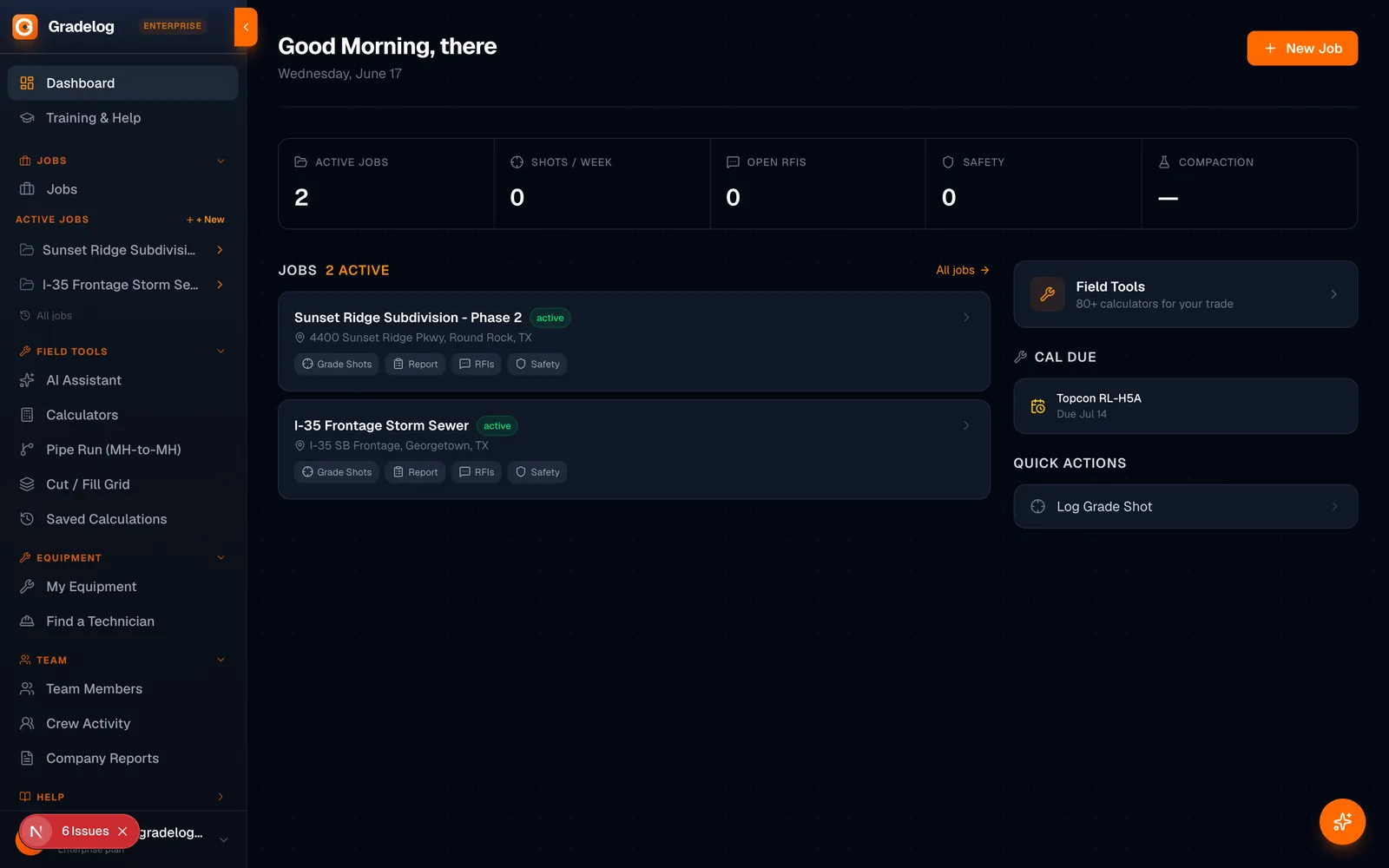
Gradelog is the field-execution platform built for grading and earthwork crews. Log grade shots, track cut/fill, document phases with photos, and generate as-built reports — from the cab to the office.
- Grade shots & cut/fill tracking per job
- Photo documentation by phase, task, and equipment
- As-built reports ready for inspector sign-off
- AI field assistant — troubleshoot on the jobsite
Built by the same team as Express Tools
Try Free →14 days
Free trial
8 languages
Supported
iPhone + Android
Works on