

Pipe Laser Grades Explained: Setting Grade for Sewer & Utilities
Quick Answer
Whether you're installing sanitary sewers, storm drains, or utility lines, proper grade setting is critical to system performance and longevity. This comprehensive guide explains how pipe laser grades work, why they matter, and how to set them correctly on your job site. Learn ab
Whether you're installing sanitary sewers, storm drains, or utility lines, proper grade setting is critical to system performance and longevity. This comprehensive guide explains how pipe laser grades work, why they matter, and how to set them correctly on your job site. Learn about slope calculations, accuracy standards, and how modern pipe lasers from industry leaders like Spectra Precision and Topcon help contractors maintain precision on every run.
What is Grade and Why Does It Matter?
Grade refers to the slope or gradient of a pipe or channel, typically expressed as a percentage or ratio (e.g., 0.5%, 1:200). For gravity-flow systems like sanitary sewers and storm drains, grade is essential because:
- Self-Cleaning: Proper grade maintains minimum flow velocity to prevent solids from settling
- Prevent Backups: Inadequate grade can cause water to pond, leading to system failures
- Structural Longevity: Correct slope reduces stress on pipe joints and prevents premature degradation
- Code Compliance: Most jurisdictions mandate minimum grades (typically 0.5% for sanitary sewer)
- Cost Efficiency: Avoiding re-excavation and repairs saves substantial time and money
Understanding Grade Calculations
Grade as Percentage
Expressed as a percentage, grade is the ratio of vertical drop to horizontal distance, multiplied by 100:
Grade (%) = (Elevation Drop ÷ Horizontal Distance) × 100
Example: If a sewer line drops 5 feet over 500 feet of run:
Grade = (5 ÷ 500) × 100 = 1%
Grade as Ratio
Engineers often express grade as a ratio (e.g., 1:200), which means 1 unit of drop per 200 units of distance:
1:200 ratio = 0.5% grade
Working with Design Documents
Most construction documents specify invert elevations (the lowest inside point of the pipe) at key stations. Modern pipe lasers simplify this by automatically calculating the required beam angle and height to match design grades.
How Pipe Lasers Work
Basic Operation
A pipe laser projects a laser beam inside or along a pipe at a precise angle that corresponds to the design grade. The laser head tilts to establish the correct slope, and receivers or targets detect the beam position to guide excavation and pipe laying.
Setting Grade Manually vs. Automatically
Step-by-Step: Setting Grade on a Pipe Laser
1. Determine Design Grade
From your engineer's drawings, identify:
- Starting invert elevation (upstream)
- Ending invert elevation (downstream)
- Pipe run length
- Confirm grade = (Drop ÷ Length) × 100
2. Set Up the Laser
Position the laser at or near the upstream end of the run. For long runs (>500 ft), you may need to relocate midway.
3. Input Grade or Angle
- Auto Models (Spectra Precision, Topcon): Enter the grade percentage or invert elevations; the laser self-tilts
- Manual Models (SitePro): Use the grade dial or inclinometer scale to manually set the angle
4. Verify with Receiver or Target
Place a laser receiver or grade rod at the downstream end. The beam should be centered on the target if grade is correct. Minor adjustments may be needed.
5. Lay Pipe to Laser
Operators use the laser reference inside the trench to position pipe sections and bedding material. Handheld laser detectors make this straightforward even in daylight.
6. Verify Accuracy
Use a surveyor's level or theodolite to spot-check invert elevations at key points, especially on long runs.
Accuracy Standards and Tolerances
Industry standards vary by application and jurisdiction:
Common Grade Setting Mistakes and How to Avoid Them
Mistake #1: Inverting the Grade
Setting the laser uphill instead of downhill is a costly error. Always confirm upstream vs. downstream before starting.
Mistake #2: Not Accounting for Laser Height
If your laser is 3 feet above the starting invert, you must account for this offset in your calculations or use the laser's built-in offset feature.
Mistake #3: Neglecting Subsidence
Soil settlement after backfill can cause pipe sag. Lay slightly steeper than design (0.1-0.2% extra) on compressible soils, then verify after a week.
Mistake #4: Using Outdated Equipment
Older manual-grade lasers drift over time. Modern auto-grade models from Spectra Precision and Topcon correct for slope and tilt automatically, reducing human error.
Mistake #5: Ignoring Weather and Distance
Laser accuracy degrades over distance and in bright sunlight. Use infrared or laser detectors on long runs (>800 ft) rather than visual sighting.
Choosing the Right Pipe Laser for Your Needs
Spectra Precision LaserPipe Grade
Pros
- Auto-leveling and auto-grade tilt for minimal setup time
- Excellent accuracy for sanitary and storm sewer work
- Large range suitable for longer pipe runs
- Robust design withstands jobsite abuse
- Compatible with most laser detectors on market
Cons
- Higher initial cost ($3,500–$5,500)
- Requires trained operator for complex grade setups
- Not ideal for very steep grades (>20%)
Express Tools specializes in laser grade-control and layout equipment. For field documentation, Gradelog organizes your job logs, calibration records, and as-built reports — free to start.
Topcon TP-L4R Pipe Laser
Pros
- Superior accuracy (±0.005 ft) for critical installations
- Extra-wide grade range handles complex profiles
- Real-time inclinometer shows exact grade without digital input
- Excellent long-range performance (600 ft+)
- Durable magnesium construction for heavy-duty use
Cons
- Premium price ($4,800–$6,500)
- Steeper learning curve for manual operation
- Heavier than compact models (~18 lbs)
Express Tools specializes in laser grade-control and layout equipment. For field documentation, Gradelog organizes your job logs, calibration records, and as-built reports — free to start.
SitePro Basic Grade Laser
| Grade Range: | 0.5% to 20% |
| Accuracy: | ±0.03 ft at 100 ft |
Verify Your Pipe Grade Before You BuyBefore committing to a pipe laser, use Gradelog's free pipe grade calculator to verify your project requirements — invert elevation, pipe fall, percent grade, and required accuracy. No account needed. Use Free Pipe Grade Calculators at Gradelog →Document Your Pipe Grade Work DigitallyOnce your pipe laser is dialed in, GradeLog replaces paper shot logs with digital field records — invert elevations, pipe grades, as-built reports. Replace the clipboard with a system that generates reports automatically. $19–$149/mo. Try GradeLog →Our VerdictPipe Laser Grades Explained: Setting Grade for Sewer & Utilities * { margin: 0; padding: 0; box-sizing: border-box; } body { font-family: -apple-system, BlinkMacSystemFont, 'Segoe UI', Roboto, Oxygen, Ubuntu, Cant For the full breakdown, see the sections above covering specifications, pros and cons, and use case recommendations for each option.  Built for equipment owners Run the jobsite around your equipmentGradelog is the AI field platform for contractors — grade shots, photo documentation, calibration tracking, and as-built reports, all tied to your gear.
Try Gradelog FreeFree to start · iPhone & Android · 8 languages  Free 14 days with every Express Tools purchase Your equipment. Your data. All in one place.Gradelog is the field-execution platform built for grading and earthwork crews. Log grade shots, track cut/fill, document phases with photos, and generate as-built reports — from the cab to the office.
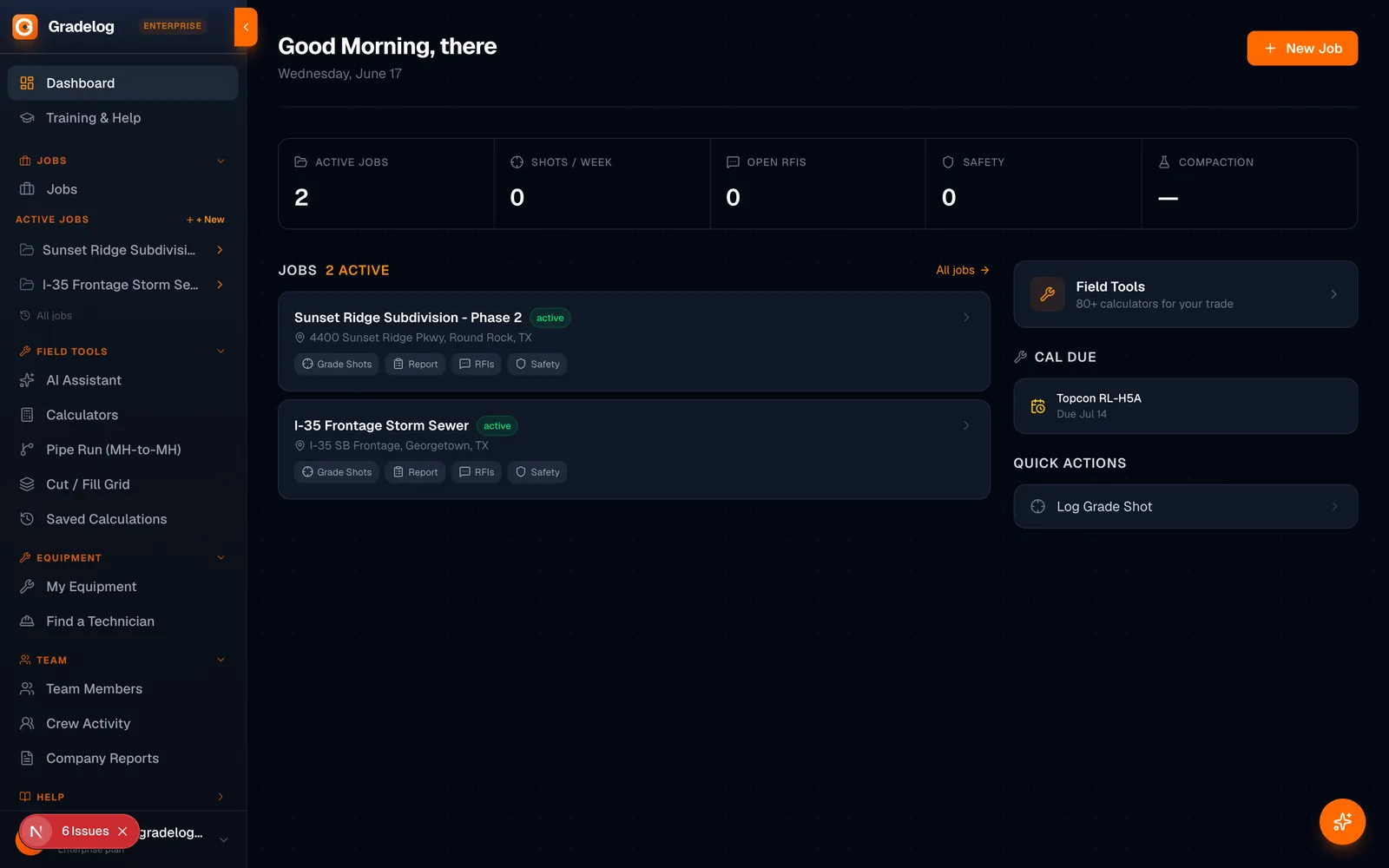 Built by the same team as Express Tools Try Free →14 days Free trial 8 languages Supported iPhone + Android Works on |