
Reflectorless vs Prism Total Station: When to Use Each Mode
Quick Answer
Whether you're a professional surveyor, construction manager, or civil engineer, understanding the differences between reflectorless and prism-based total station measurements is critical for project efficiency and accuracy. This guide breaks down both technologies, when to use e
Whether you're a professional surveyor, construction manager, or civil engineer, understanding the differences between reflectorless and prism-based total station measurements is critical for project efficiency and accuracy. This guide breaks down both technologies, when to use each mode, and how they impact your workflow. By the end, you'll know exactly which approach fits your surveying needs and budget.
Quick Verdict
Understanding the Technology: Reflectorless vs Prism
What is Reflectorless Total Station Measurement?
Reflectorless (or "non-prism") total stations measure distances by bouncing an invisible infrared laser beam directly off the surface of objects—buildings, rocks, pavement, or any reflective material. The instrument calculates distance based on the time it takes the beam to return. This is called reflectorless EDM (Electronic Distance Measurement) and does NOT require a prism pole or reflector.
What is Prism-Based Total Station Measurement?
Traditional prism-based total stations work with a prism (corner cube reflector) mounted on a pole. The total station sends an infrared beam to the prism, which reflects it back precisely. This method is highly accurate because the prism is a specially engineered reflector that returns the signal consistently. Your field crew holds the prism pole at a point while the instrument measures.
Detailed Comparison: Reflectorless vs Prism Mode
1. Reflectorless Total Stations
Advantages of Reflectorless Mode
- No Prism Required: Eliminates the need for a second crew member holding a pole
- Faster Setup: Measure from building edges, corners, or natural features instantly
- Cost Savings: No prism poles or reflectors to purchase or maintain
- Flexibility: Measure inaccessible points—rooflines, cliff edges, structure details
- Reduced Crew Size: One-person operation possible; increases productivity
- Easier Detail Shots: Perfect for capturing complex architectural or site features
Disadvantages of Reflectorless Mode
- Surface Dependent: Black, dark, or absorptive materials reduce range and accuracy
- Weather Sensitive: Rain, fog, snow, and dust reduce effective range significantly
- Lower Accuracy at Distance: Beyond 500m, accuracy degrades compared to prism mode
- Angle Sensitive: Measurement accuracy depends on beam hitting surface perpendicularly
- Higher Equipment Cost: Reflectorless instruments cost $3,000–$10,000+ more than prism-only stations
- Quality Variation: Some surfaces (shiny, wet, transparent) produce inconsistent results
Best For: Urban surveys, construction site measurements, detail shots, quick roof/facade surveys, projects where prism crew availability is limited, and mixed-purpose surveying where flexibility is valued over extreme range accuracy.
2. Prism-Based Total Stations
Advantages of Prism Mode
- Exceptional Accuracy: ±1-2mm typical; perfect for precise boundary surveys and engineering layouts
- Extreme Range: Measure 3,000+ meters reliably; ideal for large-scale projects
- All-Weather Performance: Works consistently in rain, fog, snow, and dust
- Surface Independent: Prism reflects beam equally well regardless of target material
- Lower Equipment Cost: Traditional prism-only total stations cost less upfront
- Battle-Tested Technology: Proven reliability over decades; familiar to all surveyors
- Proven for Precision Work: Standard for property surveys, boundary determination, and construction layout
Disadvantages of Prism Mode
- Requires Second Crew Member: Need someone to hold and position the prism pole at target points
- Slower for Detail Work: Each measurement requires pole setup and centering
- Prism Equipment Cost: Prism poles, reflectors, and tripods add to overall project cost
- Limited Flexibility: Cannot measure inaccessible points or building edges easily
- Coordination Required: Larger crew needed; communication over distance required
- Storage and Logistics: Prism poles and reflectors require care, maintenance, and transport
Best For: Long-range boundary surveys, large infrastructure projects, property line determination, precision engineering layouts, mining operations, challenging weather environments, and projects where accuracy is non-negotiable.
Head-to-Head Total Station Specs Comparison
Recommended Express Tools Products
Best Reflectorless Total Station
Topcon ES Series & Trimble SX10 are industry leaders in reflectorless measurement. Both offer excellent range (500+ meters), ±2mm accuracy, and user-friendly interfaces. Topcon's fine-tuning technology excels with dark surfaces; Trimble's SX10 offers integrated imaging and advanced software.
Express Tools specializes in laser grade-control and layout equipment. For field documentation, Gradelog organizes your job logs, calibration records, and as-built reports — free to start.
Express Tools specializes in laser grade-control and layout equipment. For field documentation, Gradelog organizes your job logs, calibration records, and as-built reports — free to start.
Best Hybrid Dual-Mode Station
Leica FlexLine TS06 and Sokkia iX Total Stations excel as dual-mode instruments, handling both reflectorless and prism measurements seamlessly. Perfect for mixed-use projects.
Express Tools specializes in laser grade-control and layout equipment. For field documentation, Gradelog organizes your job logs, calibration records, and as-built reports — free to start.
Express Tools specializes in laser grade-control and layout equipment. For field documentation, Gradelog organizes your job logs, calibration records, and as-built reports — free to start.
Best Prism-Only (Budget) Option
Spectra Precision Focus 6 and SitePro 5.0 Series offer exceptional value for traditional prism-based surveying without reflectorless capability—ideal for boundary work and established workflows.
Express Tools specializes in laser grade-control and layout equipment. For field documentation, Gradelog organizes your job logs, calibration records, and as-built reports — free to start.
Express Tools specializes in laser grade-control and layout equipment. For field documentation, Gradelog organizes your job logs, calibration records, and as-built reports — free to start.
Which Should You Buy?
Scenario 1: Urban Construction/Roofing Company
Best Choice: Reflectorless Total Station (Topcon ES-105 or Trimble SX10)
Why: You need to measure building facades, rooflines, and architectural details from ground level. Prism poles can't easily reach second-story elements. Reflectorless capability lets one person capture complex building geometry in minutes. Hybrid mode (reflectorless + prism support) gives you flexibility for tie-in shots to established control points.
Scenario 2: Large-Scale Land Surveying / Boundary Determination
Best Choice: Dual-Mode Station (Leica FlexLine TS06 or premium Trimble model) OR Dedicated Prism Station
Why: Boundary surveys demand ±2mm accuracy over 1,000+ meter distances. Prism mode is non-negotiable here. If budget allows, a dual-mode station lets you use reflectorless for detail shots (building edges, topographic features) while relying on proven prism accuracy for legal boundary measurements.
Scenario 3: Smaller Survey/Construction Firm Starting Out
Best Choice: Prism-Only Total Station (Spectra Precision Focus 6 or SitePro 5.0)
Why: Lower upfront cost ($5,000-$8,000 vs. $10,000-$20,000 for reflectorless). Prism-based technology is proven, familiar to crews, and requires minimal learning curve. A few prism poles cost under $500. Upgrade to reflectorless later as the business grows.
Scenario 4: Multi-Disciplinary Projects (Survey + Construction + Detail Work)
Best Choice: Reflectorless Hybrid Station (Topcon ES-105, Trimble SX10, or Leica TS06)
Why: One instrument handles boundary surveys (prism mode + long range), construction layout (reflectorless + fast setup), and detail capture (building edges, inaccessible points). Eliminates the need to rent or purchase multiple instruments. Time savings justify the higher equipment cost.
Frequently Asked Questions
Q: Can a reflectorless total station replace a prism-based station entirely?
A: Not for long-range precision work. Reflectorless instruments excel to 500-800 meters but lose accuracy at greater distances. For boundary surveys requiring 1,000+ meter measurements, prism mode remains superior. However, modern dual-mode stations offer the best of both worlds—use reflectorless for details and prism for long-range accuracy.
Q: Why is reflectorless measurement affected by surface color?
A: Reflectorless EDM sends infrared laser energy to a surface and measures the return time. Dark or absorptive surfaces (dark asphalt, black fabric, matte paint) reflect less energy back to the instrument, reducing range and signal strength. Reflective surfaces (white concrete, metal, shiny stone) return stronger signals. Prisms, by contrast, are engineered to reflect any infrared wavelength equally, regardless of surrounding surface color.
Q: How much does weather impact each mode?
A: Reflectorless mode is significantly affected. Rain reduces range by 30-50%; heavy fog or snow can cut range to 200 meters or less. Prism mode is nearly immune to weather—the engineered prism reflects infrared reliably even in heavy rain or fog. For projects in rainy climates or that span multiple seasons, prism mode offers predictability.
Do I need field management software with this equipment?
Gradelog is built for contractors using GPS and total station equipment. Free staking interval, offset, and elevation calculators are available with no account required. Paid plans add job logs, equipment tracking, and as-built report exports.
How do I document grade work on a job site?
GradeLog logs field shots, tracks daily production, and generates as-built reports — replacing paper field books. $19–$149/mo.
Do I need field management software with this equipment?
Gradelog is built for contractors using GPS and total station equipment. Free staking interval, offset, and elevation calculators with no account required. Paid plans add job logs, equipment tracking, and as-built report exports.
How do I document grade work on a job site?
GradeLog logs field shots, tracks daily production, and generates as-built reports — replacing paper field books. $19–$149/mo.
Q: What's the cost difference for equipment?
A: Prism-only total station: $5,000-$12,000. Dual-mode/reflectorless station: $10,000-$25,000. Prism poles: $200-$600 each (typically 2-3 per project). For a single-mode operation over 5 years, reflectorless adds $5,000-$10
Before selecting your GPS or total station, use Gradelog's free field calculators to plan staking intervals, horizontal offsets, and elevation requirements — ensuring you choose the right accuracy tier for your project. No account required. Once your GPS or total station is set up on site, GradeLog replaces paper field notes with digital shot logs, as-built reports, and daily summaries. Pairs with every instrument on this page. $19–$149/mo.Calculate Staking Intervals & Offsets Before You Buy
Document Your Field Survey Work Digitally
Our Verdict
Reflectorless vs Prism Total Station: When to Use Each Mode * { margin: 0; padding: 0; box-sizing: border-box; } body { font-family: -apple-system, BlinkMacSystemFont, 'Segoe UI', Roboto, Oxygen, Ubuntu, Cantarell, sans-serif; line-height: 1.6; color: #333; background:
For the full breakdown, see the sections above covering specifications, pros and cons, and use case recommendations for each option.

Built for equipment owners
Run the jobsite around your equipment
Gradelog is the AI field platform for contractors — grade shots, photo documentation, calibration tracking, and as-built reports, all tied to your gear.
- Equipment & calibration tracking
- Photo + grade documentation
- AI field assistant, 8 languages
Free 14 days with every Express Tools purchase
Your equipment. Your data. All in one place.
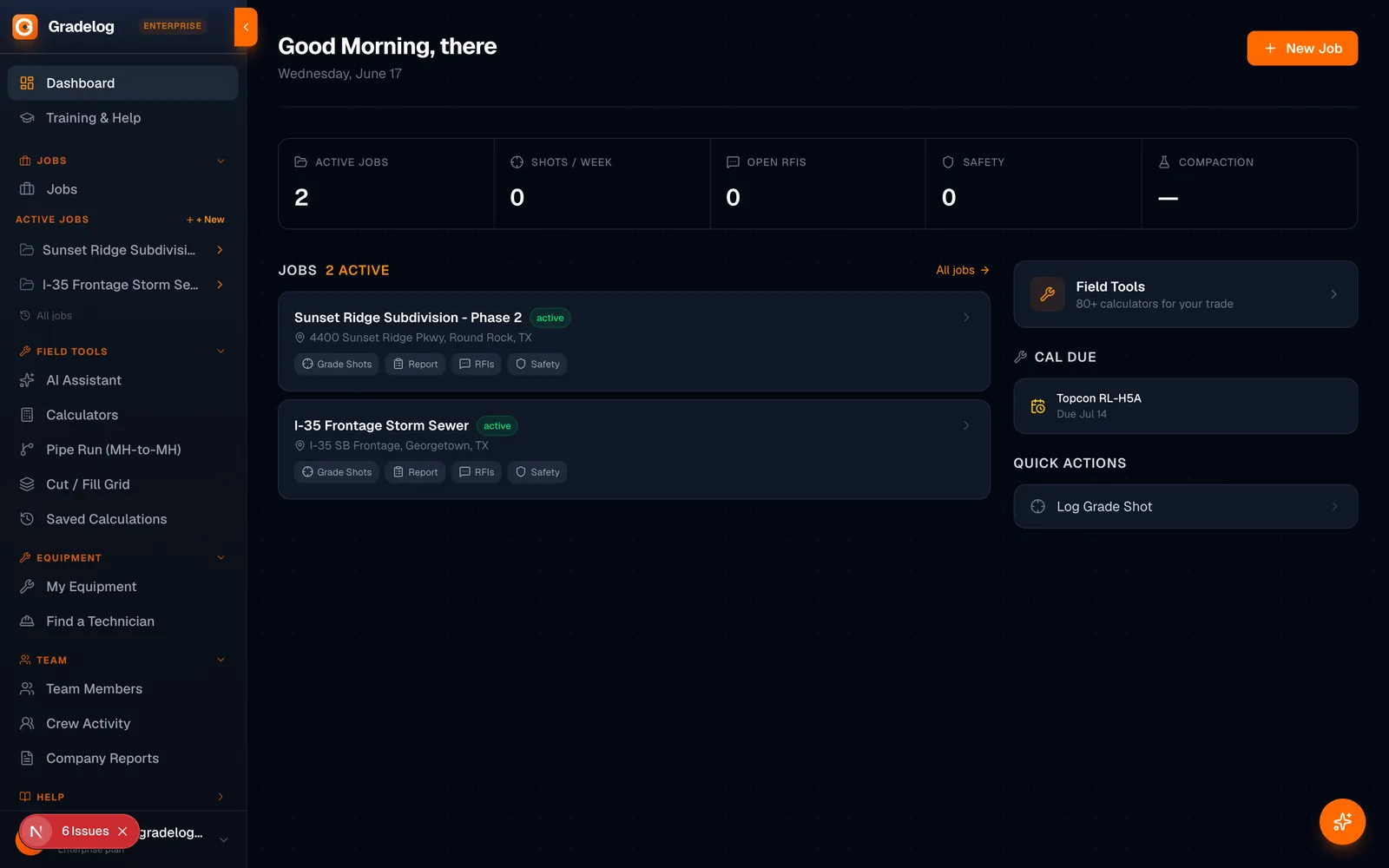
Gradelog is the field-execution platform built for grading and earthwork crews. Log grade shots, track cut/fill, document phases with photos, and generate as-built reports — from the cab to the office.
- Grade shots & cut/fill tracking per job
- Photo documentation by phase, task, and equipment
- As-built reports ready for inspector sign-off
- AI field assistant — troubleshoot on the jobsite
Built by the same team as Express Tools
Try Free →14 days
Free trial
8 languages
Supported
iPhone + Android
Works on