
Robotic vs Manual Total Station: Which is Right for Your Crew?
Quick Answer
Whether you're managing a surveying team, running a construction site, or handling precision measurements for civil engineering projects, the choice between a robotic and manual total station can significantly impact your productivity and accuracy. This comprehensive guide breaks
Whether you're managing a surveying team, running a construction site, or handling precision measurements for civil engineering projects, the choice between a robotic and manual total station can significantly impact your productivity and accuracy. This comprehensive guide breaks down the key differences between these two technologies, helping you make an informed decision based on your project requirements, budget, and crew expertise. We'll examine real-world applications, cost considerations, and performance metrics to help you select the right instrument for your operation.
Manual Total Stations Explained
Specifications
✓ Pros
- Lower initial investment – Entry-level models start under $8,000
- Less complex operation – Traditional workflows familiar to experienced crews
- Minimal software learning curve – Established interfaces and controls
- Reliable for simple projects – Excellent for small to medium surveys
- Lower training costs – Surveyors typically already know manual instruments
- Excellent build quality – Brands like Leica and Sokkia offer rugged, durable instruments
- Straightforward maintenance – Fewer electronic components means easier repairs
✗ Cons
- Lower productivity on large projects – Requires constant operator positioning
- One person per instrument – Increases labor costs on complex surveys
- Manual data entry prone to errors – Potential for transcription mistakes
- Limited real-time data processing – Slower feedback on measurements
- Cannot work unattended – Requires continuous human operation
- Less integration with modern software – May need manual data conversion
Robotic Total Stations Explained
Specifications
✓ Pros
- Superior accuracy – Automated targeting reduces human error in angle measurements
- One operator multiple stations – A single surveyor can manage several instruments simultaneously
- Unattended measurement capability – Can operate remotely or with minimal oversight
- Faster project completion – Automation speeds up data collection on large surveys
- Integrated data management – Seamless transfer to CAD and surveying software
- Real-time error detection – Immediate feedback on measurement quality
- Better ROI on large projects – Labor cost savings offset higher equipment cost
- Advanced features – Tilt compensation, intelligent searching, automated setup
✗ Cons
- Higher initial cost – Entry-level robotic stations start around $25,000+
- Steeper learning curve – Requires training on robotics and software platforms
- More complex troubleshooting – Electronic and motor components require specialized service
- Dependent on battery power – Extended projects may require backup power
- Environmental sensitivity – Extreme temperatures can affect electronic performance
- Higher maintenance costs – More moving parts mean more potential for repairs
- Overkill for simple jobs – Unnecessary complexity for small surveys
Head-to-Head Specifications Comparison
Which Should You Buy?
📊 Small Survey Firm
Choose Manual Total Station
If your firm handles 5-10 small to medium projects annually with experienced surveyors, a quality manual station like a Sokkia or Leica offers excellent value. You'll leverage existing expertise and avoid unnecessary technology investment.
🏗️ Active Construction Company
Choose Robotic Total Station
For staking, layout, and machine guidance on ongoing construction sites, a Topcon or Trimble robotic station justifies its cost through labor savings, faster execution, and integration with modern construction software. ROI materializes within 1-2 years on active operations.
🔧 Budget-Conscious Operation
Consider Manual Total Station + Upgrade Plan
Start with a quality manual station to build your team's expertise and cash flow. Plan to invest in robotic equipment as your project volume grows and revenue increases. This phased approach reduces financial risk while maintaining operational capability.
🌍 Large-Scale Infrastructure Projects
Choose Robotic Total Station
For highway construction, utility mapping, or mining operations requiring tens of thousands of survey shots, robotic stations deliver unmatched efficiency. The higher equipment cost is negligible against the total project budget and labor savings.
Key Differences to Understand
Accuracy and Precision
While both technologies deliver professional-grade accuracy, robotic total stations typically achieve tighter tolerances (±1" to ±3") compared to manual instruments (±2" to ±5"). For most surveying applications, both are more than adequate. The real difference lies in consistency – robotic instruments eliminate human error in targeting, ensuring every measurement meets specifications without variation based on operator skill.
Productivity and Labor Costs
A robotic total station allows one surveyor to manage multiple instruments or conduct unattended measurements. On a large project requiring 1,000+ shot stations, this capability can reduce your crew from 4 people to 2, offsetting the higher equipment cost. For small surveys (100-300 shots), manual stations remain more cost-effective overall.
Software and Data Integration
Modern robotic stations integrate seamlessly with cloud-based surveying software, CAD platforms, and construction management systems. Manual instruments still require manual data entry or third-party software bridges. If your workflow depends on real-time data sync and automated reporting, robotic is the clear winner.
Training and Operator Requirements
Any experienced surveyor can pick up a manual total station within a few hours. Robotic systems require dedicated training (typically 2-3 days) and ongoing familiarity with software interfaces. Factor in training costs when budgeting for robotic equipment.
Reliability in the Field
Manual total stations are simpler mechanically, making them more forgiving in harsh environments (extreme heat, dust, heavy vibration). Robotic instruments' motors and electronics can be sensitive to environmental stress, though modern sealed designs have improved durability significantly.
Recommended Brands at Express Tools
For Manual Total Stations
- Sokkia – Legendary durability and affordability; excellent for surveyors prioritizing reliability
- Leica – Premium build quality; precision instruments for demanding projects
- Spectra Precision – Strong mid-range option; good balance of features and cost
- SitePro – Value-oriented; perfect for budget-conscious teams
For Robotic Total Stations
- Topcon – Industry leader in automation; excellent robotics and construction software integration
- Trimble – Premium robotic solutions; best-in-class accuracy and connectivity features
- Spectra Precision – Solid robotic offerings; good mid-range automation capabilities
Frequently Asked Questions
Calculate Staking Intervals & Offsets Before You Buy
Before selecting your GPS or total station, use Gradelog's free field calculators to plan staking intervals, horizontal offsets, and elevation requirements — ensuring you choose the right accuracy tier for your project. No account required.
Use Free Staking & Survey Calculators at Gradelog →Document Your Field Survey Work Digitally
Once your GPS or total station is set up on site, GradeLog replaces paper field notes with digital shot logs, as-built reports, and daily summaries. Pairs with every instrument on this page. $19–$149/mo.
Try GradeLog →Our Verdict
Robotic vs Manual Total Station: Which is Right for Your Crew? * { margin: 0; padding: 0; box-sizing: border-box; } body { font-family: -apple-system, BlinkMacSystemFont, 'Segoe UI', Roboto, Oxygen, Ubuntu, Cantarell, sans-serif; line-height: 1.6; color: #333; }
For the full breakdown, see the sections above covering specifications, pros and cons, and use case recommendations for each option.

Built for equipment owners
Run the jobsite around your equipment
Gradelog is the AI field platform for contractors — grade shots, photo documentation, calibration tracking, and as-built reports, all tied to your gear.
- Equipment & calibration tracking
- Photo + grade documentation
- AI field assistant, 8 languages
Free 14 days with every Express Tools purchase
Your equipment. Your data. All in one place.
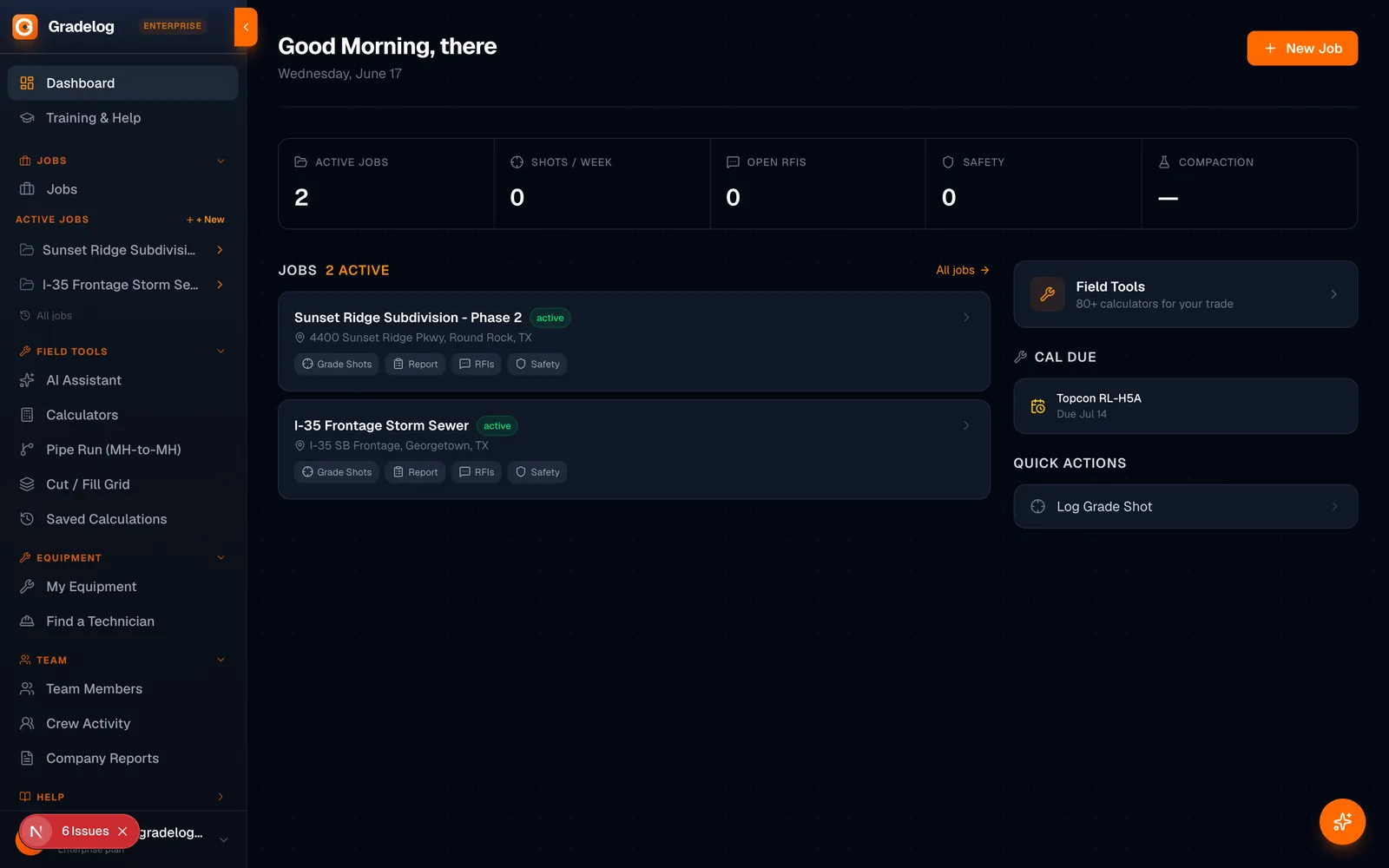
Gradelog is the field-execution platform built for grading and earthwork crews. Log grade shots, track cut/fill, document phases with photos, and generate as-built reports — from the cab to the office.
- Grade shots & cut/fill tracking per job
- Photo documentation by phase, task, and equipment
- As-built reports ready for inspector sign-off
- AI field assistant — troubleshoot on the jobsite
Built by the same team as Express Tools
Try Free →14 days
Free trial
8 languages
Supported
iPhone + Android
Works on