
Single Slope vs Dual Slope Grade Laser: Which Do You Need?
Quick Answer
If you're in construction, road building, or site development, grade lasers are essential for achieving proper drainage slopes and accurate elevation work. But which type should you invest in? This comprehensive guide compares single slope and dual slope grade lasers, helping gen
If you're in construction, road building, or site development, grade lasers are essential for achieving proper drainage slopes and accurate elevation work. But which type should you invest in? This comprehensive guide compares single slope and dual slope grade lasers, helping general contractors, excavation crews, and grading specialists make the right choice for their projects and budget. You'll learn the key differences, when each excels, and which brands deliver the best value.
Quick Verdict
Single Slope Grade Laser: The Basics
What Is a Single Slope Grade Laser?
A single slope grade laser projects a horizontal or sloped plane in one direction only. It's designed to establish and maintain a consistent grade (slope) for applications like foundation work, parking lot grading, and drainage slopes. The laser creates a reference line that your crew follows with a receiver rod.
Key Specifications
✓ Pros
- Lower initial cost
- Simple setup and operation
- Less training required
- Reliable for standard grading
- Excellent battery life
- Durable, fewer moving parts
- Perfect for linear applications
✗ Cons
- Only one slope direction
- Limited to linear/straightforward work
- Can't handle complex grading simultaneously
- Requires repositioning for changes
- Not ideal for curved roadways
- Shorter working range than dual slope
Recommended Single Slope Models
Spectra Precision DG412: Industry workhorse with proven durability. Simple controls, excellent battery life, accurate to ±1/8" at 100 feet. Popular with contractors nationwide.
Sokkia SDL30: Lightweight and compact. Perfect for crews that move between job sites. Fast setup, reliable performance on modest-sized projects.
Topcon DL-511: Premium single slope option with advanced tilt sensors. Wireless remote capability on some models. Higher accuracy (±1/16").
Dual Slope Grade Laser: The Advanced Option
What Is a Dual Slope Grade Laser?
A dual slope grade laser projects two independent planes simultaneously—one in each direction. This allows you to establish both cross-slope and longitudinal slope at the same time, making it ideal for complex grading projects like roadways, parking lots with drainage requirements, and site development work. Your receiver can follow both slopes concurrently.
Key Specifications
✓ Pros
- Two slopes simultaneously
- Handles complex grading efficiently
- Longer working range (100-300 ft)
- Covers larger areas per setup
- Better for highway/road work
- More flexible slope adjustments
- Reduces repositioning time
- Wireless remote options available
✗ Cons
- Higher upfront cost (2-3x single)
- More complex operation
- Requires more training
- Overkill for simple projects
- More components to maintain
- Slightly heavier unit
- Battery drain faster with extended range
Recommended Dual Slope Models
Spectra Precision DG613: The industry standard. Dual slope capability, excellent range, proven reliability. Used on major highway and site development projects. ±1/8" accuracy. Widely available, strong support network.
Topcon DL-502: Premium grade laser with wireless remote control. Extended range (300+ feet), dual slope mastery, advanced tilt sensors. Perfect for large projects and professional crews needing efficiency.
Leica Sprinter: Advanced laser system with digital integration options. Dual slope, excellent accuracy, robust construction. Premium option for high-precision work.
Head-to-Head Specification Comparison
Which Should You Buy?
Scenario 1: General Contractor / Small to Mid-Size Projects
Recommendation: Single Slope Grade Laser (e.g., Spectra Precision DG412)
If you handle foundations, parking lots, modest drainage work, and site prep with straightforward slopes, a single slope laser delivers everything you need. The $2,500-$4,000 investment is reasonable, setup is fast, and your crew can be productive immediately with minimal training. Save money, get the job done right.
Scenario 2: Road/Highway Construction Company
Recommendation: Dual Slope Grade Laser (e.g., Spectra Precision DG613 or Topcon DL-502)
Complex grading with crown slopes and cross-slopes is your daily work. A dual slope laser covers larger areas faster, reduces repositioning, and handles simultaneous longitudinal and cross-slope requirements. The $8,000-$12,000 investment pays for itself in efficiency on your first major project. Non-negotiable for highway work.
Scenario 3: Budget-Conscious Crew with Diverse Work
Recommendation: Start with Single Slope, Upgrade Later
Buy a quality single slope laser now ($2,500-$3,500). Master it, use it on dozens of jobs, and generate cash flow. In 18-24 months when you have consistent dual-slope work, upgrade to a dual slope model. You'll have two lasers for backup, and both will stay busy. Smart financial progression.
Scenario 4: Full-Service Site Development / Large Projects
Recommendation: Invest in Both
If you're consistently bidding large, complex projects, own both a single slope and dual slope laser. Use single slope for simple linear work (foundations, utility trenches, basic grading). Deploy dual slope for complex site development. Redundancy means project continuity if one needs service. The $8,000-$10,000 total investment is minor compared to project value.
Frequently Asked Questions
Can I use a single slope laser on a curved roadway?
Technically yes, but inefficiently. You'd need to reposition frequently as the roadway curves. A dual slope laser or total station (like Topcon, Trimble, or Leica models) is better suited for curved work, as it can be set up once and cover the entire curve more effectively.
What's the difference between accuracy on single vs. dual slope?
Accuracy (±1/8" to ±1/4" at 100 feet) is essentially the same between single and dual slope models from major manufacturers. The advantage of dual slope isn't accuracy—it's capability. Both can meet standard construction tolerances. The difference is in how many directions you can grade simultaneously.
Do I really need a wireless remote?
It depends on your workflow. For large site coverage or if your operator is far from the laser, a wireless remote (available on premium dual slope models like Topcon DL-502) speeds up slope adjustments. For standard single-slope work or when your operator stays nearby, it's less critical. Nice to have, not essential.
How often do grade lasers need calibration?
Annual calibration is standard best practice, especially if you use the laser 200+ hours per year. Most manufacturers (Spectra Precision, Topcon, Sokkia, Leica) offer calibration services. Well-maintained lasers stay accurate for 5-10 years. Avoid drops and extreme temperature swings to extend service life.
Can I use a GPS/RTK system instead of a grade laser?
Not really—they serve different purposes. RTK GPS (from Trimble, Topcon, Leica) is excellent for large-scale site surveying and elevation data. But grade lasers are superior for real-time, continuous slope guidance during active grading and excavation. Many crews use both: GPS for stakeout and planning, lasers for execution.
What's the typical range difference, and does it matter?
Single slope: 50-150 feet. Dual slope: 100-300+ feet. For a small parking lot (under 200 feet), range difference doesn't matter much. For highway work or large sites, the extended range of dual slope means fewer setups, faster progress, and lower labor cost. If you're working on large projects regularly, range matters.
Do I need field management software with this equipment?
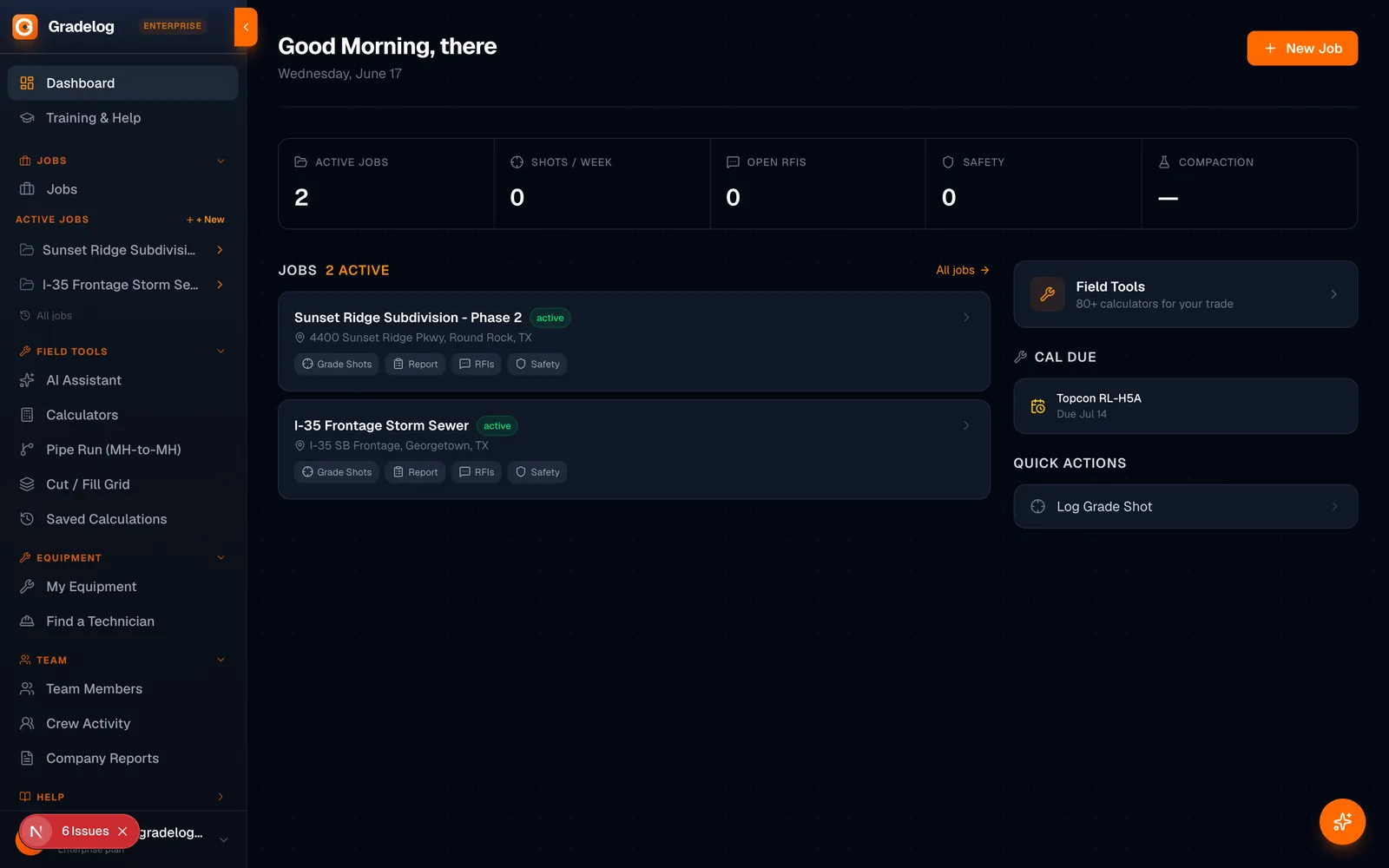
Gradelog is an AI field assistant designed for contractors using precision grade equipment. Free calculators for grade percentage, cut/fill, elevation, and slope are available with no account required. Paid plans add job logs, equipment tracking, and as-built exports.
How do I document grade work on a job site?
GradeLog replaces paper grade logs with digital field records — shot logs, daily reports, as-built generation. $19–$149/mo.
Shop Grade Lasers at Express Tools
Ready to upgrade your grading capability? Express Tools carries all major brands and models:
Express Tools specializes in laser grade-control and layout equipment. For field documentation, Gradelog organizes your job logs, calibration records, and as-built reports — free to start.
Express Tools specializes in laser grade-control and layout equipment. For field documentation, Gradelog organizes your job logs, calibration records, and as-built reports — free to start.
Express Tools specializes in laser grade-control and layout equipment. For field documentation, Gradelog organizes your job logs, calibration records, and as-built reports — free to start.
Express Tools specializes in laser grade-control and layout equipment. For field documentation, Gradelog organizes your job logs, calibration records, and as-built reports — free to start.
View All Grade LasersCalculate Your Grade Before You Buy
Before selecting between these instruments, use Gradelog's free field calculators to verify your project requirements — grade percentage, cut and fill, elevation, slope, and more. No account required.
Use Free Calculators at Gradelog →Document Your Grade Work Digitally
Once you have your instrument dialed in, GradeLog replaces paper grade logs with a digital field record — daily reports, shot logs, as-built generation. Pairs with every instrument on this page. $19–$149/mo.
Try GradeLog →