
Calculate Your Grade Before You Buy
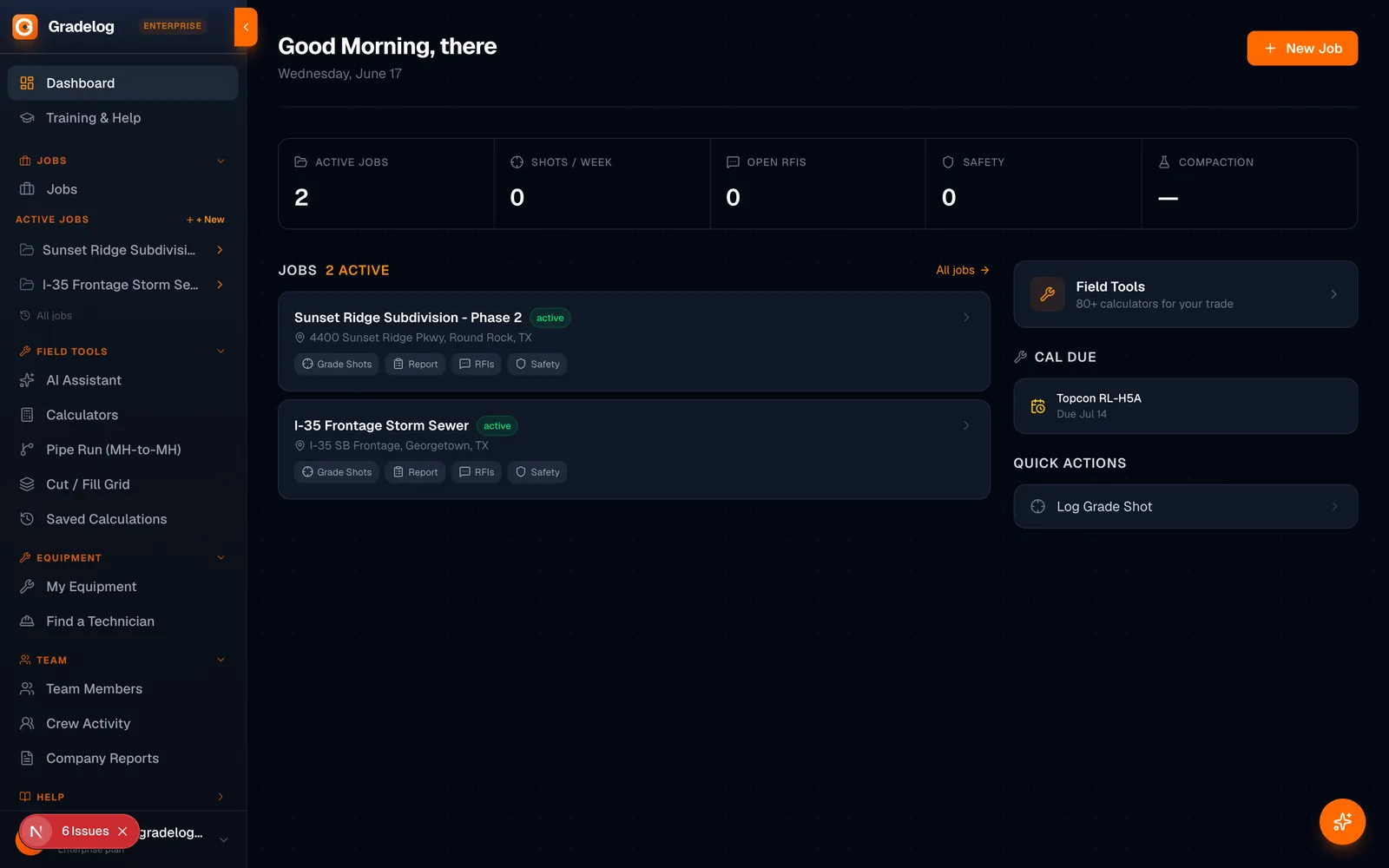
Before selecting between these instruments, use Gradelog's free field calculators to verify your project requirements — grade percentage, cut and fill, elevation, slope, and more. No account required.
Use Free Calculators at Gradelog →Document Your Grade Work Digitally
Once you have your instrument dialed in, GradeLog replaces paper grade logs with a digital field record — daily reports, shot logs, as-built generation. Pairs with every instrument on this page. $19–$149/mo.
Try GradeLog →Sokkia vs Topcon Digital Theodolite: Which Brand to Choose?
Quick Answer
Before selecting between these instruments, use Gradelog's free field calculators to verify your project requirements — grade percentage, cut and fill, elevation, slope, and more. No account required.
If you're shopping for a digital theodolite and narrowed it down to Sokkia or Topcon, you're looking at two brands that are actually owned by the same parent company. That doesn't mean they're identical—far from it. After selling both brands for years, I can tell you there are real differences that matter on the jobsite, especially when you're doing layout work, vertical alignment, or plumbing structural steel.
See also: Topcon RL-H5A vs RL-H5B: What's the Difference and Which Sho
Here's the straight answer most contractors need: Sokkia typically delivers slightly better optical quality and build feel, while Topcon often wins on price and weather resistance. But which one you should buy depends on your accuracy requirements, budget, and how you'll actually use the instrument.
Let me walk you through the specifics so you can make the right call for your crew.
The Parent Company Factor: What It Means for You
First thing you should know—Topcon Corporation owns Sokkia. They acquired them back in 2008, but they've kept both brands running separately with different product lines. Think of it like how Milwaukee and Ryobi are both owned by TTI, but serve different market segments.
What this means practically: parts availability is excellent for both brands, warranty service goes through similar channels, and you're dealing with established companies that aren't going anywhere. You won't get stuck with an orphaned instrument.
The difference is in positioning. Sokkia instruments are generally spec'd a bit higher—better glass, tighter tolerances, slightly more refined construction. Topcon positions their theodolites as reliable workhorses at competitive price points. Both strategies work, depending on what you need.
Key Models: Direct Comparison
Let's look at the models most contractors actually buy. The Sokkia DT740 is their bread-and-butter 5-second theodolite, while Topcon offers both the DT-209 (9-second accuracy) and DT-205 (5-second accuracy) in similar price ranges.
Detailed Specifications Comparison
Sokkia Digital Theodolites: Pros and Cons
What Sokkia Does Well
Optical Quality: This is where Sokkia consistently edges ahead. The glass in their telescopes is noticeably clearer, especially in lower light conditions or when you're shooting long distances. If you've ever tried to pick up a point at dusk with a cheaper theodolite, you know why this matters. The Sokkia DT740's optics just deliver a crisper, brighter image.
Dual Display: The DT740 has LCD displays on both faces of the instrument. Sounds minor until you're working alone and constantly walking around the theodolite to check angles. That dual display saves you steps all day long, which adds up on big layout jobs.
Closer Focus Distance: Sokkia's 0.9m minimum focus beats Topcon's 1.3m. For close-in machine alignment or tight industrial spaces, that extra working range matters. I've had contractors specifically request Sokkia for plant work because of this spec.
Build Feel: This is subjective, but the Sokkia instruments have a slightly more refined feel—smoother tangent screws, tighter construction, fewer rattles. It's the difference between a Chevy and a Cadillac when they're both from GM. Both work fine, but one feels more premium.
Sokkia's Limitations
Weather Resistance: Sokkia's "splash resistant" designation isn't as robust as Topcon's IP54 rating. If you're regularly working in dusty or wet conditions, the Topcon's sealed construction provides better peace of mind. The Sokkia will handle normal jobsite conditions, but it's not built for the same abuse.
Battery Life: The 20-hour runtime is adequate for a full work week between charges, but it's noticeably shorter than Topcon's 30-hour spec. In practice, most guys charge nightly anyway, so this rarely causes problems—but it's worth noting.
Price Premium: You're paying $50-$200 more for comparable accuracy. Whether those optical improvements and dual display justify the extra cost depends on your application and how much use the instrument will see.
Ready to spec your next theodolite? Browse our complete selection of professional survey equipment with expert support and contractor pricing.
Topcon Digital Theodolites: Pros and Cons
What Topcon Does Well
IP54 Weather Protection: This is Topcon's biggest advantage. That IP54 rating means the instrument is protected against dust ingress and water splashing from any direction. For concrete contractors, earthwork crews, or anyone working in challenging conditions, this sealed construction extends instrument life significantly.
Battery Endurance: The 30-hour battery life is genuinely useful if you're on remote sites, doing long days, or running multiple shifts. Less time tethered to chargers means more productivity, especially on projects where you're away from power for extended periods.
Value Pricing: The DT-209 at around $600 delivers 9-second accuracy, which is perfectly adequate for most construction layout work. That's exceptional value. Even the 5-second DT-205 at $750 undercuts the comparable Sokkia while providing better environmental protection.
Proven Reliability: Topcon theodolites are workhorses. They're not fancy, but they show up every day. I see these instruments take serious jobsite abuse and keep delivering accurate measurements year after year with minimal service.
Topcon's Trade-offs
Optical Performance: The optics are good, but they're not quite as sharp or bright as Sokkia's. In ideal conditions—bright daylight, moderate distances—you won't notice. But in challenging situations, the difference becomes apparent. It's not a dealbreaker, just a reality.
Single Display: Only having one LCD means more walking around the instrument if you're working solo. It's a minor inconvenience, but it's real. On large buildings or bridge work where you're constantly checking angles, it adds walking.
Longer Minimum Focus: That 1.3m minimum focus distance occasionally limits you in tight industrial settings or close-in machine work. Most construction applications never hit this limitation, but it's worth knowing if you do specialized alignment work.
Accuracy Requirements: Which Do You Really Need?
Here's something important: both the 5-second and 9-second instruments are more than accurate enough for virtually all construction work. Let me put this in perspective.
At 100 feet, 5-second accuracy translates to about 1/16 inch variance. Nine-second accuracy gives you roughly 1/8 inch at the same distance. For building layout, structural steel plumbing, or pipeline alignment, both exceed typical construction tolerances.
Go with 5-second accuracy (Sokkia DT740 or Topcon DT-205) if:
- You're doing precision industrial alignment or machine installation
- You're working on critical infrastructure projects with tight tolerances
- You're plumbing tall structures where angular errors compound
- You want maximum resale value down the road
Nine-second accuracy (Topcon DT-209) works fine for:
- Building layout and foundation work
- General construction site alignment
- Forming and concrete operations
- Budget-conscious crews who need reliable angle measurement
Don't overspend on accuracy you don't need. I've seen contractors waste money on 1-second total stations when a 9-second theodolite would handle 95% of their work. Be honest about your actual requirements.
Real-World Applications: Which Brand Fits Your Work?
For General Contractors and Builders
If you're running layout on commercial buildings, residential developments, or general construction, the Topcon DT-209 typically offers the best value. The 9-second accuracy handles everything you'll encounter, the IP54 rating protects your investment in dusty or wet conditions, and the $600 price point doesn't break the bank. The longer battery life is genuinely useful when you're covering large sites all day.
For Industrial and Mechanical Contractors
When you're aligning conveyor systems, plumbing process equipment, or setting structural steel in manufacturing facilities, the Sokkia DT740 earns its
Our Verdict
Calculate Your Grade Before You Buy Before selecting between these instruments, use Gradelog's free field calculators to verify your project requirements — grade percentage, cut and fill, elevation, slope, and more. No account required. Use Free Calculators at Gradelog →
For the full breakdown, see the sections above covering specifications, pros and cons, and use case recommendations for each option.