
Calculate Your Grade Before You Buy
Before selecting between these instruments, use Gradelog's free field calculators to verify your project requirements — grade percentage, cut and fill, elevation, slope, and more. No account required.
Use Free Calculators at Gradelog →Document Your Grade Work Digitally
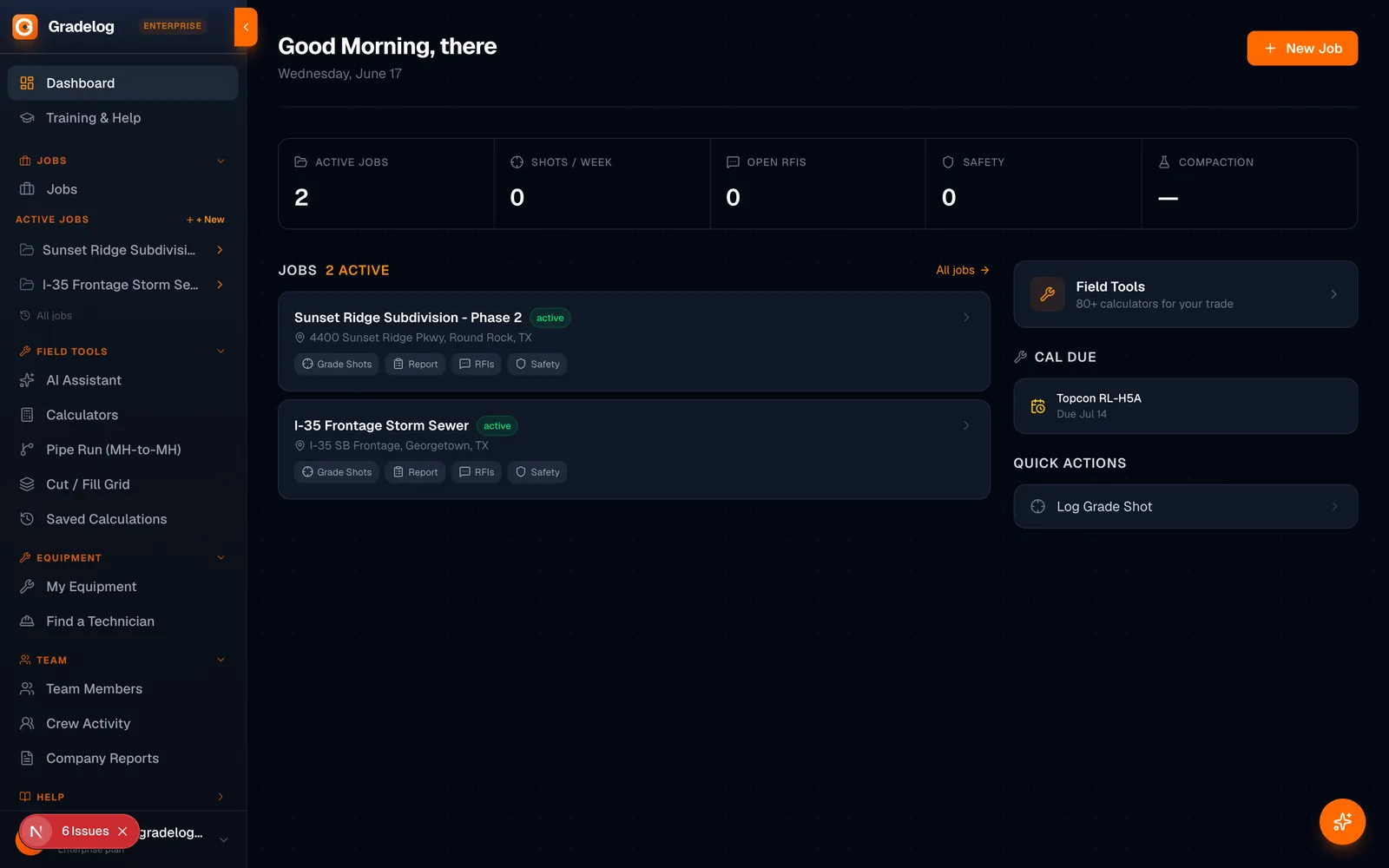
Once you have your instrument dialed in, GradeLog replaces paper grade logs with a digital field record — daily reports, shot logs, as-built generation. Pairs with every instrument on this page. $19–$149/mo.
Try GradeLog →Spectra LL300N vs LL300S: Which Model Is Right for You?
Quick Answer
Before selecting between these instruments, use Gradelog's free field calculators to verify your project requirements — grade percentage, cut and fill, elevation, slope, and more. No account required.
If you're shopping for a Spectra Precision rotating laser level and stuck between the LL300N and LL300S, you're not alone. This is one of the most common questions we field at Express Tools, and for good reason—these models look nearly identical on paper, but that $400 price difference represents one critical feature that either makes or breaks the deal depending on your work.
I'm going to cut through the marketing speak and give you the straight story on both models. We've sold hundreds of these units to contractors across every trade, and I'll share exactly what we tell them when they're trying to decide which one to buy.
The Bottom Line Up Front
The LL300N is a horizontal-only self-leveling rotary laser. The LL300S adds single-axis slope capability from 0-10%. Everything else—accuracy, range, durability, compatibility—is identical. That's it. You're paying roughly $400 more for the ability to set grade on one axis.
For most general contractors doing foundation layout, concrete pours, drop ceiling installation, or basic site work where you need level reference points, the LL300N does the job perfectly. For excavators, paving crews, drainage contractors, or anyone regularly working with designed slopes, the LL300S pays for itself on the first job where you'd otherwise be setting up batter boards or shooting grade with a total station.
Ready to make your choice? Browse our complete selection of rotating laser levels or check out our professional laser equipment to find the perfect tool for your crew.
Complete Specs Comparison
What You're Actually Paying For
Let's be clear about what that extra $400 buys you with the LL300S: single-axis slope matching capability. Not dual-axis—this isn't a pipe laser or a full grade laser. You get one plane that you can tilt up to 10% grade in one direction.
The LL300S has a slope adjustment mechanism that lets you manually set the angle of the rotating laser plane. You match your plans, set the grade using the remote control or built-in controls, and the laser maintains that slope across your entire work area. For drainage work, parking lot paving, foundation footings with designed pitch, or any application where you're working to a consistent slope, this is invaluable.
The LL300N doesn't have this mechanism. It's level, period. If you need slope, you're manually calculating offsets, setting up batter boards, or using a different tool altogether.
LL300N: Pros and Cons
Advantages of the LL300N
- Lower cost: At roughly $1,200, this is about as affordable as professional-grade rotary lasers get
- Simpler operation: Fewer controls mean less training for crew members and less that can go wrong
- Faster setup: Set it down, turn it on, and you're working—no grade adjustments to dial in
- Perfect for most horizontal work: Foundation layout, concrete forms, ceiling grid, deck framing—anything level, this handles beautifully
- Same accuracy and range: You're not sacrificing performance, just capability
- Identical durability: Same IP55 rating, same rugged construction, same 3-year warranty
Limitations of the LL300N
- No slope capability: This is the obvious one—if the job requires grade, you need another solution
- Less versatile: You're adding a tool to your kit, not replacing multiple tools
- Lower resale value: Slope-capable lasers hold value better because they serve more applications
LL300S: Pros and Cons
Advantages of the LL300S
- Single-axis slope capability: Set grades from 0-10% for drainage, paving, footings, and site work
- Replaces multiple tools: One laser handles both level and grade applications
- Eliminates grade calculations: Set the slope once and work from the beam—no offset math in the field
- Increases productivity on grade work: Excavator operators can work directly to the beam rather than waiting for grade checks
- Better long-term value: As your business grows and job types diversify, you've got the capability
- Same core performance: All the accuracy, range, and reliability of the LL300N
Limitations of the LL300S
- Higher initial cost: That $400 premium is real money, especially if you're outfitting multiple crews
- More controls to learn: Slope adjustment adds complexity—not much, but it's there
- Single-axis only: You can't do dual-slope work or compound grades; this isn't a pipe laser replacement
- Slightly heavier: Negligible difference (0.2 lbs), but worth mentioning for completeness
Real-World Applications: Which Model for Which Job?
LL300N Is Perfect For:
- Commercial framing: Layout of wall plates, beam elevations, ceiling heights
- Concrete forming: Setting foundation forms, checking deck elevations, flatwork screeding
- Interior finish: Drop ceiling installation, wainscoting, chair rail, tile work
- Deck building: Establishing post heights, beam levels, railing alignment
- General layout work: Any application where you need a consistent horizontal reference
- Elevation transfers: Moving benchmark elevations around a site
LL300S Excels At:
- Site drainage: Setting swale grades, establishing drainage runs, French drain installation
- Paving operations: Parking lot grading, sidewalk pitch, ADA-compliant slopes
- Foundation work: Sloped footings, drainage around foundations, waterproofing grades
- Landscaping: Retaining wall batters, lawn drainage, irrigation trenching
- Excavation work: Rough grading to design slopes, trench grades, pad preparation
- Agricultural construction: Equipment pad slopes, barn floor drainage, feed lot grading
- Plus everything the LL300N does: It's horizontal when you need it, sloped when you don't
Our Verdict
Calculate Your Grade Before You Buy Before selecting between these instruments, use Gradelog's free field calculators to verify your project requirements — grade percentage, cut and fill, elevation, slope, and more. No account required. Use Free Calculators at Gradelog →
For the full breakdown, see the sections above covering specifications, pros and cons, and use case recommendations for each option.