
Topcon LN-150 vs Trimble RTS Layout Navigator: Which Layout Station Delivers?
Quick Answer
If you're running layout on commercial jobs, you know the drill: accuracy matters, speed matters, and downtime costs money. Both the Topcon LN-150 and Trimble RTS Layout Navigator are purpose-built robotic total stations designed specifically for construction layout. But which on
See also: Topcon RL-H5A vs RL-H5B: What's the Difference and Which Sho
If you're running layout on commercial jobs, you know the drill: accuracy matters, speed matters, and downtime costs money. Both the Topcon LN-150 and Trimble RTS Layout Navigator are purpose-built robotic total stations designed specifically for construction layout. But which one belongs on your next job site?
We're breaking down the specs, real-world performance, and price-to-value ratio so you can make the right call for your crew.
Side-by-Side Specs Comparison
What These Specs Mean on the Job
Accuracy & Range: Trimble Takes the Lead
The Trimble RTS773 delivers 3" angular accuracy versus the LN-150's 5" spec. In layout work, that difference shows up when you're setting anchor bolts, elevator rails, or any tolerance-critical work. If you're doing tilt-up panels or structural steel, that extra precision matters.
Trimble also extends your working range—800m with a prism and 500m reflectorless. The Topcon tops out at 600m and 300m respectively. On large sites or when you can't relocate your setup point easily, Trimble gives you more flexibility.
Tracking Speed: Topcon's Advantage
The LN-150 tracks at 20 Hz versus Trimble's 15 Hz. That's 20 measurements per second compared to 15. If you're doing as-built verification or running single-operator workflows where the robotic function gets heavy use, Topcon's faster tracking means less waiting around.
Battery Life & Field Endurance
Trimble edges out Topcon with 10 hours of continuous operation versus 8 hours. Two extra hours might not sound like much, but it's the difference between swapping batteries mid-afternoon or running a full shift. Both units handle temperature extremes equally well and carry the same IP66 dust and water resistance rating.
Software Ecosystem
Topcon's MAGNET Field Layout software is contractor-focused and integrates smoothly with most common BIM and CAD formats. The interface is straightforward—your crew won't need a surveying degree to run layout.
Trimble Field Link offers similar functionality with tight integration into the broader Trimble ecosystem. If you're already running Trimble GPS or other positioning gear, the RTS meshes seamlessly. The TSC5 controller is rugged and field-proven, though you'll pay extra for it if it's not included in your package.
Price-to-Performance Reality Check
The Topcon LN-150 typically runs $28,000-$32,000 configured for layout work. The Trimble RTS773 starts around $35,000 and can push past $40,000 depending on controller and software options.
That $7,000-$10,000 difference is real money. You're paying for Trimble's tighter tolerances, longer range, and brand reputation. If your work demands survey-grade precision or you're frequently working large sites, it's justified. If you're running standard commercial layout—walls, columns, MEP—the Topcon delivers professional results at a lower entry point.
The Verdict: Which One Should You Buy?
Choose the Topcon LN-150 if: You need a reliable layout station for commercial construction where 5" accuracy meets project specs, you want faster robotic tracking for single-operator efficiency, and you're budget-conscious without sacrificing quality. It's the value pick that still delivers professional-grade performance.
Choose the Trimble RTS773 if: Your work demands tighter tolerances (structural steel, precast, precision anchor bolts), you need extended range on large sites, you're already invested in the Trimble ecosystem, or you want maximum battery life and the confidence of the industry's leading brand. You'll pay more, but you're getting measurable performance advantages.
Both are legitimate professional tools. The Topcon LN-150 hits the sweet spot for most contractors doing layout. The Trimble RTS is the premium option when tolerances tighten and budgets allow.
Frequently Asked Questions
Can I use third-party prisms with both systems?
Yes. Both the Topcon LN-150 and Trimble RTS work with standard survey prisms. You don't need proprietary prisms for basic layout work, though each manufacturer's robotic prisms offer optimized performance for their respective systems. For best tracking results in robotic mode, stick with the manufacturer's 360-degree prisms.
What's the learning curve for operators without surveying experience?
Most construction professionals get productive within 1-2 days with either system. The Topcon MAGNET Field Layout interface is slightly more intuitive for first-time users, but Trimble Field Link isn't far behind. Budget time for training either way—these aren't plug-and-play tools, but they're not rocket science either. Both companies offer training programs, and YouTube has plenty of real-world tutorials.
How do these compare to Leica's layout systems?
Leica's iCON robotic total stations compete in the same space with comparable accuracy and pricing closer to Trimble. Topcon generally offers better value, Trimble has the broadest ecosystem, and Leica sits in the middle with excellent optics. All three are professional-grade—choose based on dealer support in your area and what equipment your crew already knows.
Do I need a dedicated data collector or can I use a tablet?
Both systems support Android devices running their respective field software. A consumer-grade tablet will work in a pinch, but dedicated controllers like Topcon's Tesla or Trimble's TSC5 are purpose-built for job sites—brighter screens, better battery life, and they survive drops that would kill an iPad. If you're running layout daily, spend the extra money on a proper controller. If you're occasional-use, a rugged tablet case might get you by.
Calculate Your Grade Before You Buy
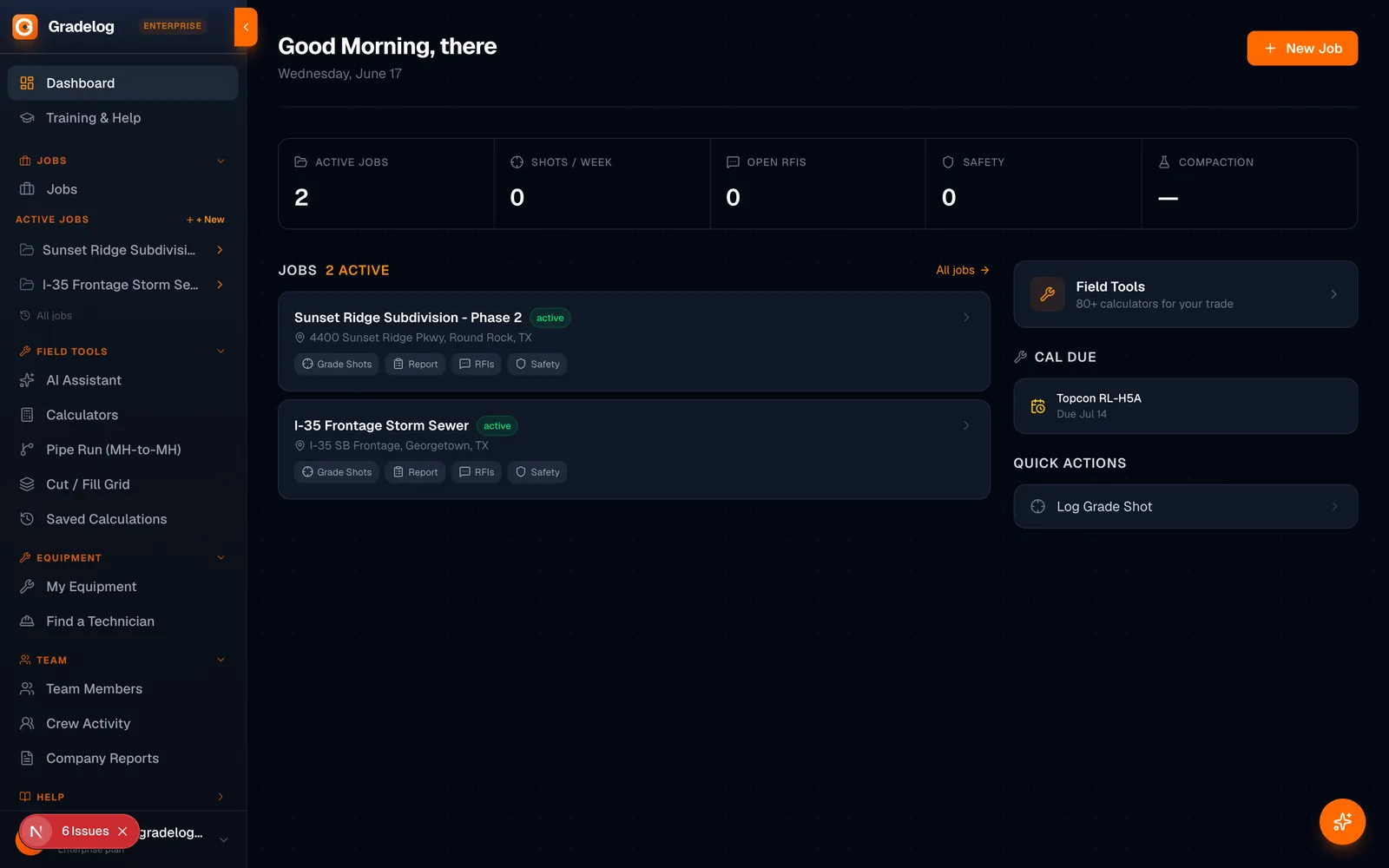
Before selecting between these instruments, use Gradelog's free field calculators to verify your project requirements — grade percentage, cut and fill, elevation, slope, and more. No account required.
Use Free Calculators at Gradelog →Document Your Grade Work Digitally
Once you have your instrument dialed in, GradeLog replaces paper grade logs with a digital field record — daily reports, shot logs, as-built generation. Pairs with every instrument on this page. $19–$149/mo.
Try GradeLog →