
Topcon TP-L5G vs TP-L6B Pipe Laser: Choosing the Right Model for Your Crew
Quick Answer
Both the Topcon TP-L5G and TP-L6B represent professional-grade pipe lasers designed for gravity-flow sewer and drainage installation. Understanding which model fits your project requirements and budget determines whether you're maximizing productivity or overspending on features
See also: Topcon RL-H5A vs RL-H5B: What's the Difference and Which Sho
Both the Topcon TP-L5G and TP-L6B represent professional-grade pipe lasers designed for gravity-flow sewer and drainage installation. Understanding which model fits your project requirements and budget determines whether you're maximizing productivity or overspending on features you won't use. This comparison breaks down the technical differences, field performance characteristics, and value proposition of each unit.
Quick Overview: Key Differences at a Glance
The TP-L5G (Green Beam) and TP-L6B (Red Beam) share the same rugged housing and control interface but diverge significantly in laser technology, working range, and price point. The TP-L5G's green diode delivers approximately 4x the visibility of the TP-L6B's red beam in identical conditions—critical when working long runs or in bright ambient light. The TP-L6B counters with a lower acquisition cost and simpler maintenance profile for crews running primarily 8-inch to 24-inch pipe on standard municipal projects.
Beam Visibility: Where the Green Beam Wins
The human eye perceives green light at 532nm approximately four times more readily than red at 635nm under equivalent power output. This physiological fact translates directly to field performance. When setting up the TP-L5G in 36-inch concrete pipe for a 500-foot storm drain run, your target operator identifies the beam center on the first attempt. The TP-L6B requires dimming work lights or relying more heavily on the receiver's audio tones in the same scenario.
Daylight conditions amplify this advantage. Morning sun streaming through manhole openings washes out red beams considerably faster than green. Crews running the TP-L5G report maintaining visual beam contact 150–200 feet farther than comparable red units before switching to receiver-only operation. For projects involving 400-foot-plus runs in 48-inch or larger pipe, the green beam reduces setup time and minimizes callbacks for grade verification.
The trade-off appears in battery consumption. Green diodes require more power to generate equivalent beam intensity, explaining the TP-L5G's 20-hour reduction in alkaline battery life compared to the TP-L6B. Crews running single-shift operations typically extract 3–4 days from a set of quality alkaline D-cells in the TP-L5G versus 4–5 days in the TP-L6B.
Range Performance in Real-World Applications
Topcon rates the TP-L5G at 800 feet diameter working range with the HR400 receiver—a 200-foot extension over the TP-L6B's 600-foot specification. These numbers reflect ideal conditions: clean air, minimal ambient light interference, fresh batteries. Field reality introduces variables.
In typical municipal sewer work using 8-inch to 18-inch pipe, you're rarely pushing past 400 feet between manholes. Both units handle this range with identical performance. The TP-L5G's advantage emerges on arterial storm drain projects involving 300–600 foot runs in 24-inch to 60-inch RCP or HDPE. The extended range means fewer laser relocations per shift, directly improving linear footage installed per day.
Industrial site work and mining applications occasionally demand the maximum range. One crew reported successfully running the TP-L5G to 720 feet in 72-inch steel casing for a mine dewatering project—well beyond the TP-L6B's practical limit. These edge cases don't justify the price premium for general contractors focused on residential subdivisions or standard commercial site work.
Durability and Environmental Resistance
Both models carry identical IP67 ratings and survive the same drop tests (5 feet onto concrete). The dual-keypad design—one on each end of the housing—accommodates setup from either direction without rotating the unit. Topcon's pendulum compensator uses the same servo motor and dampening system in both models, maintaining ±10 arc second accuracy regardless of jobsite vibration from nearby compaction equipment or traffic.
Green diodes historically exhibited higher failure rates than red in extreme temperature cycling, but current-generation modules in the TP-L5G have closed this reliability gap. Both units operate from -4°F to 122°F, though lithium battery performance degrades faster at temperature extremes. Crews working winter sewer projects in Minnesota or summer installations in Arizona report equivalent reliability from both models when following proper cold-weather and heat-management protocols.
The identical housing means repair parts inventory requirements don't multiply when running mixed fleets. Keypads, compensators, leveling vials, and most internal components interchange between models. Only the laser diode module and associated driver circuitry differ—relevant for warranty repairs but rarely an issue in the first 5–7 years of service life.
Control Interface and Grade Setting
Both pipe lasers use Topcon's intuitive control system with large tactile buttons operable while wearing work gloves. Grade adjustments occur in 1% increments via up/down arrows, with a digital display showing the current grade setting. Fine-tuning uses a dedicated button to switch to 0.01% increments for precise matching to engineered drawings.
The -10% to +40% grade range handles virtually all sanitary sewer (0.5% to 2% typical), storm drain (0.5% to 4% typical), and specialty applications. Steep service lateral installations up to 40% fall within spec without requiring secondary laser setups or manual shooting. The ±5° self-leveling range accommodates reasonable setup errors, though proper trivet or tripod placement remains critical for maintaining accuracy over long runs.
Neither unit offers Bluetooth connectivity or app-based control—features appearing in premium models like the TP-L6BW or competitive units from Leica and Spectra. For crews prioritizing simplicity and bulletproof reliability, the absence of wireless technology eliminates potential connectivity troubleshooting and keeps the focus on core laser performance.
Receiver Compatibility and Target Systems
Both pipe lasers pair with Topcon's HR400 receiver and standard 4-inch to 60-inch diameter targets. The HR400's five-channel detection system provides consistent lock-on performance with either red or green beams, though the larger detection window and audio feedback prove more critical when using the TP-L6B's red beam in bright conditions.
Target selection depends on pipe diameter and material. Translucent targets work for PVC and HDPE installations where ambient light reaches the target face. Opaque targets suit concrete pipe and steel casing applications. The TP-L5G's brighter beam allows using smaller targets (4-inch and 6-inch) at longer distances compared to the TP-L6B, where crews typically upsize to 8-inch or 10-inch targets beyond 400 feet to maintain reliable visual confirmation.
Third-party receiver compatibility exists but voids certain warranty provisions. Most professional crews standardize on manufacturer-matched receivers to eliminate variables during troubleshooting. The HR400 runs approximately $800–$950, representing a relatively minor expense compared to the laser unit itself but critical for extraction maximum range and accuracy from either model.
Total Cost of Ownership Analysis
The TP-L5G's $1,200–$1,600 price premium over the TP-L6B requires justification through increased productivity, expanded project capabilities, or reduced labor costs. A crew running 200+ feet of pipe daily sees measurable time savings from the green beam's extended visible range—fewer setups, faster target acquisition, and reduced grade verification callbacks translate to 10–15% productivity gains on appropriate projects.
Calculate the payback period by estimating hours saved per week multiplied by blended crew labor rates. A three-person crew earning $180/hour combined who saves 3 hours weekly through faster setups recovers the $1,400 premium in roughly 2.6 weeks of operation. Crews running primarily short residential laterals or working in small-diameter pipe may not realize sufficient time savings to justify the upgrade.
Battery costs favor the TP-L6B marginally—the 25% longer runtime reduces annual battery expense by $100–$150 depending on usage intensity. Calibration and service intervals remain identical. Resale value historically favors green-beam units, with 3–5 year old TP-L5G models commanding 55–60% of original MSRP versus 45–50% for equivalent TP-L6B units on the used market.
Application-Specific Recommendations
Choose the TP-L5G if: Your crew regularly installs pipe runs exceeding 350 feet, works in large-diameter pipe (24-inch and up), operates in high-ambient-light conditions (open trenches, uncovered pipe), handles projects where visual beam contact eliminates measurement disputes with inspectors, or runs mixed commercial and industrial work requiring maximum versatility. The green beam becomes essential rather than optional for specialized applications like jack-and-bore guidance, microtunneling support work, and installations in reflective pipe materials.
Choose the TP-L6B if: Typical projects involve residential subdivisions with 200–300 foot maximum runs, pipe diameters stay primarily in the 8-inch to 18-inch range, budget constraints require proven performance at the lowest acquisition cost, or your crew already operates comfortably with red-beam technology and sees no compelling reason to change. The TP-L6B delivers identical accuracy and reliability while keeping $1,400+ available for other tool purchases or working capital.
Competitive Context
Compare both Topcon models against the complete pipe laser category including Leica Piper series, Spectra Precision DG813/913, and CST/berger models. The Leica Piper 200 offers comparable performance to the TP-L6B at similar pricing, while the Spectra DG813 provides Bluetooth connectivity but sacrifices some ruggedness. None of the competitive green-beam pipe lasers match the TP-L5G's combination of range, visibility, and proven Topcon durability at this price point.
For crews also shopping rotary lasers or grade lasers, consider whether a single dual-slope rotary laser might handle both pipe installation and site grading duties. The Topcon RL-H5A, for example, serves as a viable pipe laser substitute while offering broader versatility—though dedicated pipe lasers maintain advantages in confined spaces and ease of setup for trench work.
Ready to Upgrade Your Pipe Laser?
Express Tools stocks both models with same-day shipping for orders placed before 3 PM EST. Need help sizing the right laser to your projects? Call our contractor equipment specialists at 1-800-xxx-xxxx or view the TP-L5G and TP-L6B product pages for current pricing, package configurations, and bulk pricing for fleets.
Final Verdict
The TP-L5G justifies its premium when beam visibility and extended range deliver measurable productivity gains. Crews handling long runs, large pipe, or challenging lighting conditions recoup the investment rapidly. The TP-L6B remains the smarter choice for general contractors focused on typical municipal work where proven red-beam performance meets project requirements at a lower price point. Neither model represents a bad decision—the right choice depends on honest assessment of your project mix and productivity requirements.
Frequently Asked Questions
Can I use the TP-L5G and TP-L6B with the same receiver and targets?
Yes. Both models work with identical receivers (HR400 recommended) and standard Topcon pipe targets ranging from 4-inch to 60-inch diameters. The receiver's detector responds to both red and green laser wavelengths without adjustment. However, the TP-L5G's brighter green beam allows visual target alignment at longer distances, potentially letting you use smaller targets than you'd need with the TP
Before selecting between these instruments, use Gradelog's free field calculators to verify your project requirements — grade percentage, cut and fill, elevation, slope, and more. No account required. Once you have your instrument dialed in, GradeLog replaces paper grade logs with a digital field record — daily reports, shot logs, as-built generation. Pairs with every instrument on this page. $19–$149/mo.Calculate Your Grade Before You Buy
Document Your Grade Work Digitally
Our Verdict
Quick Answer Both the Topcon TP-L5G and TP-L6B represent professional-grade pipe lasers designed for gravity-flow sewer and drainage installation. Understanding which model fits your project requirements and budget determines whether you're maximizing productivity or overspending on features
For the full breakdown, see the sections above covering specifications, pros and cons, and use case recommendations for each option.

Built for equipment owners
Run the jobsite around your equipment
Gradelog is the AI field platform for contractors — grade shots, photo documentation, calibration tracking, and as-built reports, all tied to your gear.
- Equipment & calibration tracking
- Photo + grade documentation
- AI field assistant, 8 languages
Free 14 days with every Express Tools purchase
Your equipment. Your data. All in one place.
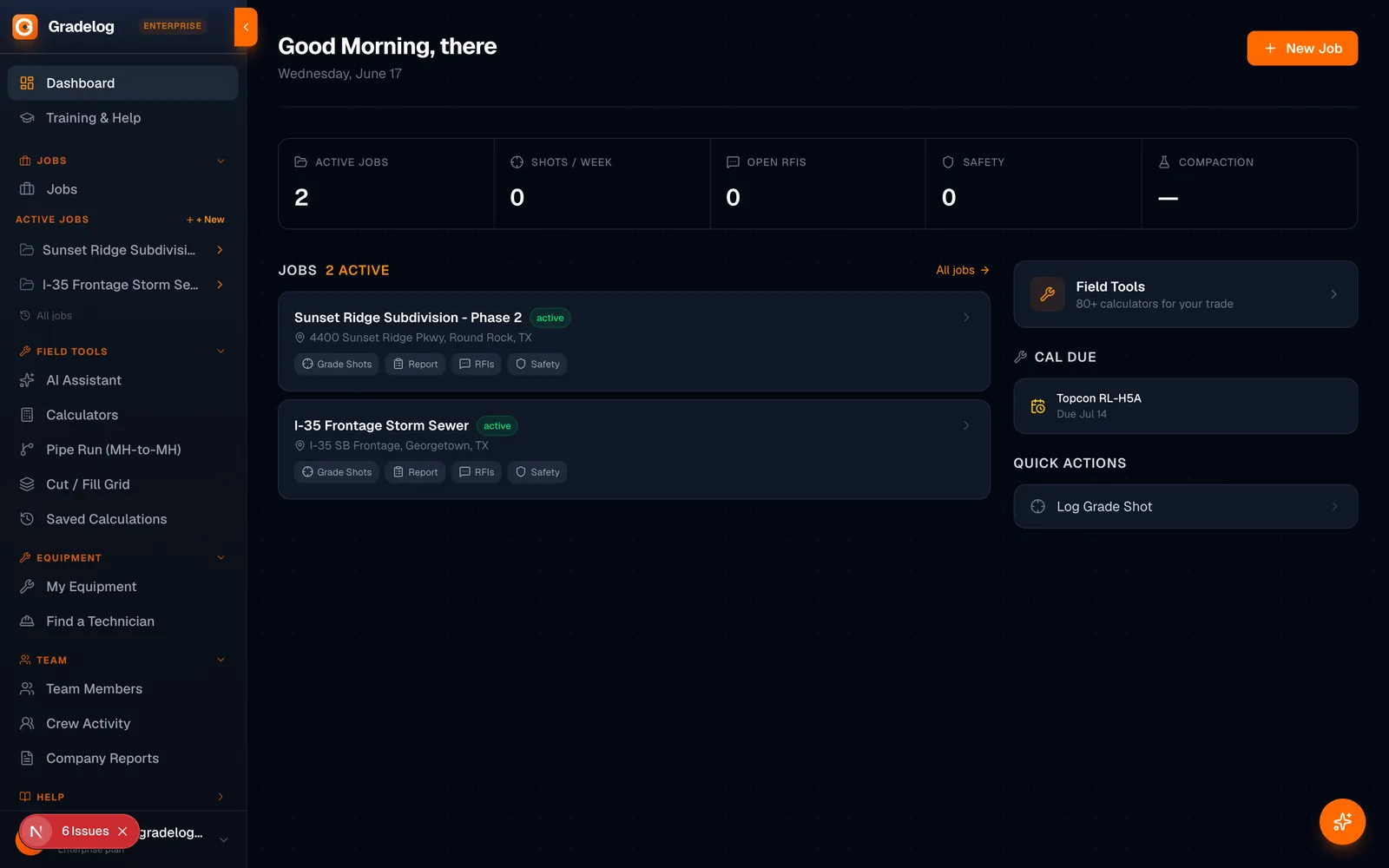
Gradelog is the field-execution platform built for grading and earthwork crews. Log grade shots, track cut/fill, document phases with photos, and generate as-built reports — from the cab to the office.
- Grade shots & cut/fill tracking per job
- Photo documentation by phase, task, and equipment
- As-built reports ready for inspector sign-off
- AI field assistant — troubleshoot on the jobsite
Built by the same team as Express Tools
Try Free →14 days
Free trial
8 languages
Supported
iPhone + Android
Works on