

Trimble vs Leica Rotary Laser: Which Wins on the Job Site?
Quick Answer
Whether you're grading a foundation, setting drainage slopes, or running layout lines across a large project, your rotary laser is only as good as its accuracy and durability. Trimble and Leica are both industry leaders in optical and laser leveling equipment, but they take diffe
Whether you're grading a foundation, setting drainage slopes, or running layout lines across a large project, your rotary laser is only as good as its accuracy and durability. Trimble and Leica are both industry leaders in optical and laser leveling equipment, but they take different approaches to design, features, and price. This comprehensive guide compares both brands head-to-head so you can make an informed decision for your surveying or construction needs.
Best all-around value and integration with modern site tech.
Legendary accuracy and build quality for traditional work.
More affordable entry-level and mid-range options.
Unmatched durability and extreme-condition performance.
Trimble Rotary Lasers
Pros
- Strong integration with Trimble job site software and mobile apps
- Excellent value for money; competitive pricing on mid-range models
- Robust self-leveling technology with manual grade adjustment
- Wide range of receiver options for different job types
- Fast spin speeds and excellent outdoor visibility
- Good customer support and widely available parts
Cons
- Not quite as legendary for durability in extreme conditions as Leica
- Some older models lack modern connectivity features
- Receiver batteries can drain faster on high-range outdoor work
Express Tools specializes in laser grade-control and layout equipment. For field documentation, Gradelog organizes your job logs, calibration records, and as-built reports — free to start.
Leica Rotary Lasers
Pros
- Industry-leading accuracy and precision engineering
- Exceptional durability; designed for harsh, wet, and rugged job sites
- Longer battery life and more stable beam in high-speed applications
- Superior receiver sensitivity and consistent range performance
- Premium build quality with proven reliability over decades
- Better performance in dust, rain, and extreme temperatures
Cons
- Higher upfront cost compared to comparable Trimble models
- Fewer modern connectivity and software integration features
- Smaller ecosystem of aftermarket accessories compared to Trimble
- Steeper learning curve for operators new to laser levels
Express Tools specializes in laser grade-control and layout equipment. For field documentation, Gradelog organizes your job logs, calibration records, and as-built reports — free to start.
Head-to-Head Specs Comparison
Which Should You Buy?
Scenario 1: Small Contractor (5–10 Employees, Mixed Work)
Recommendation: Trimble
You need flexibility, affordability, and the ability to integrate with modern job site management tools. Trimble's mid-range rotary lasers offer excellent value, and their software ecosystem lets you track equipment, collaborate with crews, and manage site data from your phone. Budget: ~$2,000–$3,000 all-in with receiver and tripod.
Scenario 2: Large Contracting Firm or Rental Company
Recommendation: Leica (Primary) + Trimble (Secondary)
Buy Leica units as your premium lineup for high-value jobs and daily intensive use where accuracy and durability justify the cost. Use Trimble for lighter-duty projects and to offer customers value-pricing options. Leica's superior build quality means less downtime and longer asset lifespan on your fleet.
Scenario 3: Heavy Civil / Survey Firm Doing Grade Work
Recommendation: Leica
Your reputation depends on precision. Leica's ±1/16" accuracy on premium models and legendary durability in wet, dusty, high-temperature conditions give you confidence on demanding civil work. The longer battery life and superior receiver sensitivity also reduce daily setup time and improve crew productivity.
Scenario 4: Budget-Conscious Residential Builder
Recommendation: Trimble
You need reliable leveling for foundation work and modest grading without premium features. Entry-level Trimble rotary lasers (~$1,500–$2,000) deliver ±1/8" accuracy and good battery life. The lower price point and easier operator learning curve let you add the tool to your fleet without heavy capex impact.
Frequently Asked Questions
What's the main difference between Trimble and Leica rotary lasers?
Leica prioritizes rugged durability and extreme-condition performance with premium accuracy (down to ±1/16"), while Trimble emphasizes value, connectivity, and software integration. Both deliver ±1/8" accuracy on standard models, but Leica's build quality and battery life edge out Trimble on high-use, demanding jobs. Trimble wins on affordability and modern digital workflows.
Which brand is more accurate?
In real-world conditions, both brands deliver ±1/8" @ 100 ft on standard models, which meets or exceeds most grading and excavation work requirements. Leica's premium models reach ±1/16", offering an edge for precision-critical survey-grade work. For typical construction, the difference is negligible; consistency and operator technique matter more than choosing one brand over the other.
Do I need software integration, or is it just a nice-to-have?
If you're managing multiple projects, crews, and equipment across several sites, Trimble's software integration (JobSite, HQ) dramatically improves efficiency and data accuracy. For smaller firms or rental companies, it's nice-to-have but not essential. Leica users often rely on traditional site notebooks or external project management software.
How much should I budget for a complete rotary laser setup?
Trimble: $2,500–$4,500 (laser unit + receiver + tripod + rod).
Leica: $4,000–$6,500+ (laser unit + premium receiver + tripod + rod).
Prices vary by model, receiver type, and whether you buy bundles vs. individual components. Express Tools offers competitive pricing and bundled options on both brands.
Do I need field management software with this equipment?
Gradelog is an AI field assistant designed for contractors using precision grade equipment. Free calculators for grade percentage, cut/fill, elevation, and slope are available with no account required. Paid plans add job logs, equipment tracking, and as-built exports.
How do I document grade work on a job site?
GradeLog replaces paper grade logs with digital field records — shot logs, daily reports, as-built generation. $19–$149/mo.
Do I need field management software with this equipment?
Gradelog is an AI field assistant designed for contractors using precision grade equipment. Free calculators for grade percentage, cut/fill, elevation, and slope with no account required. Paid plans add job logs, equipment tracking, and as-built exports.
How do I document grade work on a job site?
GradeLog replaces paper grade logs with digital field records — shot logs, daily reports, as-built generation. $19–$149/mo.
Can I use Trimble receivers with Leica lasers (or vice
Calculate Your Grade Before You Buy
Before selecting between these instruments, use Gradelog's free field calculators to verify your project requirements — grade percentage, cut and fill, elevation, slope, and more. No account required.
Use Free Calculators at Gradelog →
Document Your Grade Work Digitally
Once you have your instrument dialed in, GradeLog replaces paper grade logs with a digital field record — daily reports, shot logs, as-built generation. Pairs with every instrument on this page. $19–$149/mo.
Try GradeLog →
Our Verdict
Trimble vs Leica Rotary Laser: Which Wins on the Job Site?
* {
margin: 0;
padding: 0;
box-sizing: border-box;
}
body {
font-family: -apple-system, BlinkMacSystemFont, "Segoe UI", Roboto, "Helvetica Neue", Arial, s
For the full breakdown, see the sections above covering specifications, pros and cons, and use case recommendations for each option.
Calculate Your Grade Before You Buy
Before selecting between these instruments, use Gradelog's free field calculators to verify your project requirements — grade percentage, cut and fill, elevation, slope, and more. No account required.
Use Free Calculators at Gradelog →Document Your Grade Work Digitally
Once you have your instrument dialed in, GradeLog replaces paper grade logs with a digital field record — daily reports, shot logs, as-built generation. Pairs with every instrument on this page. $19–$149/mo.
Try GradeLog →Our Verdict
Trimble vs Leica Rotary Laser: Which Wins on the Job Site? * { margin: 0; padding: 0; box-sizing: border-box; } body { font-family: -apple-system, BlinkMacSystemFont, "Segoe UI", Roboto, "Helvetica Neue", Arial, s
For the full breakdown, see the sections above covering specifications, pros and cons, and use case recommendations for each option.

Built for equipment owners
Run the jobsite around your equipment
Gradelog is the AI field platform for contractors — grade shots, photo documentation, calibration tracking, and as-built reports, all tied to your gear.
- Equipment & calibration tracking
- Photo + grade documentation
- AI field assistant, 8 languages
Free 14 days with every Express Tools purchase
Your equipment. Your data. All in one place.
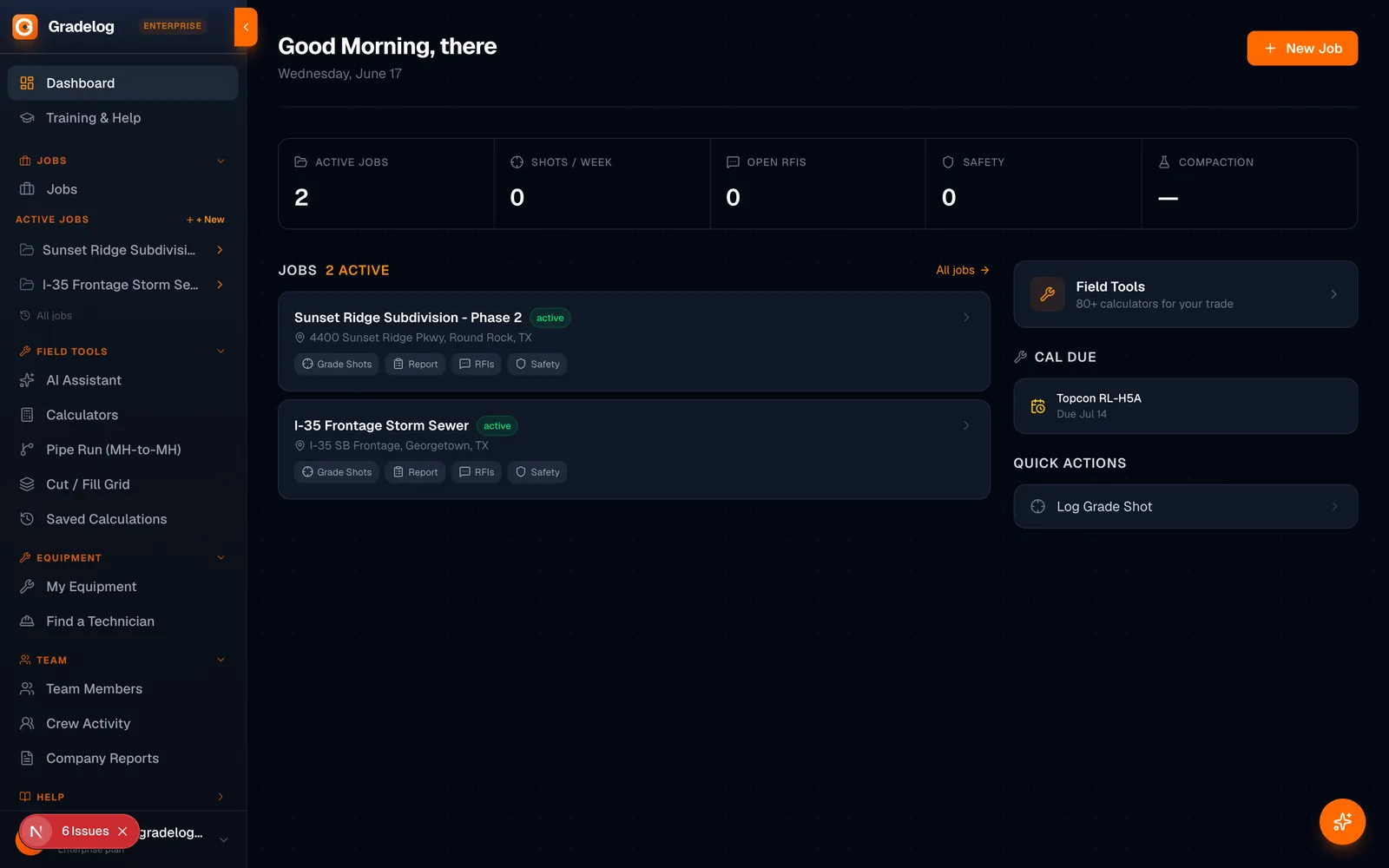
Gradelog is the field-execution platform built for grading and earthwork crews. Log grade shots, track cut/fill, document phases with photos, and generate as-built reports — from the cab to the office.
- Grade shots & cut/fill tracking per job
- Photo documentation by phase, task, and equipment
- As-built reports ready for inspector sign-off
- AI field assistant — troubleshoot on the jobsite
Built by the same team as Express Tools
Try Free →14 days
Free trial
8 languages
Supported
iPhone + Android
Works on