
Quick Answer
When buying survey equipment, new instruments offer full manufacturer warranty, current firmware, and known calibration history. Used instruments can offer significant savings (40-60% of new price) but require careful inspection, a calibration certificate, and evaluation of software subscription transferability. For contractors using equipment more than 3-4 days per week, purchasing is almost always more economical than renting. Buy from authorized dealers to ensure warranty coverage and legitimate software licensing.
Buying Survey Equipment FAQ: New vs Used, Warranty, Support
New vs Used: The Real Decision
The case for new: full warranty (typically 1 year), current software version, clean calibration history, and manufacturer support from day one. The case for used: savings of 40-60% on instruments that may have years of productive life remaining. Professional survey instruments are built to last 10-20 years with proper maintenance — a 3-year-old instrument with a calibration certificate and clean inspection may be a better value than its new cost implies.
The risk with used equipment is unknown history — dropped instruments, undisclosed service issues, expired software subscriptions, and outdated firmware that cannot be updated without additional cost. Always request a calibration certificate and ask the seller directly about the instrument's service history before purchasing used.
Rent vs Buy Analysis
A professional rotary laser with receiver rents for $50-80 per day. If you use a laser more than 10-15 days per year, owning costs less than renting within 2-3 years. Total stations rent for $150-300 per day — ownership breaks even faster. For high-use contractors, the equipment pays for itself and every additional day of use is pure savings over rental cost.
Frequently Asked Questions
Is it better to buy new or used survey equipment?
For high-precision instruments (total stations, GNSS), new is generally recommended unless you can verify the used instrument's calibration history, physical condition, and software subscription status. For rotary lasers and pipe lasers — simpler, more robust instruments — quality used equipment at 50% of new price is often a practical choice. Have any used instrument professionally inspected before purchase.
What does a manufacturer warranty cover on survey equipment?
Standard warranties (1 year) cover defects in materials and workmanship — components that fail under normal operating conditions. Warranties do not cover: drops and impact damage, water ingress beyond the IP rating, normal wear (batteries, seals), unauthorized modifications, or software licensing issues. Read the warranty statement for the specific instrument before purchase.
What should I inspect when buying used survey equipment?
Physical inspection: check for dents, cracked housing, damaged connectors, and scratched optical surfaces. Functional check: power on the instrument and confirm all functions work, including self-leveling, EDM (fire at a prism), ATR if applicable, and data communication. Request a recent calibration certificate (within 12 months). Confirm software subscription status and whether it can be transferred to the new owner.
How do I know if a used total station is in calibration?
Request a calibration certificate from an authorized service center dated within the last 12 months. If none is available, budget for a calibration check ($150-300) before relying on the instrument for precision work. A reputable seller should either provide a calibration certificate or reduce the price to account for the buyer's cost of obtaining one.
Can software subscriptions be transferred on used equipment?
It depends on the manufacturer. Trimble Access and Topcon Magnet Field subscriptions are typically tied to the data collector (serial number) and can often be transferred through the manufacturer with a transfer fee. Leica Captivate licenses are similar. Machine control software licenses may or may not be transferable — verify with the manufacturer before purchasing used machine control equipment.
What is the difference between buying from an authorized dealer vs a private seller?
Authorized dealers provide manufacturer warranty (on new equipment), legitimate software licensing, and access to factory support. They can also perform in-house calibration checks before delivery. Private sellers (eBay, Craigslist, Facebook Marketplace) offer lower prices but no warranty, uncertain software status, and no service history. For instruments used on precision work, authorized dealer purchase is strongly recommended.
How much does a professional rotary laser cost?
Professional rotary lasers (Topcon RL-H5A, Spectra LL500) with receiver and case cost $800-1,200 new. Entry-level professional models run $400-600. Dual-grade lasers (Topcon RL-SV2S, Spectra GL412N) cost $2,000-3,500. Used professional rotary lasers in good condition sell for $300-600. See the rotary laser catalog for current pricing.
How much does a construction total station cost?
Conventional total stations (3-5 arc second) cost $4,000-8,000 new. Robotic total stations start at $15,000 and run to $50,000+ for the highest-accuracy models (Trimble S7, Topcon GT-1200). Used conventional total stations in good condition sell for $1,500-4,000. Used robotic stations vary widely — condition and software status are critical factors.
How much does a GNSS receiver cost?
Professional RTK GNSS receivers (Trimble R10, Topcon HiPer VR, Leica GS18) cost $8,000-18,000 new as complete rover kits with data collector. Base stations add $3,000-8,000. Network RTK subscriptions run $50-150/month per rover. Used professional GNSS equipment is complex to evaluate — always verify software subscription status and check the antenna for physical damage.
What accessories should I budget for when buying a total station?
Essential accessories: a compatible data collector with field software (if not included), prisms (at least 2), prism poles, a heavy-duty tripod, spare batteries, and a carrying case. For robotic instruments, a 360 prism is necessary. Budget an additional $1,500-3,000 for accessories on a new total station purchase if they are not included in the kit.
Should I buy the latest model or a previous generation?
Previous-generation instruments often sell for significantly less and offer only slightly different feature sets from current models. A Trimble S5 (previous generation) and Trimble S7 (current) have different accuracy ratings, but both are viable for general construction layout. Evaluate whether the new features in the current model justify the price premium for your specific application.
What is a "kit" vs individual components when buying survey equipment?
A kit bundles the core instrument with commonly needed accessories — typically a receiver, data collector, tripod, prisms, and carrying case. Kits are usually priced below buying components separately. Verify exactly what is included before comparing kit prices. Some "kits" include only the instrument and a basic case without the accessories needed to start working.
How do I evaluate an online seller for survey equipment?
For online purchases: check that the seller is an authorized dealer for the brand, verify the return policy and warranty terms in writing, and confirm that software subscriptions are valid and transferable. Ask for photos of the instrument serial number and the original purchase invoice. For used equipment from private sellers, consider a local sale where you can inspect and test the instrument in person before payment.
Is leasing survey equipment a good option?
Equipment leasing is used by larger contractors who want current-generation instruments without capital outlay and prefer predictable monthly costs. Lease payments for a full total station or GNSS system run $400-1,200/month depending on the system. Leasing makes less sense for simple instruments (rotary lasers, pipe lasers) where purchase prices are low. Compare total lease cost to purchase price over the expected usage period before deciding.
What is the resale value of survey equipment?
Professional survey instruments hold value well. A 3-5 year old rotary laser or total station in good condition typically sells for 40-60% of its original purchase price. GNSS receivers depreciate faster due to software subscription issues and rapid technology changes. Well-maintained, calibrated instruments with documentation sell faster and at higher prices — keep your service records.
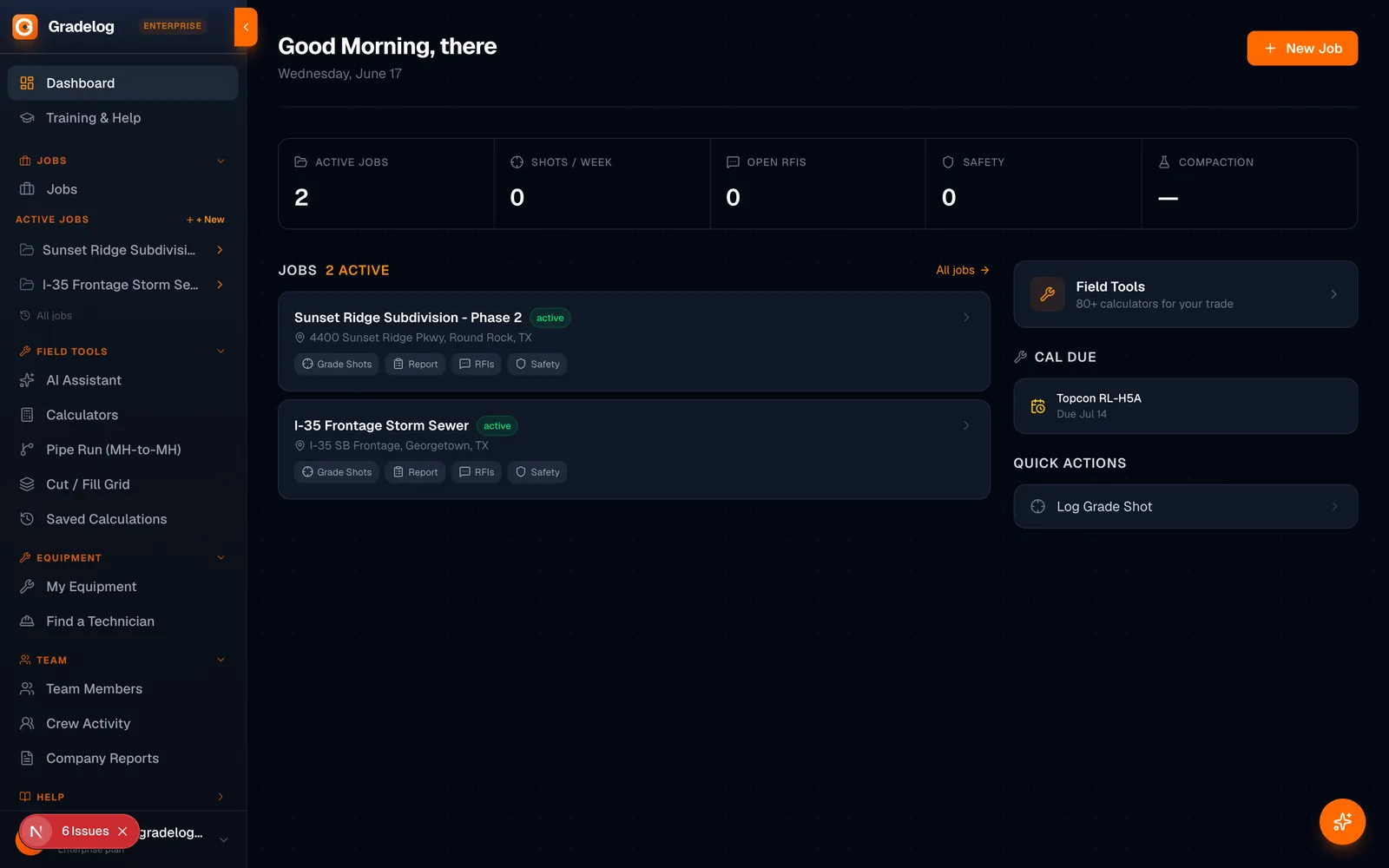
Managing a fleet of survey instruments on active job sites? Gradelog provides instrument inventory tracking, calibration records, and field documentation. Free to start at gradelog.com.