
What Machine Control Does for Contractors
Quick Answer
GPS machine control eliminates grade stakes, reduces survey costs, and allows machines to work faster with higher accuracy. Instead of a grade checker placing stakes every 50 feet and the operator manually working to stakes, GPS machine control shows the opera
GPS machine control eliminates grade stakes, reduces survey costs, and allows machines to work faster with higher accuracy. Instead of a grade checker placing stakes every 50 feet and the operator manually working to stakes, GPS machine control shows the operator their blade elevation relative to the design surface in real time — allowing continuous grade correction without stopping for checks. For earthwork contractors doing 10,000+ cubic yards per project, the productivity gain typically pays for a system in 6-12 months.
Top 3 Machine Control Systems
1. Trimble Earthworks — Best Current Generation
Trimble Earthworks is the most modern machine control platform available. The 10-inch touchscreen tablet replaces the older panel-mounted displays, runs on familiar Android OS, and connects to Trimble Connect for wireless design file delivery — no USB drives required. The automatic machine recognition system identifies the machine type and configures system parameters automatically, reducing setup time from 45 minutes to under 15 minutes for known machine types.
Earthworks integrates with Trimble Business Center for seamless design-to-machine workflow. The operator dashboard shows real-time blade elevation, cut/fill display, and cross-slope against the design surface. Earthworks supports motor graders, dozers, scrapers, and excavators with grade control kits specific to each machine type.
Best for: New installations, contractors preferring modern tablet interface, Trimble Business Center users, operations with cloud design file delivery needs
2. Topcon 3D-MC2 — Best Alternative
The Topcon 3D-MC2 is the strongest alternative to Trimble Earthworks. Compatible with a wider range of machine models than Earthworks, the 3D-MC2 is often the right choice for contractors running older or less common equipment. MAGNET Office integration provides the same design-to-machine workflow as Trimble, and the 3D-MC2 display is well-regarded for readability in direct sunlight.
The 3D-MC2 supports LandXML and Topcon native formats, both common in contractor offices. Topcon's service network is excellent — service centers in all major markets with fast turnaround.
Best for: Contractors with diverse or older machine fleets, Topcon ecosystem users, operations in areas with strong Topcon service presence
3. Trimble GCS900 — Best Legacy/Upgrade Option
GCS900 is the previous-generation Trimble system, still fully supported and available for new installations at lower cost than Earthworks. For contractors with existing GCS900 infrastructure (base station, rover, office software), adding additional GCS900 machine kits is significantly cheaper than migrating to Earthworks. GCS900 achieves the same GPS accuracy as Earthworks — the Earthworks premium is for the improved UI and cloud workflow, not GPS performance.
Best for: Contractors with existing GCS900 infrastructure, cost-sensitive new installations, operations that don't require cloud design delivery
Machine Control System Comparison
2D vs 3D Machine Control
2D machine control uses a grade laser for elevation reference — the laser sets the elevation plane, the machine controller maintains the blade at the correct height relative to the laser. Cross-slope is controlled manually by the operator. 2D works without GPS but requires setting up a laser for each grade change.
3D machine control uses GPS — the machine controller compares the blade position to a digital design file and controls both elevation and cross-slope automatically. 3D is faster (no laser setup) and follows complex designs without any operator grade interpretation. 3D requires GPS reception and a design file; it doesn't work in GPS-challenged environments.
Trimble Earthworks and Topcon 3D-MC2 support both 2D (laser) and 3D (GPS) modes.
Document Machine Control Grade with Gradelog
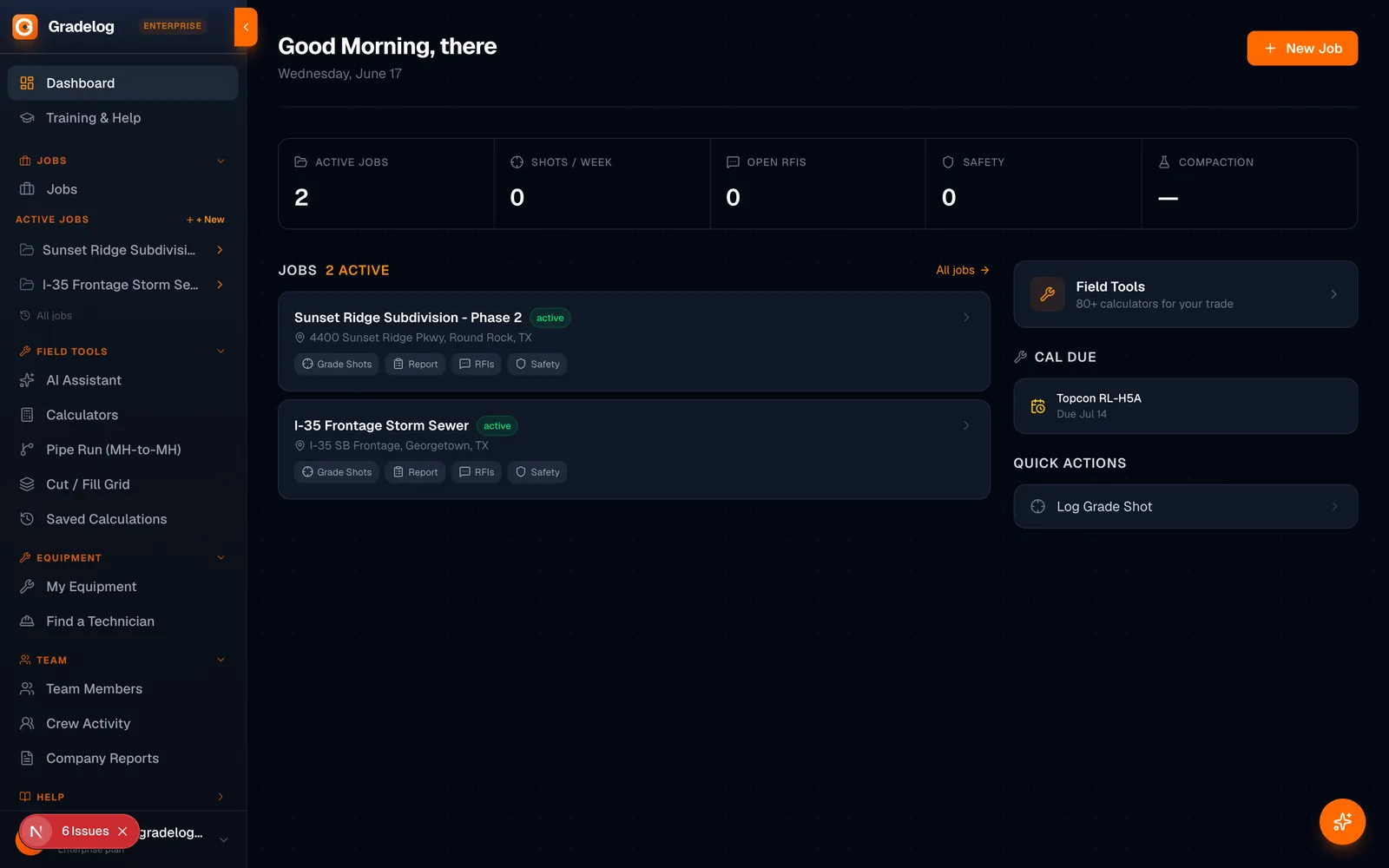
Gradelog accepts as-built surface data from Earthworks, GCS900, and 3D-MC2. Generate DOT QC reports, station-by-station deviation analysis, and compaction documentation. Track machine calibration dates for your entire fleet. Free to start.
See Machine Control Documentation →FAQs
How much does a GPS machine control system cost?
A complete GPS machine control system (display, two GPS receivers, IMU, cables, installation) for a single machine runs $25,000-$60,000 depending on system and machine type. Trimble Earthworks for a motor grader is typically $45,000-55,000 installed. Topcon 3D-MC2 is similar. GCS900 kit prices are lower due to older hardware. Annual software/subscription costs add $2,000-5,000/year. ROI analysis: if GPS eliminates one grade checker ($75/hour × 8 hours × 200 days = $120,000/year), payback is under one year.
Can I use my own GPS base station with Earthworks or 3D-MC2?
Yes. Both Earthworks and 3D-MC2 accept RTK corrections from a base station or network RTK. A dedicated base station on the site is the most reliable approach — no cellular dependency, consistent accuracy regardless of network load. One base station can serve multiple machines and rovers simultaneously on the same site (using the same frequency/channel).
Does machine control GPS work on cloudy days?
Yes. GPS signals are not affected by cloud cover — only by physical signal blockage (buildings, trees, terrain) and atmospheric effects (ionospheric delay on very long baselines). Machine control works normally in rain, overcast, fog, and all weather conditions. Only ice or heavy snow accumulation on the GPS antenna affects reception.
What is the ROI calculation for GPS machine control?
Typical ROI drivers: elimination of 1-2 grade stakers ($50-80/hour each), 20-30% productivity increase from continuous grade feedback vs stake-to-stake, 5-10% material savings from tighter grade control (less over-excavation), and fewer grade corrections on finished surfaces. Calculate your specific ROI based on: number of grade stakers per machine, hourly cost, and project days per year versus system cost and financing.
Express Tools specializes in laser grade-control and layout equipment. For field documentation, Gradelog organizes your job logs, calibration records, and as-built reports — free to start.