
Quick Answer
Top pick: Topcon RL-H5A — The RL-H5A is the field standard for site prep and grading. Self-leveling, ±10 arc second accuracy, 800m diameter working range, IP66 waterproof, and compatible with all major machine control receivers. The most widely used rotary laser on US civil construction sites for pad prep and grade control.
Best Rotary Lasers for Site Preparation and Grading (2025)
Site preparation requires an elevation reference across the entire work area — whether a building pad, parking lot, or highway cut. A rotary laser spinning at 600 RPM creates a 360-degree level plane that a receiver on a grade rod or machine mast reads continuously, without an observer at the instrument. For site prep, this means one laser covers the whole site while a crew or machine works independently. The instruments below are chosen for professional site prep and grading work where range, durability, and receiver compatibility define the value of the instrument.
Top Picks
Topcon RL-H5A — Best overall for site prep and grading
Price: $700–$1,100
Self-leveling within ±5 degrees, ±10 arc second accuracy, 800m diameter working range, IP66 waterproof, 100-hour battery life on AA batteries. The RL-H5A's 800m diameter range covers even large commercial building pads from a single setup. The IP66 rating means it can be left outside in rain without concern. The RL-H5A is compatible with Topcon LS-series receivers, Spectra HR series, and most third-party construction receivers — critical because many equipment operators use machine-mounted receivers from different manufacturers. The most widely deployed horizontal rotary laser on civil sites in the US.
Spectra Precision LL300N — Best for large site coverage
Price: $700–$1,000
Self-leveling within ±5 degrees, ±1.5mm/30m accuracy, 800m diameter range, IP66. The LL300N is the standard Spectra Precision horizontal rotary laser for site grading. Comes with an HR320 machine receiver that mounts to grade rod or machine mast. Spectra Precision instruments are favored by equipment rental companies and contractors who buy through Home Depot Pro/rental channels. The HL760 receiver is a common add-on for crews needing machine control receiver capability. Strong field service network through Trimble/Spectra distribution.
Leica Rugby 680 — Best for multi-slope site grading
Price: $2,200–$3,200
Manual dual-slope capability, ±10 arc second accuracy, 800m range, IP67. For site prep involving slope — parking lots with cross-fall, athletic fields with crown, drainage-graded pads — the Rugby 680's dual-slope feature sets both X and Y grade simultaneously from one instrument setup. The instrument beam follows the programmed slope, and the receiver guides the grade accordingly. Far faster than staking a sloped pad with an optical level. For flat pads only, the RL-H5A at lower cost delivers the same result. For sloped site work, the Rugby 680 pays back in eliminated staking passes.
Budget / Mid-Range / Professional Tiers
- Budget ($200–$500): Bosch GRL 300 HVG, Dewalt DW074LR. Limited to 300–500m range, adequate for smaller building pads. IP ratings vary — check before deploying in wet conditions.
- Mid-range ($600–$1,200): Topcon RL-H5A, Spectra LL300N, Nikon LV1. 800m range, IP66, full receiver compatibility. The right choice for most commercial site prep work.
- Professional ($1,500–$4,000): Leica Rugby 680, Topcon RL-200/2S (dual slope). Grade control on complex sloped sites. Remote grade adjustment capability for single-operator grade work from the machine.
What to Look For
- Working range — Listed as diameter, not radius. An 800m diameter range means 400m from the instrument in any direction. For a 200m x 200m building pad, an 800m instrument covers from center with margin. Do not undersize range on large sites — a second laser setup doubles staking complexity.
- IP rating — IP66 minimum for outdoor site prep. Rotary lasers are often set up before a grading shift and left running through weather changes. IP66 means sustained heavy rain exposure does not damage the instrument.
- Self-leveling range — The instrument self-levels within ±3–5 degrees. On rough cleared ground or unstable tripod bases, a wider self-leveling range prevents instrument lockout from minor ground settlement.
- Receiver compatibility — Verify that your existing machine-mounted receivers (if any) are compatible with the laser you select. Cross-brand compatibility is common but not universal — Topcon receivers work with most lasers; some proprietary systems are brand-locked.
- Battery life — 60+ hours on a standard battery set means the laser runs a full work week without battery change. Instruments requiring specialty batteries add operating cost and field logistics.
Frequently Asked Questions
What receiver do I need for a rotary laser on site prep work?
For hand-held grade rod work, a standard construction receiver (Topcon LS-80L, Spectra HR320) mounts to the grade rod and audible beeps guide you to grade. For machine-mounted use on a dozer or grader blade mast, a machine control receiver (Topcon LS-B10W, Spectra HL760) is mounted on the mast and displays cut/fill on an in-cab indicator. The receiver, not the laser, determines whether you get hand-held or machine control operation.
Can a rotary laser handle a sloped building pad?
A standard horizontal rotary laser creates only a flat level plane — it cannot directly reference a sloped pad. For sloped grades, use a dual-slope capable laser (Leica Rugby 680, Topcon RL-200 2S) that tilts the beam to match the design grade, allowing the receiver to track directly to the sloped reference. Alternatively, a surveyor sets slope stakes and the grader operator cuts to stakes without laser guidance on the slope.
How do I protect a rotary laser on an active site prep site?
Mount the laser on a heavy-duty tripod with leg locks fully tightened. Position the setup away from equipment travel paths and machine swing zones. Use a laser safety flag on the tripod to increase visibility to equipment operators. Most professional rotary lasers have an anti-bump shutoff that locks the compensator if jolted — verify it re-levels correctly after any disturbance. Bring the laser inside during lightning or severe weather.
What is the difference between a rotary laser and a pipe laser for site prep?
A rotary laser creates a 360-degree horizontal (or sloped) plane for surface grade reference. A pipe laser creates a single visible beam projected forward in a straight line — used for setting line and grade inside a pipe or trench. On site prep, you use a rotary laser for surface grading. A pipe laser is used only for buried utility installation, not surface grade work.
How far in advance can I set up a rotary laser before grading starts?
Set up the laser at the beginning of the work shift and verify the elevation against a known benchmark before any grading begins. The laser's self-leveling compensator can drift slightly on unstable ground — re-check the setup elevation at mid-shift if the tripod location has experienced ground disturbance from nearby equipment. Never leave a laser running overnight and assume it held its elevation.
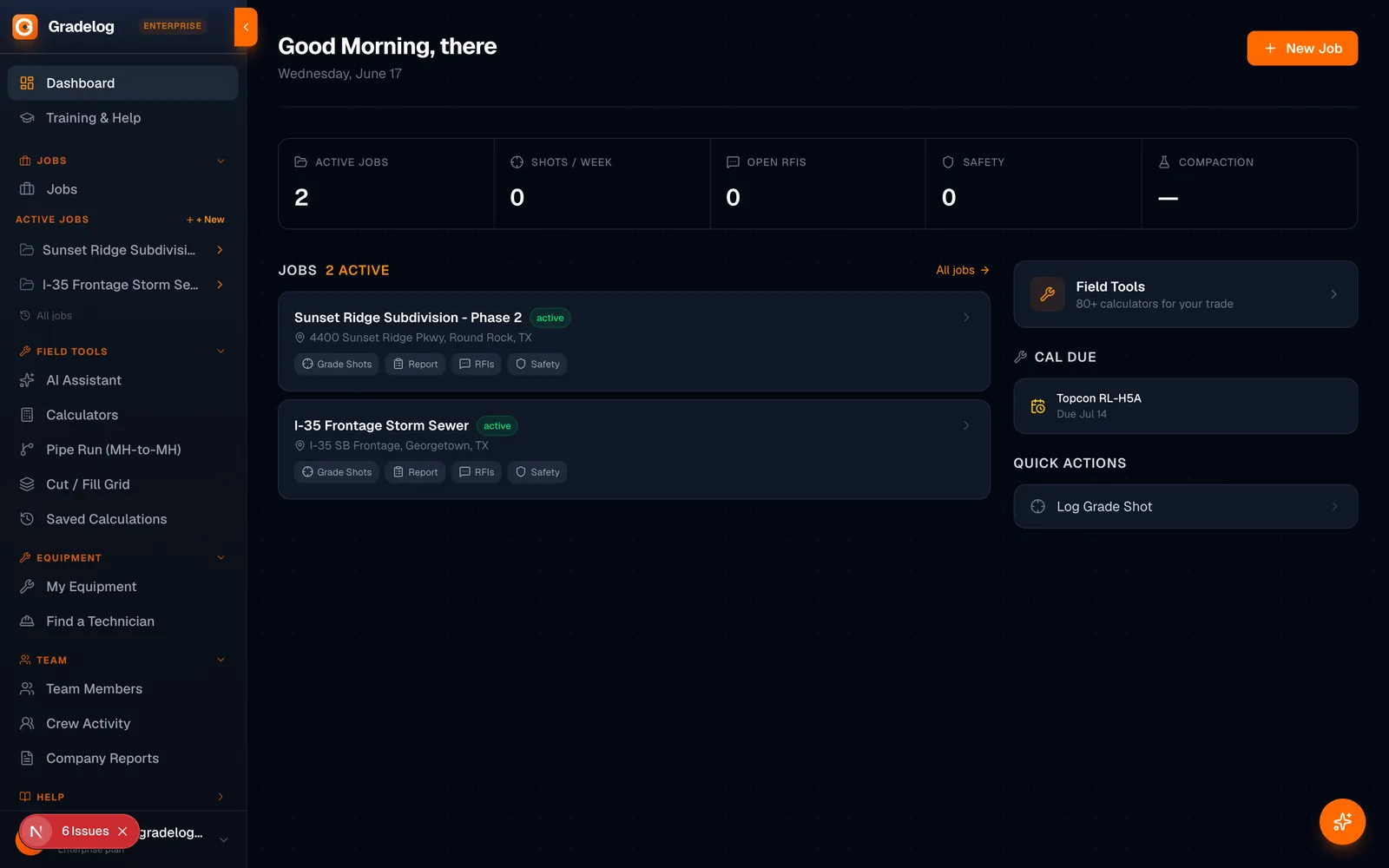
Track rotary laser setups, benchmark elevations, and equipment assignments by project. Gradelog keeps site prep crews organized — free to start at gradelog.com.