
The Complete Contractor's Guide to Construction Equipment: How to Choose, Use & Buy the Right Tools for Every Job
Quick Answer
Express Tools Editorial Team — Updated 2025 — Reading time: ~35 minutes
Why the Right Construction Equipment Makes or Breaks Your Project
If you've ever watched a pour go wrong because someone was working off a bad benchmark, or spent three hours re-digging a trench because the grade was off by half a percent, you already know this truth: construction equipment isn't overhead — it's insurance. The right laser level, rotary laser, pipe laser, or survey instrument doesn't just save time. It saves rework, saves relationships with clients, and ultimately saves your margin.
The market for professional construction equipment has exploded over the last decade. Where a crew once relied on a water level and a string line, today's foreman has access to self-leveling rotary lasers accurate to ±1/16" at 100 feet, pipe lasers with remote-controlled grade adjustment, and digital levels that log readings directly to a tablet. That's genuinely exciting — but it also means the buying decision is more complicated than it used to be.
This guide exists to cut through the noise. Whether you're a one-man landscaping operation looking for your first laser level, a civil contractor specifying pipe lasers for a large drainage project, or a project manager trying to standardize equipment across a 50-person crew, we'll give you the technical grounding you need to buy confidently and use effectively.
At Express Tools, we're not a general marketplace. We're a contractor-specialist supplier with real field experience, authorized dealer status for the industry's leading brands, and a team that actually picks up the phone. Every recommendation in this guide comes from that lived knowledge — not from a spec sheet alone.
Let's get into it.
Laser Levels: The Foundation of Precision Work
Ask any seasoned contractor what single piece of construction equipment has changed their day-to-day work the most, and the answer is almost always a laser level. It's the workhorse of the modern job site — versatile enough to handle interior fit-out, accurate enough to set foundations, and fast enough that a two-person layout crew can cover ground in hours that previously took a full day.
Types of Laser Levels and What They're Used For
Not all laser levels are created equal, and the terminology can get confusing fast. Here's a practical breakdown of what you'll encounter on the market.
Cross-Line Laser Levels
Cross-line lasers project a horizontal and/or vertical beam, creating an intersecting cross pattern on a wall or surface. They're the go-to for interior work: hanging drywall, setting cabinets, tiling, plumbing walls, and aligning door frames. Most cross-line lasers self-level within a ±4° range and will alert you with a flashing beam if the unit is out of that compensating range. For indoor laser levels, accuracy specifications typically run ±1/8" at 30 feet, which is more than sufficient for finish carpentry and fit-out trades.
Where cross-line lasers fall short is working range. Most are usable to about 50–100 feet without a detector. On a bright job site, you'll need a pulse mode — a feature that makes the beam pulse rapidly so a compatible laser detector can pick it up even in daylight. If you're going to use your cross-line laser outdoors at all, make sure it has pulse mode.
Point-Transfer Lasers (Plumb Lasers)
Also called plumb-point or dot lasers, these units project reference points straight up (zenith), straight down (nadir), and sometimes to the sides. They're critical for transferring control points between floors in multi-story construction, setting columns plumb, and aligning structural steel. If you're doing commercial interior work with multiple floor levels, a five-point plumb laser is worth its weight in gold.
Line and Grade Lasers
A step up from a basic cross-line unit, line and grade lasers can tilt the beam to a specified slope — useful for drainage, ramps, ADA-compliant ramp installations, and sloped ceilings. Some grade lasers allow dual-axis grade setting, meaning you can dial in a slope in two directions simultaneously. These are particularly popular among concrete finishers and excavation contractors.
Key Specifications to Understand Before You Buy
Accuracy
Accuracy is stated as a linear tolerance at a given distance — for example, ±1/8" at 30 feet, or ±1/16" at 100 feet. Always look at both the tolerance and the reference distance together. A laser that's ±1/4" at 100 feet is less accurate than one that's ±1/16" at 100 feet. For foundation work and structural applications, aim for ±1/16" or better. For finish-carpentry, ±1/8" is typically adequate.
Self-Leveling Range
Most laser levels use a magnetic damped pendulum or servo motor to self-level within a stated range, typically ±4° to ±5°. Outside that range, the laser locks out and the beam flashes. This matters on uneven ground — if your tripod isn't reasonably level, the laser won't compensate. Get a quality tripod with a fine-adjustment ball head, especially on outdoor sites.
IP Rating (Ingress Protection)
Construction sites are wet, dusty, and unforgiving. An IP54 rating means the unit is dust-protected and splash-resistant — adequate for most indoor/covered conditions. IP65 and above means the unit is fully dust-tight and can handle water jets, which is what you want for year-round outdoor use. Don't buy an IP54 laser if you're working in rain or heavy concrete dust regularly.
Battery Life and Power Source
Lithium-ion rechargeable batteries are increasingly standard and offer consistent performance across their charge cycle. AA/AAA alkaline-battery models give flexibility when you can't charge, but performance can degrade in cold weather. If your crew runs multiple shifts or works remotely, a model that accepts both rechargeable and alkaline power is a smart hedge.
Best Applications for Laser Levels by Trade
- Concrete: Slab flatness, footing layout, column layout, floor levelness verification
- Framing: Wall layout, stud alignment, header elevation, sole plate layout
- Plumbing/HVAC: Pipe slope, duct alignment, penetration layout
- Electrical: Panel alignment, conduit runs, junction box height consistency
- Finish/Tile: Floor leveling, wall plumb, tile layout lines, ceiling grid
- Landscaping: Patio grading, retaining wall layout, irrigation trench slope
Browse our full range of professional laser levels — from entry-level interior units to contractor-grade IP65 cross-line and grade lasers. Every unit we stock ships free on orders over $99, and if you order before 2pm CT, it goes out the same day.
Rotary Lasers: Covering Large Sites with Speed and Accuracy
When the job site is bigger than a room — when you're grading a parking lot, setting forms for a large slab, establishing elevations across an entire floor of a warehouse, or working on any application where you need a reference plane that covers hundreds of feet — a rotary laser is the answer. This is the heavy-duty workhorse of professional construction equipment, and understanding how to spec one correctly is critical.
How Rotary Lasers Work
A rotary laser spins a laser beam (typically at 100–600 RPM, depending on the model) to create a 360° horizontal plane of laser light. Paired with a laser detector — a receiver that mounts on a grade rod or machine mast — the system allows one person to check elevations, set grades, and control equipment across distances of 500, 1,000, or even 2,000+ feet. The detector beeps and displays above/below/on-grade information, allowing precise grade control without a helper holding a target.
Self-leveling rotary lasers use either a pendulum-and-lock system or a dual-axis electronic compensator to establish a level plane. Electronic self-leveling is faster, more reliable in vibration-prone environments (like sites with heavy equipment running), and allows remote-controlled grade adjustment on higher-end models.
Single-Axis vs. Dual-Axis Grade
This is one of the most important spec distinctions in rotary lasers for contractors who work with sloped grades.
Single-axis grade lasers tilt the plane in one direction only. They're suitable for most road construction, drainage, and site grading applications where you're working with a consistent slope in one direction. They're simpler, typically more durable, and cost less than dual-axis models.
Dual-axis grade lasers can tilt the reference plane in two directions simultaneously — think of a plane that slopes toward the front corner of a building at the same time it slopes toward the side. This is essential for parking lot grading, stadium seating grades, complex drainage systems, and any application where you need compound slopes. Dual-axis models are more expensive and require more skill to set up correctly, but on the right job, they're indispensable.
Working Range: What the Specs Actually Mean
Manufacturers rate rotary lasers by their maximum working diameter — the total circle of coverage. A laser rated at 2,000-foot diameter covers a radius of 1,000 feet from the instrument. However, real-world working range depends heavily on ambient light conditions, atmospheric haze, and detector quality. In bright daylight, a quality detector with a large photodiode cell will outperform a budget detector significantly. When you see specs, assume optimistic conditions — in practice, budget 20–30% less than the stated maximum for reliable site use.
Remote Control and Machine Control
Mid-range and premium rotary lasers increasingly offer wireless remote control — the ability to change grade settings, adjust RPM, and lock/unlock the compensator from a distance. This is a massive productivity gain when you're working alone or when the instrument is in a difficult-to-access location. Some systems integrate with machine control receivers on excavators, graders, and scrapers, allowing semi-automated grade control — the machine's blade automatically adjusts to maintain the laser-defined grade plane.
Choosing the Right Rotary Laser for Your Work
- Interior flat work (warehouse floors, large slabs): An indoor-rated model with ±1/16" accuracy and 800–1,200 ft diameter range is typically sufficient.
- Site grading and earthwork: Choose an outdoor-rated model (IP66+) with a quality detector, single-axis grade, and 1,500–2,000 ft range minimum.
- Parking lots, complex drainage: Step up to dual-axis grade capability.
- Machine control integration: Verify compatibility with your specific machine control receiver system before purchasing.
- Harsh environments: Look for models rated for operation in rain, dust, and extreme temperatures. Some are designed to survive a 1-meter drop — this matters on active sites.
Our rotary laser category includes models from Topcon, Spectra Precision, and Leica — three brands that professional contractors rely on for accuracy, durability, and support. Our specialists can help you match the right model to your specific site conditions and budget. Get in touch — no scripts, no runaround.
Rotary Laser Accessories You Shouldn't Skip
A rotary laser alone doesn't give you a complete system. Here's what you need to make it work at its best:
- Laser Detector/Receiver: Essential for outdoor use. Matches the laser's frequency for best performance. Don't mix and match brands without verifying compatibility.
- Grade Rod: The detector clamps to a grade rod for elevation checking. Fiberglass rods resist heat expansion better than aluminum; check our grade rod selection for the right length and graduation.
- Tripod or Elevating Tripod: A heavy-duty aluminum or fiberglass tripod keeps the instrument stable. An elevating tripod (with a rising center column) is useful for getting above obstructions.
- Carrying Case: Protect your investment. Many quality rotary lasers come with a hard case, but aftermarket cases offer additional foam customization for transport.
- Spare Battery / Charger: Keep a second battery charged so downtime isn't downtime.
Pipe Lasers: Grade and Alignment for Underground Work
Pipe lasers are among the most specialized — and most unforgiving — pieces of construction equipment a contractor can buy. When you're setting gravity-fed sewer lines, stormwater culverts, or underground conduit, the grade tolerance is often ±0.1% or tighter. A pipe laser that's slightly out of calibration, improperly set up, or mismatched to the job can mean thousands of dollars in rework and, in the worst case, a drain system that doesn't drain.
This section is for contractors who need to understand pipe lasers at a level that goes beyond reading a brochure.
What a Pipe Laser Does
A pipe laser is a highly specialized construction laser designed to be placed inside a pipe — typically on the invert (the lowest interior surface) — and project a visible laser beam along the centerline of the pipe run. A target at the working end of the excavation intercepts the beam, allowing the crew to position each successive pipe section so that the centerline and invert elevation match the design grade exactly.
Unlike a rotary laser (which creates a horizontal plane), a pipe laser projects a single beam that can be precisely tilted to any specified grade — typically from -10% to +10%, though some models handle steeper grades. The grade is set digitally via keypad or remote control, and a built-in electronic compensator maintains that grade precisely regardless of minor instrument settling.
Types of Pipe Lasers
Manual Grade Pipe Lasers
Entry-level pipe lasers require the operator to physically adjust the instrument to achieve the desired grade, then lock it in. These are appropriate for straightforward jobs with fixed grades and experienced operators. They're less expensive but slower to reset between grade changes.
Remote-Controlled Pipe Lasers
Mid-range and premium pipe lasers allow the operator to change grade settings remotely — from the face of the excavation rather than crawling back to the instrument. This is a safety and productivity win on deep excavations. The remote control also simplifies dial-in of complex grade transitions. For any job with multiple grade changes, or where the instrument is difficult to reach, the remote control capability pays for itself quickly.
Self-Centering Pipe Lasers
Some pipe lasers include a self-centering base that automatically centers the instrument on the pipe invert. This eliminates one of the most common setup errors — an instrument that's slightly off-center horizontally, which skews the alignment reference. Self-centering models are faster to set up and reduce operator-error risk significantly.
Pipe Diameter Compatibility
Pipe lasers are designed to work within a range of pipe diameters. Most full-size pipe lasers accommodate pipes from approximately 4" to 24" diameter with adjustable base brackets. For very small pipes (4" and under) or very large diameter culverts, verify the instrument's stated range and get the appropriate adapter bracket. Running a pipe laser in a pipe that's too large — where the instrument can tip or rock — introduces alignment errors that may not be immediately obvious but will manifest downstream.
Setting Up a Pipe Laser Correctly
Correct setup is everything with a pipe laser. Even a high-end instrument will produce bad results if it's not positioned properly. Here's the key process:
- Establish your benchmark. Set the invert elevation of the first pipe based on your design drawings and verified benchmark. Don't assume the benchmark hasn't moved — always check it.
- Position the laser on the invert. The base of the instrument should sit firmly on the invert, centered in the pipe. Use a spirit level on the instrument's bubble to verify it's within the compensating range before engaging grade mode.
- Input the design grade. Enter the grade percentage (positive for uphill, negative for downhill in the direction of flow, depending on the instrument's convention — always check the manual).
- Verify with a backsight. Shoot a backsight to a known elevation to confirm the laser is producing the correct grade reference before advancing the pipe run.
- Check compensator status. Most instruments display an error light if the unit is out of the compensating range. Never work off a locked-out compensator without understanding why it locked out.
- Re-check after ground disturbance. Excavator vibration, trench wall movement, or impact from pipe handling can move the instrument. Establish a habit of periodic backsight checks during the pipe run.
Grade Tolerance and What It Means in Practice
A 0.5% grade on a 100-foot pipe run is a 6-inch elevation drop. An error of 0.1% on that same run is only 1.2 inches — barely perceptible by eye, but enough to cause a sag point in a gravity sewer that will collect solids and block. Pipe lasers typically offer grade accuracy of ±0.01% to ±0.03%, which is well within the tolerance required for standard gravity drainage design. The limiting factor is usually the setup procedure and benchmark quality, not the instrument itself.
Our pipe laser collection includes models from the brands contractors trust for underground work. If you're not sure which model suits your pipe diameter range, typical grade range, and budget, our specialist team can walk you through it — give us a call or send a message.
Surveying Equipment: Establishing Control Before You Build
Every construction project starts with survey control. Even if you're not a licensed surveyor, understanding the survey equipment that feeds your job — and having the right instruments to verify and maintain control on-site — is an essential competency for any serious contractor.
The construction surveying equipment landscape encompasses a broad range of instruments, from simple optical levels to GPS/GNSS total stations. Here's a grounded overview of what you'll encounter and when each type applies.
Optical/Automatic Levels
The automatic level (also called a dumpy level or builder's level) is one of the most reliable and cost-effective pieces of surveying equipment ever made. A compensator maintains the line of sight horizontal automatically within a small leveling range, and the instrument is read through an eyepiece against a graduated rod (staff). Accuracy in the ±1mm per kilometer range is achievable with a quality optical level and proper technique.
Optical levels are ideal when:
- You need a highly accurate, low-maintenance elevation reference
- Electronic equipment isn't practical (extreme temperature, moisture, battery logistics)
- Budget is the primary constraint
- The application is straightforward leveling, not complex layout
Digital (Electronic) Levels
Digital levels read a bar-coded staff electronically, eliminating parallax error and operator misreading. They log readings automatically, often with a data collector interface. For precise leveling loops, elevation network establishment, or any application where you need a documented, auditable record of elevation data, a digital level is significantly faster and more reliable than an optical level.
Modern digital levels can achieve standard deviation of ±0.2mm per kilometer with an invar staff — accuracy that was previously only achievable with precision geodetic instruments. For construction purposes, the ±0.3–0.5mm range available from mid-grade instruments is more than adequate.
Total Stations
A total station combines an electronic theodolite (for measuring angles) with an electronic distance meter (EDM) to determine the 3D coordinates of any point in space. On a construction site, a total station lets you:
- Set out (stake out) any point from a design coordinate
- Verify as-built positions of structures, utilities, and features
- Establish and densify a site control network
- Perform topographic survey for design verification
- Guide pile installation, column setting, and structural steel placement
Robotic total stations — where the instrument tracks a prism automatically — allow one-person operation, with the instrument following the operator as they move around the site. This is a major productivity advantage on large sites and is increasingly standard on commercial and infrastructure projects.
GNSS/GPS Receivers
Global Navigation Satellite System (GNSS) receivers use signals from GPS, GLONASS, Galileo, and BeiDou satellite constellations to determine position. For construction purposes, the relevant technology is Real-Time Kinematic (RTK) GNSS, which uses a base station transmitting correction data to a rover receiver to achieve centimeter-level accuracy in the field.
GNSS is particularly powerful for:
- Large-scale site layout where line-of-sight to a total station is impractical
- Machine control systems (blade control on graders, excavators, dozers)
- As-built verification over large areas
- Establishing control points for laser and optical instrument setups
Network RTK services — where you subscribe to a correction network rather than deploying your own base station — have made GNSS surveying significantly more accessible for contractors over the past decade.
Laser Measurers (Handheld Distance Measurers)
While not traditional surveying instruments, handheld laser distance measurers deserve a mention here because they've become indispensable daily-use tools for estimators, project managers, and site supervisors. Models from Leica (the Disto series) offer measurement ranges of 60–330 feet with ±1mm accuracy, stake-out function, area and volume calculation, and Bluetooth data transfer to a phone or tablet. For takeoffs, layout verification, and quick site measurements, a quality handheld laser measurer is one of the best returns on investment in any contractor's toolkit.
Grade Rods, Staffs & Measuring Tools: The Supporting Equipment That Makes the System Work
The finest rotary laser in the world is only as good as the grade rod it's used with. Measuring tools and accessories are often the afterthought in a contractor's equipment purchase — but they shouldn't be. Here's a grounded look at what to specify and why it matters.
Grade Rods
A grade rod (also called a leveling rod or surveying rod) is the vertical staff against which elevation measurements are taken. It's used with rotary laser receivers, optical levels, digital levels, and hand levels. The rod slides into a clamp on the detector, and as you walk the site, the detector tells you how far above or below grade you are at each point.
Key specifications for grade rods:
- Material: Fiberglass rods have lower thermal expansion than aluminum, making them more dimensionally stable in temperature extremes. For precise leveling work, fiberglass is preferred. For rough-and-tumble site use, aluminum handles abuse better.
- Length: Rod length determines the height range you can measure. Telescoping (extending) rods are practical for transport; direct-reading (rigid) rods are more accurate. For most construction applications, a 13-foot or 25-foot telescoping rod is adequate. For deep excavations or tall structures, longer rods or extension sections are needed.
- Graduation: Rods are graduated in feet/inches/eighths, feet/tenths/hundredths, or metric. Verify that the graduation matches how you're working and how your plans are dimensioned. Mixing unit systems on a site is a source of serious — and embarrassing — errors.
- Dual-reading: Some rods have graduations on both faces — one face for rod readings, the other for grade checking from a different direction. Useful on complex layouts.
Laser Detectors (Receivers)
A laser detector clips onto a grade rod and amplifies the rotary laser beam to a visible and audible above/on/below-grade signal. Without a detector, a rotary laser is nearly useless outdoors in daylight beyond 20–30 feet.
When selecting a detector, consider:
- Sensitivity: High-sensitivity detectors can pick up the laser beam at greater distances and in brighter conditions. This matters on large sites.
- Display: A digital display showing offset from grade (e.g., +0.3", -1.2") is far more useful than a simple above/on/below LED, especially when you need to know how much to cut or fill.
- Compatibility: While many detectors are cross-compatible with multiple laser brands, always verify. Some proprietary systems require brand-matched receivers for full functionality.
- Clamp type: Ensure the detector's rod clamp fits your grade rod diameter. A loose clamp that can rotate on the rod introduces reading errors.
Measuring Wheels and Tape Measures
Not glamorous, but essential. A quality measuring wheel — calibrated and checked regularly — is the fastest way to measure distances along irregular terrain. Fiberglass tape measures resist stretching better than steel in temperature cycles; for long-distance layout tapes (100-foot or longer), tension consistency matters for accuracy. For critical measurements, always make two independent checks.
Hand Levels and Abney Levels
Hand levels are simple, inexpensive leveling tools that use a bubble vial and a single-lens optic to determine if you're looking at a level point. They're the backup when the laser is down, the quick-check tool when you don't need electronic precision, and the right answer for approximate grade slopes in landscaping and drainage layout. An Abney level adds a graduated arc for measuring vertical angles and slopes — useful for rough topographic reconnaissance.
Plumb Bobs and Optical Plummets
For precise vertical transfer of a point — centering an instrument over a control monument, checking column plumb, or transferring a control point to a new floor — a quality plumb bob or an optical plummet (built into most total stations and theodolites) is essential. A laser plummet is now standard on most total stations and offers faster, more accurate point transfer than a traditional hanging plumb bob.
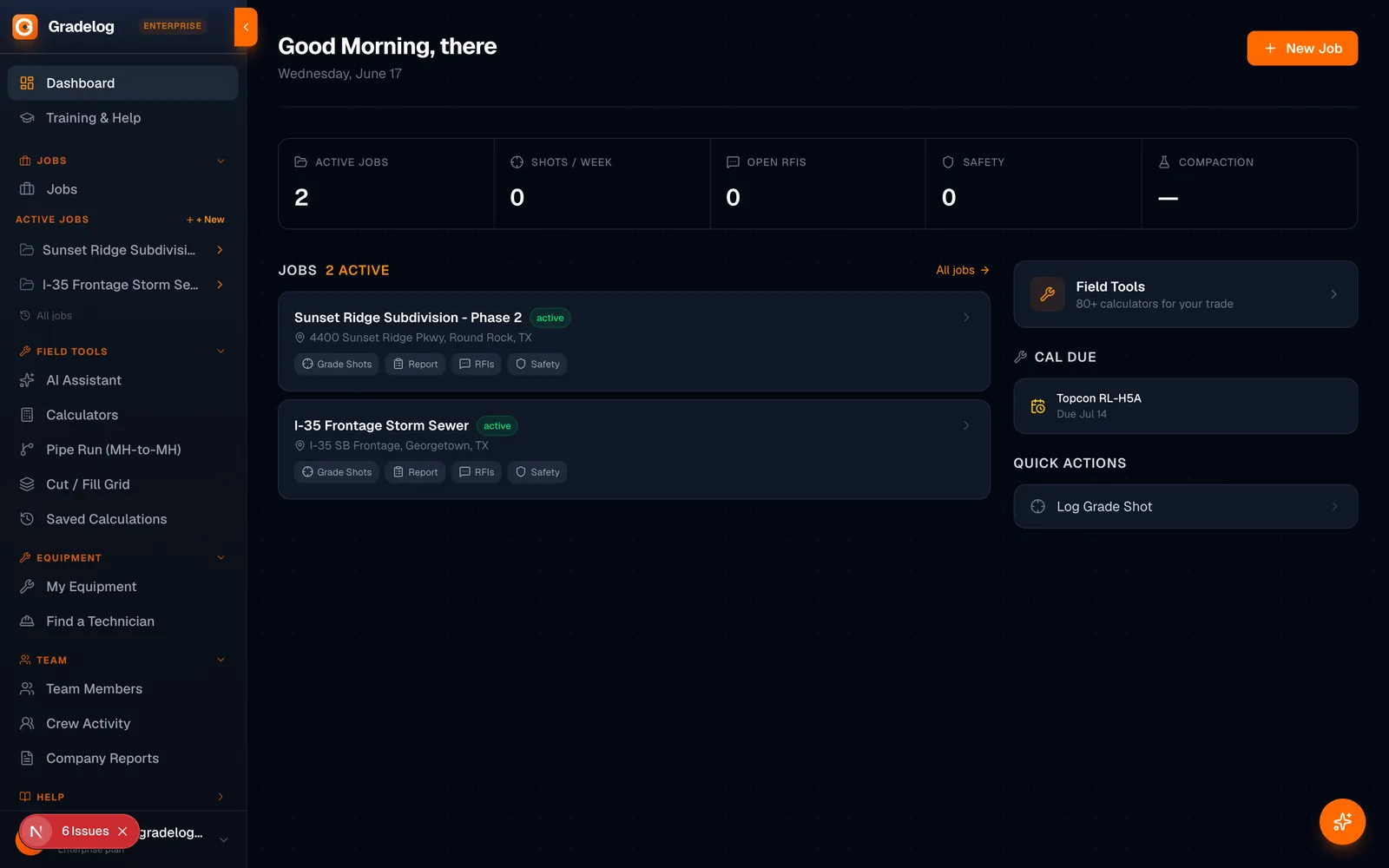
Already own this equipment? Gradelog keeps your calibration records, job logs, and field reports organized. Free to start.