Free Shipping on orders over $500


Equipment Guide
GPS Equipment for Solar Farm Pile Verification
Why GPS rovers beat total stations for EPC pile verification, which rover handles all-day solar sites, and how to set up network RTK vs base station for remote projects.
Why Solar EPCs Use GPS Rovers (Not Total Stations)
Solar pile verification requires checking elevation and position at hundreds or thousands of piles per block. GPS rovers changed the economics: one operator can verify 400-800 piles/day vs a two-person total station crew at 200-400/day. More importantly, GPS auto-records coordinates with every shot — EPCs require GPS coordinates in as-built packages.
RTK GPS Rover
- ✓ 400-800 piles/day (1 operator)
- ✓ GPS coordinates auto-recorded
- ✓ No second person required
- ✓ Works across entire site from one setup
- ✗ ±0.05ft accuracy (marginal for tight EPC specs)
- ✗ Needs clear sky (no obstructions)
Total Station
- ✓ ±0.01ft accuracy
- ✓ Works under tree canopy and obstructions
- ✓ No cellular needed
- ✗ 200-400 piles/day (2 operators)
- ✗ Requires traverse setup (time-consuming)
- ✗ Must move setup as work progresses
Top GPS Rovers for Solar Verification
8+ hour battery life handles full solar site days without swapping. Tilt compensation lets you shoot without leveling the rod — significant time savings at 400-800 pile touchpoints. Tracks all GNSS constellations (GPS, GLONASS, Galileo, BeiDou) for maximum satellite availability on open desert terrain.
Industry-leading satellite acquisition for solar sites with partial obstructions (adjacent structures, terrain). IMU tilt compensation allows extreme rod angles. If your solar site has any coverage challenges, the R12i maintains RTK fix where other rovers drop out.
IMU tilt technology enables the fastest pile verification — no leveling required at any angle. On large solar farms where you're shooting thousands of piles, eliminating 2-3 seconds per pile saves hours per day. Battery is shorter (6-7 hours) — budget for spare batteries on full-day work.
Network RTK vs Base Station for Solar Sites
Solar sites are often in open desert terrain — excellent sky coverage for GPS, but potentially limited cellular coverage for network RTK. Know which approach you need before mobilizing.
| Factor | Network RTK | Base Station RTK |
|---|---|---|
| Setup time | ~2 minutes | 15-20 minutes |
| Requires cellular | Yes | No |
| Extra equipment | None | Base receiver + tripod |
| Ongoing cost | RTK network subscription | None after purchase |
| Range | Unlimited (network) | 10-15km from base |
| Best for solar | Sites with cellular coverage | Remote desert sites |
This equipment + Gradelog
Gradelog generates your EPC as-built package automatically
Import pile coordinates and elevations from your GPS rover. Gradelog compares to design, calculates deviation at each pile, flags non-conforming piles, and generates block-by-block EPC conformance reports — ready for IFC sign-off.
Frequently Asked Questions
What GPS rover is used for solar farm pile verification?+
What accuracy does EPC specification require for pile elevation verification?+
Should solar contractors use network RTK or a base station for GPS?+
How many solar piles can one operator verify per day with GPS?+
Does Gradelog work with GPS rover data for EPC as-built packages?+
Free 14 days with every Express Tools purchase
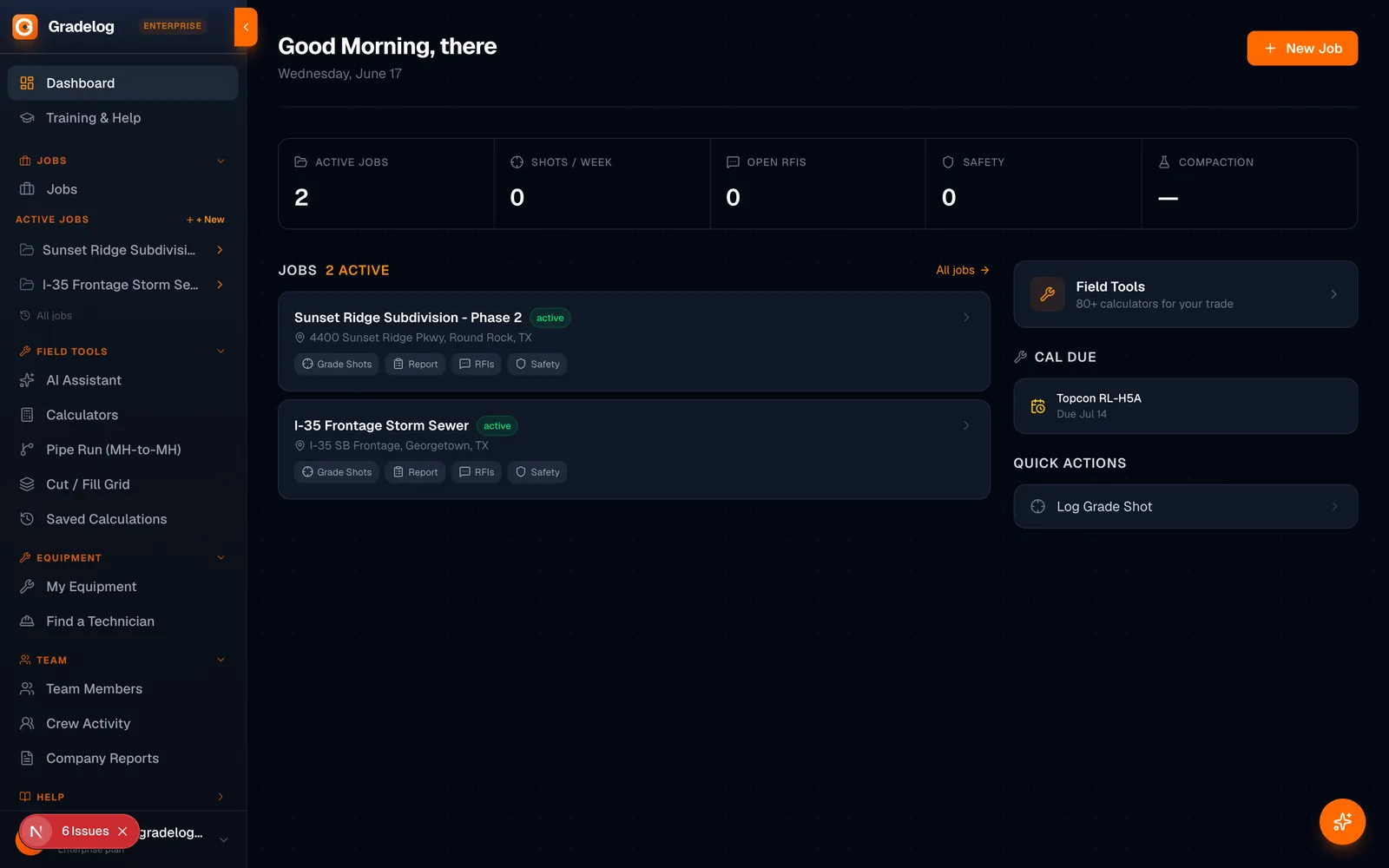
Your equipment. Your data. All in one place.
Gradelog is the field-execution platform built for grading and earthwork crews. Log grade shots, track cut/fill, document phases with photos, and generate as-built reports — from the cab to the office.
- Grade shots & cut/fill tracking per job
- Photo documentation by phase, task, and equipment
- As-built reports ready for inspector sign-off
- AI field assistant — troubleshoot on the jobsite
Built by the same team as Express Tools
Try Free →14 days
Free trial
8 languages
Supported
iPhone + Android
Works on