
Quick Answer
How do you use a Topcon RL-H5A, Spectra LL500, Leica Rugby 620 for rotary laser work?
A rotary laser that's out of calibration is worse than no laser — it gives you confident, wrong readings. Calibration drift happens slowly, which is why it's easy to miss: your grades and elevations s...
How to Calibrate a Rotary Laser Level: Field Check & Service Guide
Shop related product: Topcon RL-H5A Self-Leveling Rotary Laser at Express Tools →
Shop related product: Spectra Precision LL500 Rotary Laser at Express Tools →
Applies to: Topcon RL-H5A, Spectra LL500, Leica Rugby 620
A rotary laser that's out of calibration is worse than no laser — it gives you confident, wrong readings. Calibration drift happens slowly, which is why it's easy to miss: your grades and elevations shift by fractions over weeks and months until you're 1/4 inch out on a pour or your drainage doesn't flow. This guide covers the two-peg field check that every laser operator should run weekly, how to interpret the results, and when field checks aren't enough and factory calibration is required.
What 'Calibration' Actually Means for a Rotary Laser
Calibration for a rotary laser means the laser plane is truly horizontal (or at the set grade angle) everywhere around the 360-degree rotation — not just in one direction. A laser that's correctly calibrated at 0 degrees might be 1/16 inch high at 180 degrees due to a tilted leveling mechanism. This is called 'grade drift' or 'tilt axis error,' and it's the most common calibration failure on high-use units.
The built-in self-leveling system corrects for tripod tilt but can't correct for errors in its own calibration. If the electronic level sensor that the leveling motor references is itself drifted, the motor will level to the wrong position every time — and you'll never know from looking at it. The field check below catches this.
The Two-Peg Test: Field Calibration Check
The two-peg test has been the standard rotary laser calibration check for decades. It requires two grade rod setups at equal distance from the laser and catches horizontal plane error that shows up as a difference between the two sides.
Setup: Set up the laser at the midpoint between two locations, each 100 feet away in opposite directions (Peg A at 100' north, Peg B at 100' south from the laser). Get an on-grade reading at Peg A — write it down (e.g., 5.250'). Without moving the laser, get an on-grade reading at Peg B — write it down (e.g., 5.252').
Now move the laser to Peg A: Set up the laser at Peg A, facing Peg B (200 feet away). Shoot back to Peg B and record the reading. Then shoot toward the original center point and to the far side — compare all readings.
Interpret results: If the difference between Peg A and Peg B readings (from the same laser position) is less than 1/16 inch over 100 feet (approximately 0.005'), calibration is good. If the difference exceeds 1/8 inch at 100 feet, the laser needs factory calibration. Differences over 1/4 inch at 100 feet should stop work on precision applications immediately.
Model-Specific Field Calibration Notes
Topcon RL-H5A: Topcon's factory specification is ±10 arc seconds (±1/16" per 100'). The two-peg test should show differences under 0.005' at 100 feet. The RL-H5A has a manual calibration adjustment, but it should only be performed by authorized Topcon service — attempting field adjustment without the right tools moves the calibration reference and can make things significantly worse.
Spectra Precision LL500: Factory spec is ±1/16" per 100'. Two-peg test results are interpreted identically to Topcon. The LL500 has no user-accessible calibration adjustment — factory service only.
Leica Rugby 610/620: Factory spec is ±0.3mm/m (approximately ±1/32" per 100'). Leica Rugby units are somewhat more sensitive to transport vibration than Topcon models — units transported in vehicle beds without foam padding show calibration drift faster. Two-peg test monthly on high-use Rugby units.
When the Two-Peg Test Isn't Enough
The two-peg test catches horizontal plane errors. It doesn't catch rotation consistency errors (beam height variation as the head rotates), beam divergence (beam spreading too wide at long range), or slope accuracy errors on dual-grade units. For these checks, factory calibration equipment is required.
Signs that field checks aren't catching the real problem: two-peg test passes but elevations are consistently off against surveyed benchmarks; readings are accurate when shooting north/south but off east/west; the laser occasionally gives a good reading then a bad one from the same position.
Factory Calibration: When to Go In
Mandatory: after any drop that landed on the laser head. Optional but recommended: annually for any laser that's in daily use, and every 6 months for lasers used in high-vibration environments (near compactors, heavy machine work, or vehicles). Also after extreme temperature exposure (left in a hot vehicle over a full summer, or extended cold storage).
Factory calibration at an authorized service center includes horizontal plane accuracy verification, rotation consistency check, beam divergence measurement, self-leveling range and accuracy verification, and electronic components check. For Topcon: $150-250. Leica: $175-300. Spectra: $100-200. Worth it on equipment you depend on for precise work.
Frequently Asked Questions
How often should I calibrate my rotary laser?
Run the two-peg field check weekly on any laser in daily use. Send to a factory service center annually, or after any significant drop or extreme temperature exposure.
Can I calibrate a rotary laser myself?
You can run the two-peg field check yourself — it requires only a grade rod and 200 feet of flat ground. Adjusting the calibration mechanism requires factory tools and should only be done at an authorized service center.
How do I know if my rotary laser is out of calibration?
Run the two-peg test: set up the laser midway between two rod locations 100 feet apart. If the on-grade reading differs by more than 1/16 inch between the two sides, the laser needs service.
What causes rotary laser calibration to drift?
The main causes are: impacts (drops, hard knocks), extreme temperature cycles (hot vehicle storage in summer, freezing in winter), and normal long-term use wear on the leveling mechanism. High-vibration work environments accelerate drift.
Does the Topcon RL-H5A have automatic calibration?
No — the RL-H5A self-levels to its internal calibration reference, but cannot detect or correct errors in that reference itself. Manual calibration by an authorized service center is required when drift is detected.
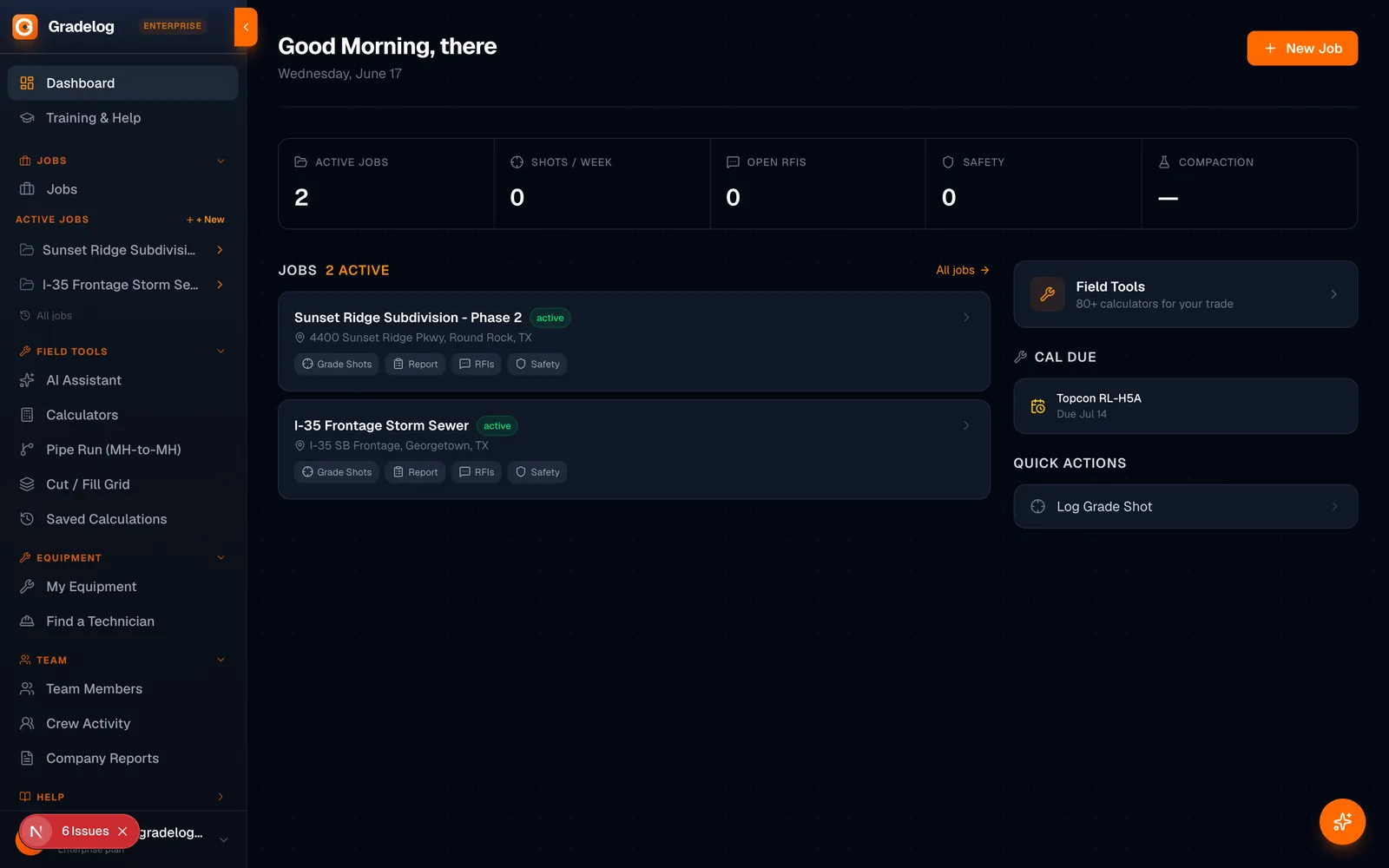
Track calibration dates for every laser in your fleet with Gradelog's Equipment Registry. Get alerts when calibration is due and log field check results. Free to start at gradelog.com.