
Tools Needed for Drainage System Installation: A Contractor's Complete Guide
Quick Answer
Drainage system installation is fundamentally about gravity and grade. A poorly installed drainage system leads to standing water, foundation damage, flooding, and expensive remediation. Professional contractors understand that success depends on precise grade control, accurate s
Drainage system installation is fundamentally about gravity and grade. A poorly installed drainage system leads to standing water, foundation damage, flooding, and expensive remediation. Professional contractors understand that success depends on precise grade control, accurate slope verification, and proper alignment. This comprehensive guide covers the tools that separate professional drainage installations from amateur work.
Essential Tools for Drainage System Installation
Drainage work demands specialized equipment designed to establish and maintain consistent grade throughout the system. The following tools are non-negotiable for professional installations:
Rotary Laser Level (Topcon RL-H5A – $608)
The Topcon RL-H5A is the foundational tool for any drainage project. This laser level is specifically suited for establishing grade lines across large excavation areas. Here's why it's essential for drainage work:
- Grade Control: Maintains ±1/8" accuracy over 100 feet—critical since drainage requires consistent 1-2% slope
- Wide Coverage: 360-degree laser output with 100-meter range covers entire drainage trenches without repositioning
- Wet Environment Durability: IP66 rating handles water spray from hydraulic systems and rain exposure
- Rapid Setup: Takes 3-5 minutes to level and rotate, minimizing crew waiting time
Drainage systems live or die by slope. A 1% slope (1 foot drop per 100 feet) is the standard minimum for many drainage systems. The RL-H5A ensures every section of your drainage line maintains this critical slope. Without proper grade, water pools, sediment accumulates, and the system fails within years instead of decades.
Pipe Laser (Spectra DG813 – $5,196)
While rotary lasers establish overall grade, pipe lasers ensure that the actual drainage pipe sits perfectly aligned throughout its entire run. The Spectra DG813 is the premium choice for drainage contractors:
- In-Pipe Accuracy: Sits inside the drainage pipe, projecting a laser beam down the center line
- Extended Range: Operates effectively to 1,600 feet, perfect for long drainage runs from building to daylight or detention pond
- Grade Capability: Accommodates slopes from -15% to +15%, handling swales and steep terrain
- Visual Feedback: Laser dot on target board shows exactly where pipe sections need adjustment for perfect alignment
In drainage work, pipe alignment directly affects flow characteristics. Even slight misalignment (1/4" per 10 feet) creates turbulence, reduces flow capacity, and causes debris to catch. The DG813 ensures pipes connect in perfect alignment, maintaining consistent flow velocity and preventing the foundation cracks and pooling that result from poor drainage.
GNSS/GPS System (Spectra GL412N – $2,595)
The Spectra GL412N provides critical functionality for drainage system design and documentation:
- Site Mapping: Establishes elevation benchmarks across the site, essential for designing proper drainage grades
- Outlet Location: Precisely identifies where drainage systems discharge to, ensuring continuity of grade
- As-Built Records: Documents final drainage system elevations and positions for warranty and future maintenance
- Stormwater Compliance: Many municipalities require as-built drainage documentation; GNSS provides this legally
Drainage systems require accurate baseline elevation data before construction begins. The GL412N enables contractors to identify high and low points, plan optimal drainage routes, and document the finished system. This is increasingly important as municipalities require detailed stormwater management compliance documentation.
Additional Essential Tools
- Laser Receiver: Handheld detector enabling site personnel to "find" the laser beam in bright daylight
- Grade Stakes (Laser Target): Specialized stakes with reflective targets for laser readings along drainage lines
- Measuring Tape (100+ feet): For verifying distances, calculating slopes, and checking grade math
- Slope Gauge: Digital or mechanical tool for field verification of installed slope
- Line Level: Quick check tool for verifying section-to-section grade consistency
- Drainage Probe/Locator: Identifies buried drainage lines (critical when tie-ins connect to existing systems)
Optional Tools That Improve Drainage System Quality
These tools aren't absolutely required but significantly improve project outcomes and efficiency:
- Digital Level with Remote Display: Reduces fatigue and math errors by providing electronic grade readouts
- Laser Distance Meter: Quickly calculates distances for slope verification without tape measures
- Video Pipe Inspection Camera: Post-installation verification that drainage pipes are properly aligned and free of defects
- Flow Meter: Measures actual flow rate to verify drainage system capacity meets design requirements
- Tablet-Based Surveying Software: Integrates laser measurements with design software, enabling real-time comparison to plans
- Drone Survey System: Pre-project site analysis and as-built documentation for large residential or commercial developments
Common Mistakes When You Don't Have the Right Tools
Contractors who attempt drainage work with inadequate tools consistently experience these failures:
- Insufficient Slope: Drainage installed at 0.5% instead of required 1% results in pooling, standing water, and foundation damage. Rework costs $15,000+ per 100 linear feet.
- Pipe Misalignment: Pipes that aren't perfectly aligned create dams inside the line where debris catches. This reduces capacity and causes backups.
- Grade Reversals: Without proper laser setup, trenches sometimes inadvertently slope backward in sections, creating ponds within the drainage system itself.
- Failed Inspections: Municipal inspectors increasingly require laser documentation of drainage grade. Manual methods fail inspection and require expensive rework.
- Warranty Claims: Drainage failures within 5 years result in contractor liability. Proper laser documentation proves compliance and protects your business.
- Timeline Overruns: Manual grade verification is 4-5x slower than laser-guided work, extending project timelines and increasing labor costs.
Frequently Asked Questions
What slope is required for drainage systems?
Most residential and commercial drainage systems require a minimum 1% slope (1 foot drop per 100 feet). Perforated drains in swales can be as shallow as 0.5%, while steep terrain allows 5-10% slopes. The Topcon RL-H5A establishes this slope across the entire drainage line, ensuring compliance throughout.
Why is pipe laser more accurate than just using a rotary laser on the finished trench?
Rotary lasers measure from the trench surface down to a leveling rod. This introduces multiple error sources: uneven trench bottom, settling during backfill, and rodman positioning errors. Pipe lasers sit directly in the installed pipe, measuring the actual drainage line. This eliminates error variables and confirms the real utility matches design specifications.
Can I use hand methods like string lines for smaller drainage projects?
Theoretically, yes—but practically, no. String lines are affected by wind, sagging, and operator error. Even on short 50-foot runs, string methods typically achieve only ±1/2" accuracy. A single 1/2" dip in a drainage line can create a sump. The RL-H5A ($608) costs far less than the rework resulting from hand method failures.
How do I document drainage installation for municipal inspectors?
Most municipalities now require either digital elevation records from GNSS systems or certified laser survey documentation. The Spectra GL412N provides GPS coordinates and elevations that integrate directly into municipal GIS systems. Many jurisdictions require this as-built data before final occupancy permits are issued.
Build professional drainage systems with confidence. Express Tools provides the laser and positioning equipment contractors trust. Browse Rotary Lasers | View Pipe Laser Systems | Shop GNSS/GPS Equipment
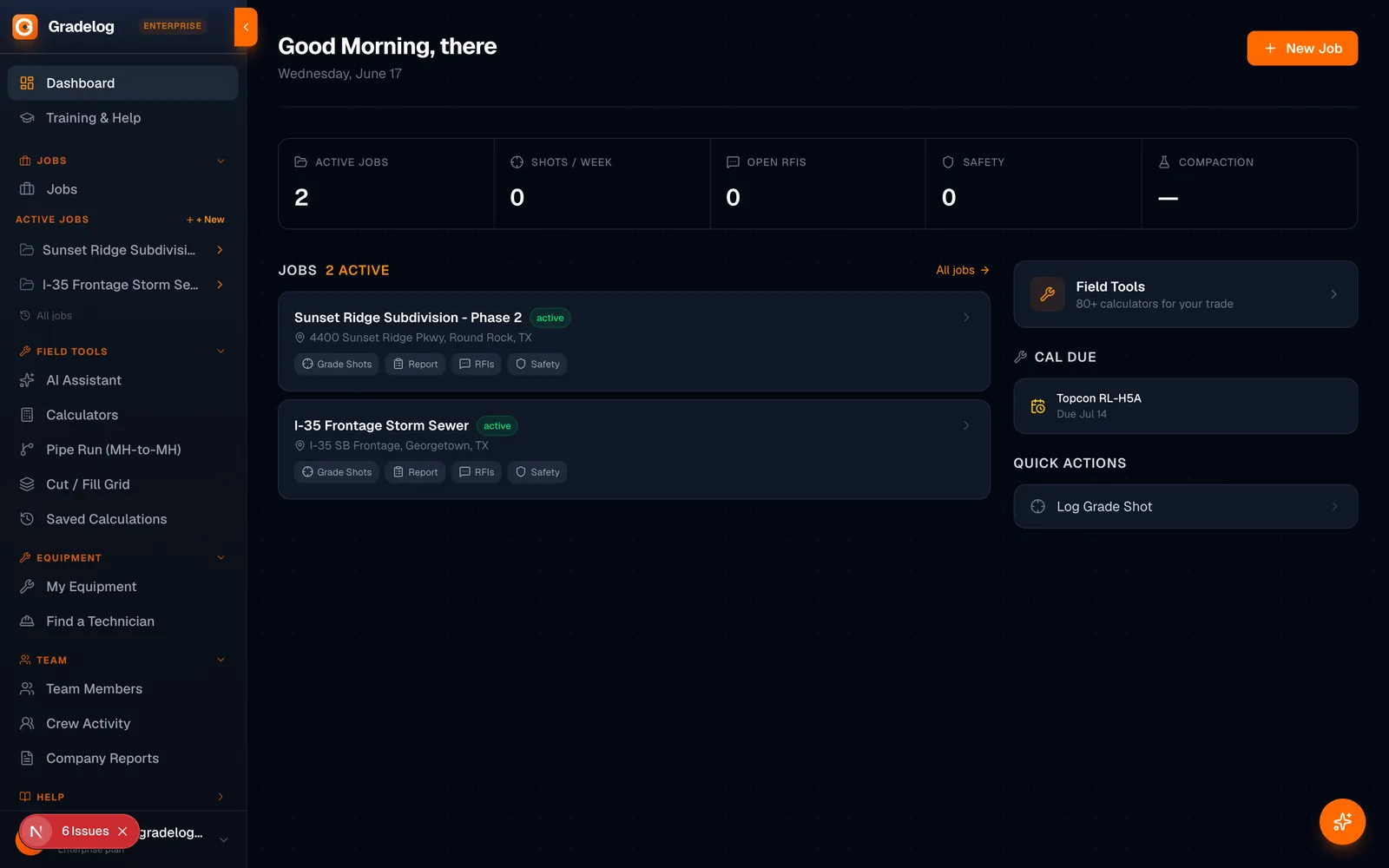
Document this job type with Gradelog — shot logs, as-built reports, calibration records. Free to start at gradelog.com.