
Tools Needed for Land Development Rough Grading: A Contractor's Complete Guide
Quick Answer
Rough grading represents the critical foundation phase of land development—transforming raw terrain into properly sloped, compacted base for subsequent utility installation and finished construction. The difference between efficient rough grading and project delays comes down to
Rough grading represents the critical foundation phase of land development—transforming raw terrain into properly sloped, compacted base for subsequent utility installation and finished construction. The difference between efficient rough grading and project delays comes down to equipment precision and operator guidance systems. This guide reveals the specific tools professional contractors deploy during rough grading, why each matters, and the costly mistakes that result from tool gaps.
Essential Tools for Land Development Rough Grading
Rough grading demands equipment capable of establishing consistent slope across large areas while accommodating variable terrain, weather, and equipment movement. Three tool categories form the professional rough grading foundation: rotary laser levels for slope establishment, pipe lasers for drainage corridor control, and increasingly, GNSS systems for site-wide elevation reference.
Topcon RL-H5A Rotary Laser Level ($608)
The Topcon RL-H5A serves as the entry point for contractors beginning rough grading operations or managing smaller land development sites (5-15 acres). This rotary laser establishes consistent reference elevation across large areas with minimal setup complexity.
Why This Tool Dominates Rough Grading: During rough grading, your primary objective is establishing uniform slope across building pads, parking areas, and fill zones. The RL-H5A rotates continuously, projecting a level laser plane that serves as reference for fill placement and cut operations. Unlike string lines or grade stakes requiring constant repositioning, this laser maintains consistent elevation reference across areas up to 2,000 feet—meaning your equipment operator sees the same grade reference whether working 50 feet or 500 feet from the instrument.
Slope Application: Rough grading typically requires 1-3% slope for proper drainage. Set the RL-H5A on a tripod, establish it at a known elevation, then tilt the laser plane to create the desired slope. Your dozer or grader operator receives continuous feedback—laser beam above the blade means cut material, beam at blade level means on-grade, beam below blade means fill material needed. This real-time guidance maintains consistency that string lines and visual estimation never achieve.
Specific Land Development Use Case: A 12-acre commercial site requires parking areas sloped at 1.5% toward perimeter drainage. Position the RL-H5A at the parking area's high point, establish the slope plane, and let the motor grader operator work across the entire area maintaining that reference. The RL-H5A's self-leveling system compensates for minor tripod repositioning, eliminating setup time between zones.
Durability for Rough Grading Conditions: Rough grading generates dust, vibration, and occasional equipment proximity that would damage sensitive instruments. The RL-H5A's sealed optics and robust construction withstand daily operation in these conditions. The sealed receiver mount survives impact and weather exposure.
Spectra DG813 Digital Grade Laser ($5,196)
The Spectra DG813 represents the professional choice for land development projects involving complex slopes, large acreages (15+ acres), or equipment automation integration. This system combines rotary laser technology with digital grade control compatibility and extended-range performance.
Why Large Land Development Projects Require the DG813: Rough grading on land development projects isn't simple single-slope work. Your site likely includes multiple pad elevations, drainage corridors, utility easements, and transition zones between cut and fill areas. The DG813 handles this complexity through its 2,600-foot range and digital receiver system that communicates equipment position and elevation requirements simultaneously.
Machine Grade Control Integration: This represents the DG813's most valuable feature for rough grading efficiency. Mount the digital receiver on your motor grader cab, and the system automatically displays whether the blade is above, on, or below target grade. Some advanced systems integrate directly with the grader's hydraulic grade control—automatically raising or lowering the blade to maintain elevation. On a 20-acre site requiring rough grading to ±0.3 feet accuracy, this integration reduces labor hours by 25-35% compared to manual laser reference.
Slope Management Across Large Areas: Land development sites rarely present uniform terrain. The DG813 manages sloped laser planes that accommodate existing grades while establishing new development elevations. A typical application: establishing finish grades across a 15-acre site where the southeast corner sits 18 feet lower than the northwest. The DG813's digital control system adjusts slope reference automatically as the grader moves between zones, eliminating manual setup transitions.
Multi-Zone Coordination: Large land development projects often involve multiple equipment operators working simultaneously on different site areas. The DG813 can broadcast separate slope references to multiple receivers, allowing coordinated grading across the site. This capability reduces the supervision time required and prevents elevation conflicts between adjacent areas.
Rough Grading Accuracy: While the term "rough grading" suggests lower precision than finish grading, modern projects often specify ±0.4-foot accuracy during rough grading to minimize subsequent finish grading labor. The DG813 delivers this accuracy consistently, preventing over-grading that wastes material and under-grading that requires expensive rework.
GL412N Pipe Laser ($2,595)
The GL412N addresses the critical challenge of establishing proper slope for drainage infrastructure during rough grading phases. This specialized tool projects laser alignment through underground pipes and conduits, ensuring gravity-flow systems function as designed.
Why Rough Grading Requires Drainage Control: Proper site drainage begins during rough grading—not after. Storm drains, site swales, and utility corridors require precise slope control. If you establish final grades without verifying drainage route slope, water ponding and erosion problems emerge after site completion, triggering expensive remediation.
Pipe Laser Application in Rough Grading: As rough grading progresses, set up the GL412N to verify drainage route elevations. Position the laser inside the drainage line at the upstream point, place the target receiver at the downstream location, and immediately confirm that the terrain slope matches required drainage slope. Most storm systems require 0.5-2% slope; sanitary laterals need 0.5-1% slope. The GL412N confirms these requirements are met during rough grading, before finish grading work begins.
Specific Land Development Scenario: You're rough-grading a 25-acre residential subdivision with internal storm drainage system. The engineer's grading plan specifies that the main storm line (buried 4 feet deep) runs northeast to the site's outfall at specific elevations. Instead of waiting until utility installation to discover the terrain is 0.8 feet too high along the corridor, use the GL412N during rough grading to confirm that surface grades align with required pipe slopes. This verification prevents the scenario where storm infrastructure can't be installed as designed—requiring expensive redesign and rework.
Cost Prevention Through Early Verification: A single storm line requiring elevation adjustment after rough grading completion typically costs $8,000-15,000 in rework. The GL412N's $2,595 investment prevents this cost on first use.
Optional Tools That Amplify Rough Grading Efficiency
While the three essential tools form the core system, several optional instruments accelerate rough grading progress and improve final grade accuracy:
GNSS/GPS Survey Systems: For land development projects exceeding 15 acres, GNSS receivers provide rapid site-wide elevation mapping. Capture grid elevations across the entire site at project start, then use this data to generate grading plans that balance cut and fill volumes. Explore comprehensive GPS/GNSS solutions here.
Grade Control Receiver Packages: Digital receivers with cab-mounted displays and automatic blade control represent the frontier of rough grading automation. These systems work seamlessly with the Spectra DG813 to maintain elevation within ±0.2 feet without operator manual blade adjustment.
Slope Reference Tools: Digital inclinometers and slope measurement devices help your superintendent verify that rough grading matches design slopes independently from laser measurement. This redundancy catches errors before they propagate through the project.
Data Logging and Cloud Capture: Wireless systems that record elevation data throughout the rough grading day, uploading to project management software, provide real-time quality verification. Review site elevation progress from the office, identifying any anomalies before work continues the next day.
Extended Range Receiver Packages: The Spectra DG813's receiver can be extended to 2,600 feet with wireless remote capabilities, allowing ground crews to verify elevations far from the laser instrument without direct line of sight.
Critical Mistakes Contractors Make During Rough Grading Without Proper Tools
Mistake #1: Relying on Grade Stakes Instead of Continuous Laser Reference — Traditional grade stakes work on small areas but become liability on land development sites. Stakes get knocked down by equipment, buried in cut/fill operations, and their spacing makes accurate slope maintenance impossible. Contractors without laser systems inevitably produce rough grades with high spots, swales, and drainage problems requiring rework. Cost impact: $2,000-5,000 per acre in finish grading and remediation.
Mistake #2: Skipping Drainage Verification During Rough Grading — Many contractors establish rough grades then discover during utility installation that drainage slopes are inadequate. By then, significant terrain modifications are necessary, often requiring re-grading 30-40% of the site. The GL412N's $2,595 cost is trivial compared to this rework expense.
Mistake #3: Using Residential-Grade Equipment on Commercial Land Development — A $200 bargain-bin rotary laser reaches 500 feet on flat ground but fails to maintain slope accuracy over variable terrain. Rough grading requirements demand professional-grade equipment (Topcon RL-H5A minimum, Spectra DG813 for complex sites) that maintains accuracy across the entire working range.
Mistake #4: Inadequate Equipment Maintenance During Active Grading — Optical instruments accumulate dust and lens degradation during rough grading. Contractors who don't perform monthly lens cleaning and quarterly calibration verification experience gradual accuracy loss—imperceptible but cumulative. By mid-project, the laser may be ±0.5 feet off specification without operator awareness, rendering subsequent grading unreliable.
Mistake #5: Failing to Coordinate Multiple Operator Laser References — Land development sites often employ multiple equipment operators simultaneously. Without a unified laser reference system (like the DG813's multi-receiver capability), operators work to different elevations, creating inconsistent grades and elevation conflicts between site zones.
Frequently Asked Questions
How do I establish the correct slope plane on a rotary laser for rough grading?
Most rotary lasers like the Topcon RL-H5A and Spectra DG813 include slope-setting features. Establish the laser instrument at a known starting elevation using a reference rod. Then tilt the laser head to the desired slope angle (typically 1-3% for site drainage). Many systems display slope in percentage or degrees. Once set, the laser rotates a sloped plane—not a level plane—providing continuous grade reference as equipment moves across the site. Digital systems like the DG813 can store multiple slope references and switch between them as work progresses across different site zones.
What's the difference between rough grading and finish grading equipment requirements?
Rough grading requires accuracy to approximately ±0.4-0.5 feet across large areas—establishing proper slope and general elevation. Finish grading demands ±0.1-0.2 feet accuracy with tight elevation control. A professional-grade rotary laser like the Spectra DG813 works for both applications but shines during rough grading where its 2,600-foot range and slope flexibility matter most. For finish grading, some contractors add complementary precision tools like laser levels or GNSS systems that provide tighter point-to-point accuracy.
Can one rotary laser cover the entire rough grading area on a large land development site?
This depends on site acreage and terrain. The Topcon RL-H5A covers about 2,000 feet effectively; the Spectra DG813 reaches 2,600 feet. On a 20-acre site, you'll likely position the laser in 2-3 different locations to maintain consistent coverage. The DG813's digital system can store different slope references for each zone, allowing coordinated work across multiple areas. Plan to reposition your laser every 6-10 acres, which typically requires 10-15 minutes per move.
Should I use GNSS for rough grading or stick with rotary lasers?
Both tools serve different purposes. GNSS excels at capturing site-wide elevation data and verifying finished grades against design specifications—ideal for pre-grading surveys and post-grading quality control. Rotary lasers like the Spectra DG813 provide real-time operator guidance during active earthwork. Professional contractors often combine both: use GNSS to establish baseline site elevation and generate grading plans, then deploy rotary lasers during actual rough grading to guide equipment operators. This combination provides comprehensive elevation management.
Planning Your Rough Grading Equipment Strategy
Land development rough grading success depends on matching tool capability to site complexity. Start with the Topcon RL-H5A for straightforward sites under 15 acres, upgrade to the Spectra DG813 for complex projects with multiple slopes and equipment coordination needs, and integrate the GL412N whenever site drainage infrastructure requires verification.
Ready to build your rough grading equipment foundation? Explore our complete selection of rotary lasers for slope and elevation control, pipe lasers for drainage verification, and GPS/GNSS systems for comprehensive site surveying. Our equipment specialists can discuss your specific land development project scope and recommend the optimal tool combination.
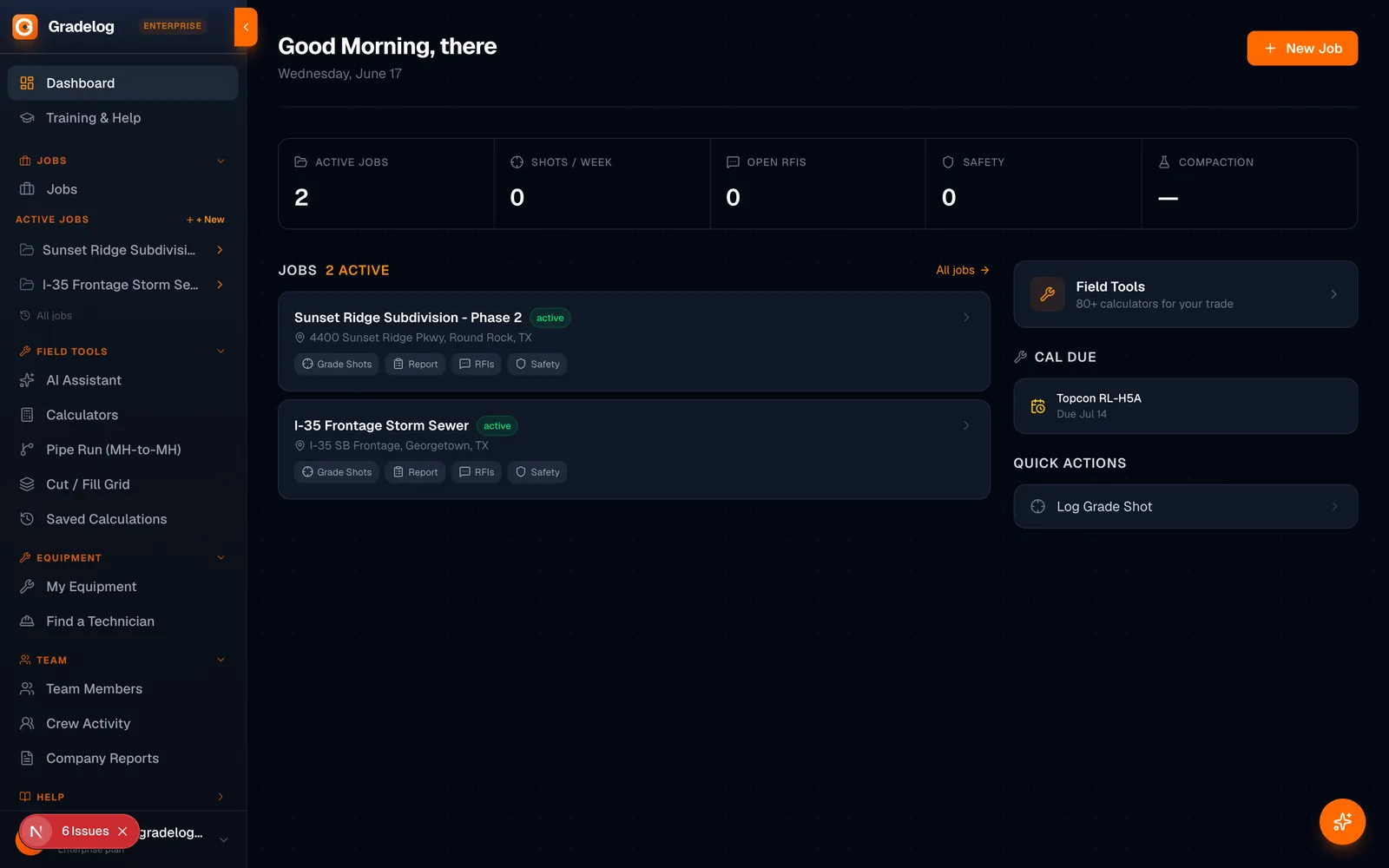
Document this job type with Gradelog — shot logs, as-built reports, calibration records. Free to start at gradelog.com.