
Tools Needed for Pipeline Installation: A Contractor's Complete Guide
Quick Answer
Pipeline installation demands precision, safety, and efficiency. Whether you're laying municipal water lines, gas pipelines, or industrial distribution networks, having the right tools makes the difference between a project that stays on schedule and budget versus one plagued by
Pipeline installation demands precision, safety, and efficiency. Whether you're laying municipal water lines, gas pipelines, or industrial distribution networks, having the right tools makes the difference between a project that stays on schedule and budget versus one plagued by costly rework and safety incidents.
Professional contractors understand that pipeline installation isn't just about heavy equipment—it's about laser-precision grade control, accurate depth measurements, and real-time positioning data. This guide walks you through the essential tools that separate seasoned pipeline contractors from those still learning the hard way.
Essential Tools for Pipeline Installation
Pipeline installation requires tools that handle both the visible challenges—terrain variation, multiple elevation changes, long distances—and the invisible ones: maintaining consistent grades over miles, ensuring proper slope for drainage or flow, and documenting accurate as-builts.
Topcon RL-H5A Rotary Laser Level ($608)
Why it matters for pipeline work: The RL-H5A is the workhorse laser for short to medium-range pipeline applications. At $608, it's an affordable entry point that doesn't compromise on accuracy. This tool projects a rotating laser plane that receivers can pick up from 0-800 meters (line-of-sight dependent), making it ideal for establishing and maintaining consistent grades along trenches.
For pipeline installation, you'll use the RL-H5A to:
- Establish initial grade lines before trenching begins
- Control excavator blade depth during trench preparation
- Monitor pipe bedding layer elevation
- Verify backfill heights at regular intervals
- Document grade checks for quality assurance records
The self-leveling feature saves time on uneven terrain—common in pipeline routes through rural and industrial areas. Its durability in dusty conditions (frequent on active construction sites) makes it reliable for week-long stretches in challenging environments.
Spectra DG813 Pipe Laser ($5,196)
Why it matters for pipeline work: When you're installing pipe—especially over long distances—a dedicated pipe laser becomes essential. The Spectra DG813 ($5,196) is specifically engineered for pipeline and sewer applications, projecting a laser beam directly through or along the pipe itself.
Unlike rotary lasers that establish grade planes, pipe lasers target the pipe centerline and slope. This is critical because:
- Alignment verification: The laser beam shows exactly where the pipe should sit, preventing misalignment that could cause joint separation or stress points.
- Grade consistency: You can verify slope accuracy (typically 0.5% for gravity pipelines) continuously as pipe is laid, catching errors before hundreds of feet are installed incorrectly.
- Long-distance accuracy: The DG813 maintains accuracy over 500+ meters, essential for major transmission lines where rotary lasers lose effectiveness.
- Safety documentation: Real-time laser verification creates an irrefutable record that pipe was installed to specification—critical for municipal projects and third-party inspections.
For contractors installing sewer, water, or gas pipelines where grade tolerance is measured in fractions of a percent, the DG813 isn't optional—it's the standard that insurers, owners, and inspectors expect.
Topcon GL412N Laser Level ($2,595)
Why it matters for pipeline work: The GL412N ($2,595) fills the gap between rotary lasers and pipe lasers. This green laser level offers superior visibility in bright sunlight—a significant advantage since pipeline work often happens in open, sunny terrain where red lasers wash out.
The GL412N excels at:
- Daytime grade control: Green laser technology means crew members can see the laser without dimly-lit laser receivers, saving time on visibility adjustments.
- Flexible grade checking: Use it for establishing benchmark elevations before trenching, checking grade as pipe is positioned, and verifying final elevations after initial installation.
- Long working range: At up to 30 meters in good conditions, it covers typical pipeline bed widths and allows for remote checking without moving the instrument frequently.
- Cost efficiency: Between a basic rotary laser and a dedicated pipe laser, it's ideal for smaller pipeline contractors or those working on projects where pipe laser precision isn't mandated.
Optional Tools That Improve Pipeline Installation
Laser receivers and mounting brackets: Magnetic or clamp-style receivers mount directly to excavator teeth, pipe, or grade stakes. For pipeline work, rod-mounted receivers let crew members identify exact grade points without electronic displays. Budget $200-400 per receiver.
GPS/GNSS positioning systems: For large-scale pipeline projects spanning kilometers, GNSS systems provide elevation data and horizontal positioning simultaneously. If your pipeline work includes horizontal boring under obstacles or complex terrain with significant elevation change, GPS-GNSS systems eliminate grade uncertainties. These start around $8,000 for receiver-based systems.
Slope checking tools and laser targets: Simple but effective—a torpedo level, slope gauge, and laser target cards cost under $100 but catch grade errors before they become expensive problems.
Digital elevation tracking software: Pairing laser data with jobsite tablets allows crew to document real-time elevation profiles, creating as-built records automatically rather than relying on hand-measured notes.
Critical Mistakes Contractors Make Without Proper Tools
Mistake 1: Relying on grade stakes alone — Old-school contractors sometimes use only painted stakes and hand-calculated measurements. Without laser verification, grade errors accumulate quickly. A 0.1% grade error on a 1,000-meter pipeline means the outlet is 1 meter higher than designed—enough to cause flow problems or backup. Pipe lasers catch this immediately.
Mistake 2: Using rotary lasers beyond their effective range — The RL-H5A works great to 400 meters, but contractors often attempt to use it at 600+ meters where atmospheric refraction introduces errors. Switching to a pipe laser at distance eliminates this problem but requires owning or renting the right tool.
Mistake 3: Skipping grade checks on cloudy days — Red lasers become nearly invisible in bright sunlight. Contractors without green laser alternatives sometimes skip midday verification, installing pipe on optimistic assumptions about grade. The GL412N's visibility eliminates this temptation.
Mistake 4: Not documenting as-builts with laser readings — Without systematic laser verification records, disputes with owners over whether pipe was installed to spec become he-said-she-said arguments. Laser documentation proves you did the work correctly.
Frequently Asked Questions About Pipeline Installation Tools
Q: Can I use a rotary laser instead of a pipe laser for all pipeline work?
A: For short runs (under 300 meters) or non-gravity pipelines where slope tolerance is loose, rotary lasers suffice. For municipal water/sewer lines or gas pipelines where grade accuracy is critical, a pipe laser is the standard. Rotary lasers establish the plane; pipe lasers verify the specific centerline and slope of the actual pipe being installed. They solve different problems.
Q: How often should I check grade during installation?
A: Best practice: every pipe section (typically every 6 meters for 6-meter pipe lengths), or at minimum every 50 meters. Some municipalities require checking at every joint. Laser tools make this feasible without slowing installation. Hand measurements at that frequency become a production bottleneck.
Q: What's the difference between a rotary laser and a pipe laser for pipeline work?
A: Rotary lasers create a rotating plane of light—imagine a spinning laser that sweeps across the entire trench. Pipe lasers project a single beam directly through or aligned with the pipe. For pipelines, the beam approach is more precise because it targets exactly where the pipe should sit, not just an elevation plane.
Q: Should I own laser equipment or rent it for pipeline projects?
A: If you run pipeline regularly (more than 6 projects yearly), ownership makes financial sense. Rental for occasional projects costs $100-300/week but avoids capital outlay. Many contractors own a rotary laser ($600-1,000) and rent pipe lasers ($400-500/week) for specialized projects to balance cost and flexibility.
Pipeline installation requires tools built for accuracy, durability, and real-time verification. The Topcon RL-H5A, Spectra DG813, and GL412N represent the essential spectrum—from fundamental grade control to precision pipe alignment. Investing in these tools isn't optional if you want to install pipelines that stay watertight, flow correctly, and pass inspection on the first shot.
Ready to upgrade your pipeline tools? Explore our complete selection of rotary lasers, pipe lasers, and positioning systems at Express Tools. We offer same-day shipping on in-stock models and flexible rental options for contractors testing equipment before purchasing.
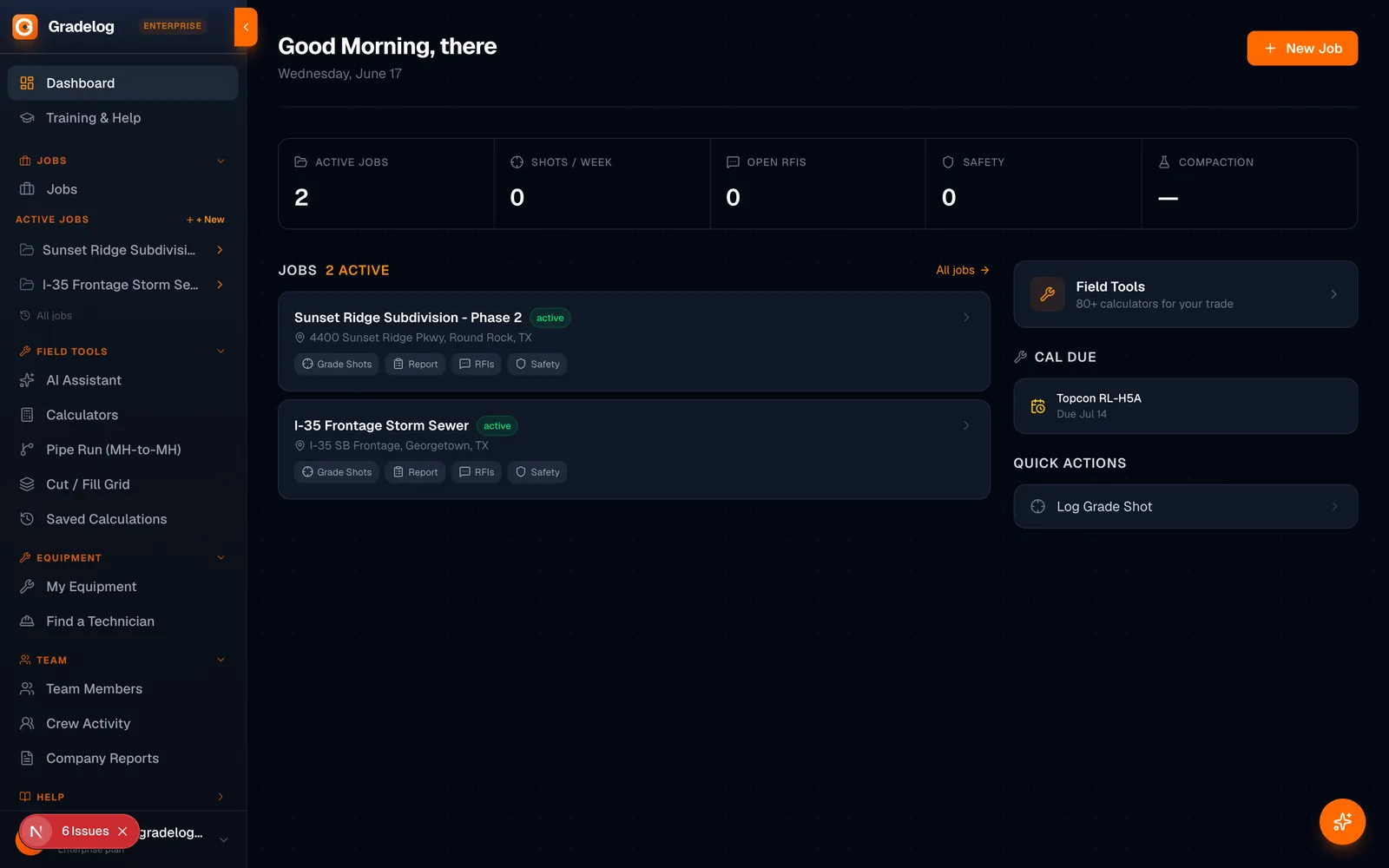
Document this job type with Gradelog — shot logs, as-built reports, calibration records. Free to start at gradelog.com.