Free Shipping on orders over $500


Transit Levels
The Short Answer
A transit level is an optical instrument that measures both level (horizontal) and vertical angles, letting one instrument handle leveling, grade checking, and basic layout. Express Tools carries David White transit levels — the Meridian LT6-900 and Universal LT8-300 series — as bare instruments or complete packages with tripod and grade rod.
Transit levels combine a builder’s level with a vertical arc, so the telescope tilts to measure vertical angles and plumb lines in addition to running levels. For foundations, footings, setting grade stakes, and checking plumb on walls and columns, a transit level is the simplest one-instrument answer — no batteries, no calibration schedule, no learning curve.
David White has built transit levels for American contractors for over a century. The Meridian LT6-900 covers everyday residential and light-commercial layout, while the Universal LT8-300 series adds a laser plummet or optical plummet for faster setups over a point.
Transit Levels In Stock
Inventory is being restocked — contact us for availability and lead times.
Frequently Asked Questions
What is the difference between a transit level and a builder’s level?
A builder’s (automatic) level only measures horizontal — the telescope is fixed level. A transit level’s telescope also tilts vertically, so it can measure vertical angles, check plumb, and carry a line up a wall or column. If you only run grades, an automatic level is simpler; if you also do layout and plumb checks, a transit level does both.
Are transit levels still used, or has everything gone laser?
Both are used. Rotary lasers are faster for one-person grade work over open sites, but transit levels remain popular for foundations, small layout jobs, and crews that want an optical instrument with no batteries or receivers. Many contractors run both: a laser for production grade work and a transit for layout and checks.
What accuracy do transit levels achieve?
Typical construction transit levels read to 5–15 minutes of arc on the circles and hold leveling accuracy around 1/4 inch per 100 feet — more than sufficient for footings, foundations, and site layout. For survey-grade angle work, step up to a theodolite or total station.
Should I buy the bare instrument or a package?
If you don’t already own a flat-head tripod and grade rod, buy the package — the bundled tripod and rod are matched to the instrument and cost less together. Packages are available with rods graduated in inches or tenths.
Related Resources

Built for equipment owners
Run the jobsite around your equipment
Gradelog is the AI field platform for contractors — grade shots, photo documentation, calibration tracking, and as-built reports, all tied to your gear.
- Equipment & calibration tracking
- Photo + grade documentation
- AI field assistant, 8 languages
Free 14 days with every Express Tools purchase
Your equipment. Your data. All in one place.
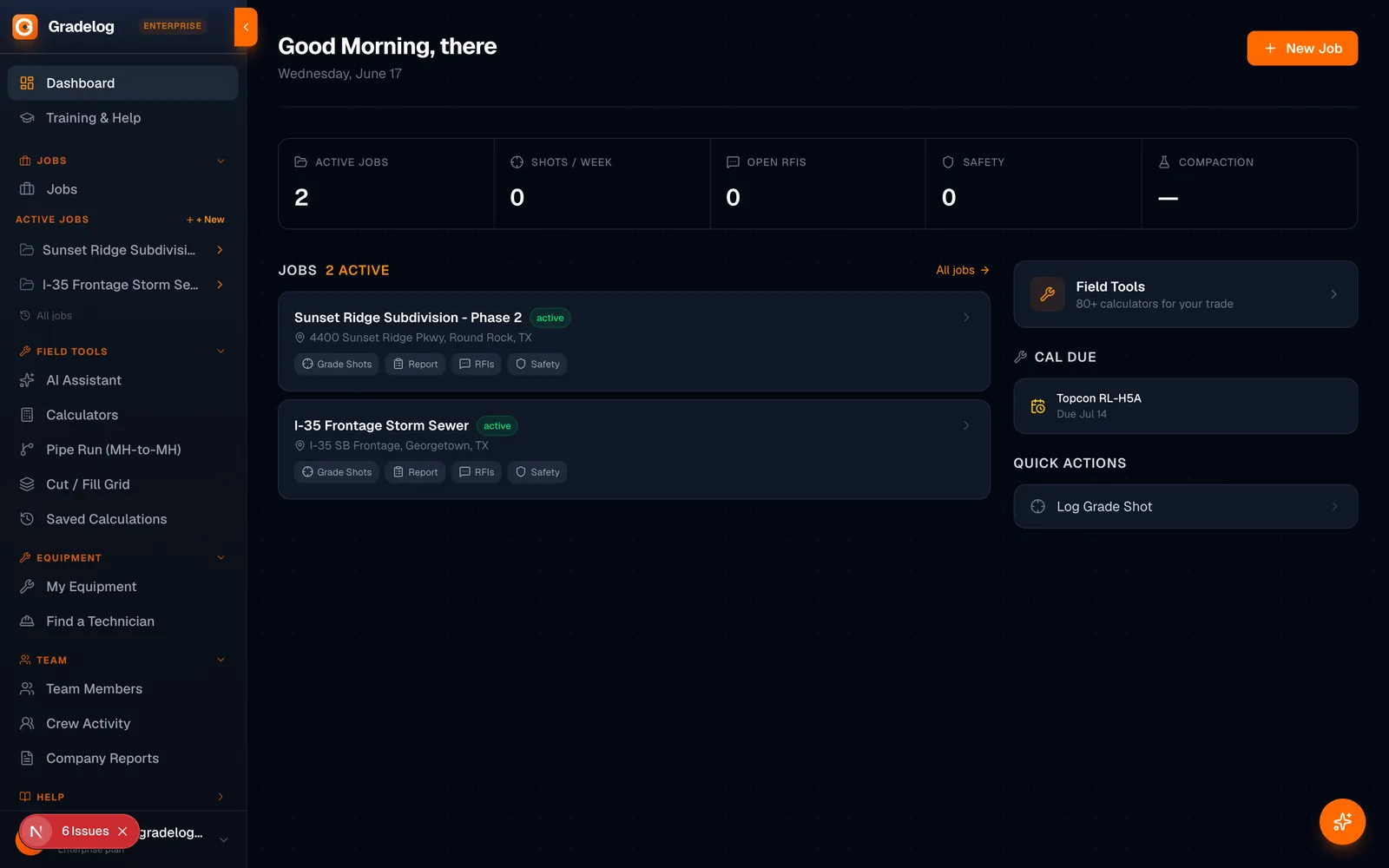
Gradelog is the field-execution platform built for grading and earthwork crews. Log grade shots, track cut/fill, document phases with photos, and generate as-built reports — from the cab to the office.
- Grade shots & cut/fill tracking per job
- Photo documentation by phase, task, and equipment
- As-built reports ready for inspector sign-off
- AI field assistant — troubleshoot on the jobsite
Built by the same team as Express Tools
Try Free →14 days
Free trial
8 languages
Supported
iPhone + Android
Works on