Free Shipping on orders over $500


Grade Rods
The Short Answer
A grade rod (also called a leveling rod or surveying rod) is a graduated staff held vertically on a ground point while an optical level or rotary laser reads its scale to determine the elevation difference between points. Express Tools stocks fiberglass rods in 13-ft, 17-ft, and 25-ft lengths plus aluminum rods, in graduations of tenths (decimal feet), inches, and metric, from SitePro, Seco, Spectra Precision, Topcon, and LaserLine.
A grade rod is the other half of any optical-level or laser-level workflow: the instrument creates a level reference line; the rod translates that line into an elevation reading. Rod graduation matches how your crew works — decimal feet (tenths) for engineering and most U.S. construction, inches for residential and rough layout, metric for civil work on metric projects.
Fiberglass rods resist moisture, warping, and the thermal expansion that makes aluminum rods shift readings over the course of a long day in the sun. Aluminum rods are lighter and less expensive, making them a practical choice for short-range utility work and residential grading where temperature-induced error stays within tolerance. Both fiberglass and aluminum construction rods telescope in sections and read directly from the instrument telescope or laser receiver clipped to the rod face.
For direct-reading laser work — where the crew wants the receiver to display a cut-or-fill number rather than a raw elevation — LaserLine direct-reading grade rods show the offset from the design elevation directly on the rod face, simplifying layout for less experienced crews.
Grade Rods In Stock

Topcon
RL-H5A Self-Leveling Laser PS.RB Kit with LS-100D Receiver, Rechargeable Batteries, Grade Rod INCHES and Tripod - 1021200-16-K2
Starting at
$1,065

Topcon
RL-H5A Self-Leveling Laser PS.DB Kit with LS-100D Receiver, Grade Rod INCHES and Tripod - 1021200-17-K2
Starting at
$1,025

Topcon
Topcon RL-H5B Self-Leveling Laser PS.DB2 Kit with LS-80X Receiver, Alkaline Batteries, Grade Rod Inches and Tripod- 1021200-73-K2
Starting at
$660

Topcon
Topcon RL-H5B Self-Leveling Laser PS.DB2 Kit with LS-80L Receiver, Alkaline Batteries, Grade Rod Inches and Tripod- 1021200-33-K2
Starting at
$660
Frequently Asked Questions
What is the difference between a grade rod, leveling rod, and surveying rod?
The terms are largely interchangeable. "Grade rod" is common in construction; "leveling rod" is the traditional survey term; "surveying rod" is the broadest label. All refer to a calibrated staff used with an optical level or laser to read elevation differences. The only meaningful technical distinction is between direct-reading (also called CR or SVR type) rods versus conventional graduated rods — both are available in this catalog.
Tenths, inches, or metric — which graduation should I choose?
Choose based on how your drawings are dimensioned. U.S. civil engineering plans almost always work in decimal feet (design elevations shown to two decimal places), so tenths rods are the professional standard for construction grading, utility work, and public infrastructure. Inches rods are common for residential rough grading and building layout where plans are in feet and inches. Metric rods are used on international projects or where specifications are in meters.
Fiberglass vs aluminum grade rod — which is better?
Fiberglass holds its dimensions better: it resists warping from moisture and expands far less with temperature change than aluminum, so readings stay consistent from morning to afternoon on a hot day. Aluminum is lighter and less expensive. For precision leveling runs, benchmarking, and control surveys, choose fiberglass. For short-range residential grading and rough layout, aluminum is a practical and cost-effective option.
What length grade rod do I need?
Match the rod length to your height-of-instrument (HI) setup plus the range of cuts and fills you expect to read. A 13-ft rod covers most residential and light-commercial work. A 17-ft rod adds reach for taller instrument setups and deeper cuts. 25-ft rods are used for tall HI setups, high-lift earthwork, and long-range leveling runs where longer sections reduce the number of setups.
What is a direct-reading laser grade rod?
A direct-reading rod (LaserLine GR-series, Spectra CTO-series) is calibrated so that when you clip a laser receiver to it and set the laser to design grade, the receiver’s position on the rod shows the cut or fill amount directly — no math required. This speeds up staking for crews who are not as familiar with conventional elevation arithmetic. Standard graduated rods require computing the difference between the design rod reading and the actual reading.
Can I use a grade rod with a rotary laser level?
Yes — clip the laser receiver to the rod face and slide it until the receiver beeps on-grade. The rod graduation at the receiver clamp tells you the HI-relative elevation. For direct-reading rods, the receiver position shows cut or fill directly. Grade rods are the standard field rod for both optical levels and rotary lasers.
Related Resources

Built for equipment owners
Run the jobsite around your equipment
Gradelog is the AI field platform for contractors — grade shots, photo documentation, calibration tracking, and as-built reports, all tied to your gear.
- Equipment & calibration tracking
- Photo + grade documentation
- AI field assistant, 8 languages
Free 14 days with every Express Tools purchase
Your equipment. Your data. All in one place.
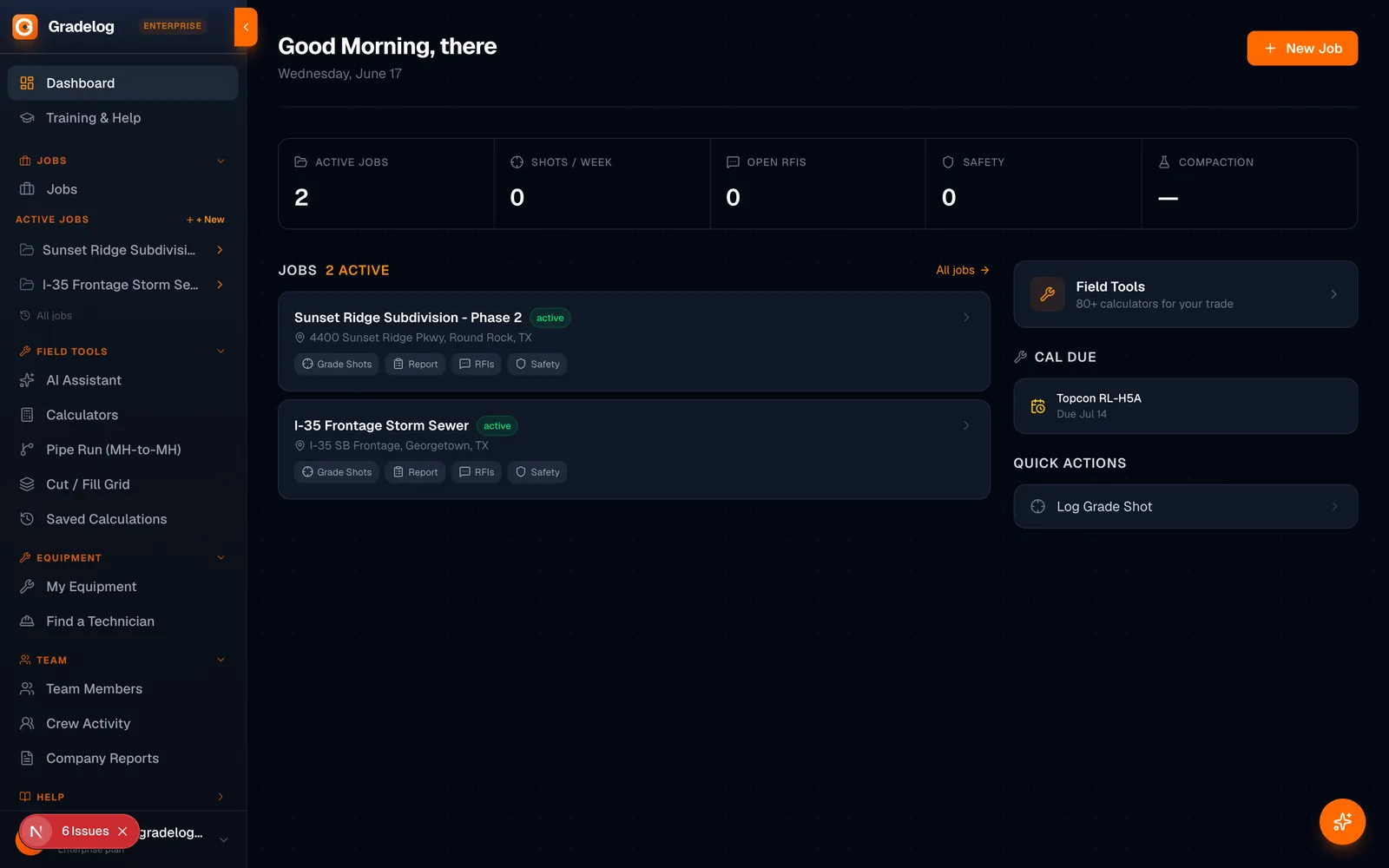
Gradelog is the field-execution platform built for grading and earthwork crews. Log grade shots, track cut/fill, document phases with photos, and generate as-built reports — from the cab to the office.
- Grade shots & cut/fill tracking per job
- Photo documentation by phase, task, and equipment
- As-built reports ready for inspector sign-off
- AI field assistant — troubleshoot on the jobsite
Built by the same team as Express Tools
Try Free →14 days
Free trial
8 languages
Supported
iPhone + Android
Works on